

Bulk purchasing air purifiers is defined as procuring multiple units under a single order to secure volume pricing, standardised equipment, and supply chain reliability. For environmental managers and purchasing agents, the air purifier bulk purchase benefits extend well beyond the initial discount. Volume deals can reduce per-unit costs by 25% to 50%, and that figure does not account for the operational savings that follow. HEPA H13 filtration standards, ENERGY STAR energy ratings, and planned maintenance schedules all compound the financial case for buying in volume.
1. How bulk purchasing air purifiers cuts upfront costs
Volume pricing is the most immediate air purifier bulk purchase benefit. Bulk discounts range from 25% to 50% off the recommended retail price, depending on order size. That means a facility ordering ten units pays significantly less per unit than one ordering two.

The table below shows how typical discount brackets work in practice.
| Order quantity | Typical discount off RRP | Effective saving per unit |
|---|---|---|
| 2–4 units | Up to 50% | High |
| 5–9 units | 35%–45% | Moderate to high |
| 10+ units | Approx. 25%–30% | Consistent |
One detail purchasing agents often miss: dealer-exclusive pricing rarely appears on standard retail or web listings. You need to contact the supplier directly and ask for their enterprise or dealer programme. That conversation alone can unlock pricing tiers that are not publicly advertised.
Pro Tip: Negotiate bulk orders during fiscal year-end or seasonal slow periods. Manufacturers offer deeper discounts during these windows, and suppliers are more willing to include extras such as extended warranties or free consumables.
2. Evaluating total cost of ownership beyond the purchase price
The upfront unit price is only part of the financial picture. Lifecycle costs including energy consumption, filter replacement, and maintenance labour routinely exceed the original purchase cost over a three to five year period. Purchasing agents who focus only on unit price consistently underestimate what a fleet of air purifiers will actually cost to run.
ENERGY STAR certified units cost more upfront but reduce electricity expenses significantly over the equipment lifespan. That saving scales directly with the number of units deployed. A facility running twenty certified units will see a measurably lower energy bill than one running twenty uncertified units at the same hours of operation.
Filter type and replacement interval are equally important. HEPA H13 filters capture particles down to PM2.5 and below, but they require scheduled replacement to maintain performance. You can review a HEPA filter replacement schedule to plan consumable costs accurately before committing to a bulk order.
| Cost category | Typical frequency | Impact on total cost |
|---|---|---|
| HEPA H13 filter replacement | Every 6–12 months | High |
| Energy consumption (ENERGY STAR) | Ongoing | Moderate to high |
| Maintenance labour | Quarterly checks | Moderate |
| Unit purchase price | One-off | Moderate |
Pro Tip: Request a service-level agreement that guarantees filter and spare part availability from your supplier. This protects you from supply delays that can halt maintenance schedules and degrade air quality across your facility.
3. Operational advantages of standardised bulk procurement
Standardising on a single air purifier model across a facility is one of the most underrated advantages of bulk buying purifiers. Equipment consistency reduces technician training complexity and lowers the risk of maintenance errors. When every unit operates identically, your team learns one set of procedures rather than several.
Bulk procurement also secures a local supply of compatible filters and spare parts. Reliable supply chains reduce downtime by removing the uncertainty of sourcing parts unit by unit. In a hospital, school, or large office, a single unit going offline for weeks because a filter is out of stock is a real operational risk.
The operational benefits of standardised bulk purchasing include:
- Simplified technician training across all sites or floors
- Consistent filter replacement scheduling for the entire fleet
- Easier fault diagnosis when all units share the same components
- Reduced spare parts inventory complexity
- Predictable maintenance windows that do not disrupt daily operations
- Faster onboarding for new facilities added to the programme
Systematic consumable management also lowers long-term maintenance costs. Purchasing filters in bulk alongside the units themselves extends the savings beyond the initial order.
4. Strategic benefits: vendor support, financing, and procurement leverage
Bulk orders give you negotiating power that single-unit purchases do not. Dealer and enterprise programmes offer tiered pricing and exclusive technical support that are simply not available to retail buyers. This support can include on-site commissioning, staff training, and priority service response.
Financing and leasing options are another advantage that purchasing agents frequently overlook. Many vendors offer tailored financing schemes for bulk orders to help organisations preserve cash flow. Instead of a large capital outlay, you spread the cost across a payment schedule while the units are already improving air quality in your facility.
Key strategic considerations for maximising procurement influence:
- Ask directly for the enterprise or dealer pricing programme before accepting any quote
- Request a pilot unit for evaluation before committing to a full fleet order
- Negotiate consumable supply agreements alongside the hardware purchase
- Time your order for fiscal year-end or post-peak season for the best terms
- Confirm local inventory availability to avoid import delays on spare parts
- Clarify warranty terms for bulk orders, as these often differ from retail warranties
Understanding air purifier energy ratings before you negotiate also strengthens your position. Suppliers know that informed buyers compare running costs, not just unit prices.
5. Situational guidance: when bulk purchasing makes sense
Bulk purchasing is not the right decision in every situation. The case for buying air purifiers in bulk is strongest when you have a defined number of spaces to cover, a clear pollutant profile, and a maintenance team in place to manage the fleet.
A comprehensive cost model should cover initial purchase price, energy usage, filter replacement, maintenance labour, and eventual disposal or recycling. Facilities in Riyadh and Dammam dealing with desert dust and PM2.5 loads will have different filter replacement intervals than coastal offices in Jeddah managing humidity-related air quality concerns.
Use this checklist before committing to a bulk order:
- Conduct an air quality assessment to identify pollutant types and concentrations
- Map each space by size to match the correct CADR rating to the room
- Calculate total lifecycle cost per unit, not just purchase price
- Evaluate supplier reliability, local inventory, and service response times
- Confirm HEPA H13 filtration certification for the units under consideration
- Model filter replacement frequency based on local environmental conditions
- Set a review date six months post-deployment to assess performance and adjust
Timing matters too. Late negotiations miss fiscal year-end discounts that can represent meaningful additional savings on large orders. Build your procurement calendar around supplier cycles, not just your own budget cycle.
Key takeaways
Bulk purchasing air purifiers delivers the greatest value when procurement teams assess lifecycle costs, standardise equipment, and negotiate directly for dealer pricing and service agreements.
| Point | Details |
|---|---|
| Volume discounts are substantial | Per-unit costs drop by 25%–50% depending on order size and supplier programme. |
| Lifecycle costs exceed purchase price | Energy, filters, and maintenance often cost more than the units themselves over three to five years. |
| Standardisation reduces operational risk | One model across a facility simplifies training, maintenance, and spare parts management. |
| Dealer programmes add hidden value | Enterprise pricing and technical support are rarely listed publicly; always ask directly. |
| Timing affects final price | Fiscal year-end and slow sales periods yield the deepest discounts and best contract terms. |
Why I think most procurement teams leave money on the table
My perspective on bulk air purifier procurement
After years of observing how facilities teams approach large equipment purchases, the pattern is consistent. Purchasing agents secure a volume discount, feel satisfied with the saving, and close the order. What they rarely do is model what the fleet will cost to run for the next four years.
The uncomfortable truth is that prioritising the lowest unit price without a full lifecycle assessment leads to suboptimal outcomes. I have seen facilities choose uncertified units to save SAR 200 per unit upfront, then spend three times that amount on energy and emergency filter orders within eighteen months.
The procurement teams that get this right treat the supplier relationship as a long-term partnership, not a one-off transaction. They negotiate service agreements, lock in consumable pricing, and schedule a review six months after deployment. That review almost always reveals adjustments that improve both air quality outcomes and cost efficiency.
My advice is straightforward. Build your cost model before you build your shortlist. The unit that looks expensive on the quote sheet is often the cheapest unit in the building by year three.
— Pauline
Climasaudi’s air purifier range for businesses and institutions
Climasaudi supplies air purifiers, HEPA H13 filters, and accessories suited to bulk procurement across Saudi Arabia, with local inventory in Riyadh, Jeddah, and Dammam. Products are categorised by room size and pollutant type, making it straightforward to match units to your facility’s specific air quality requirements.
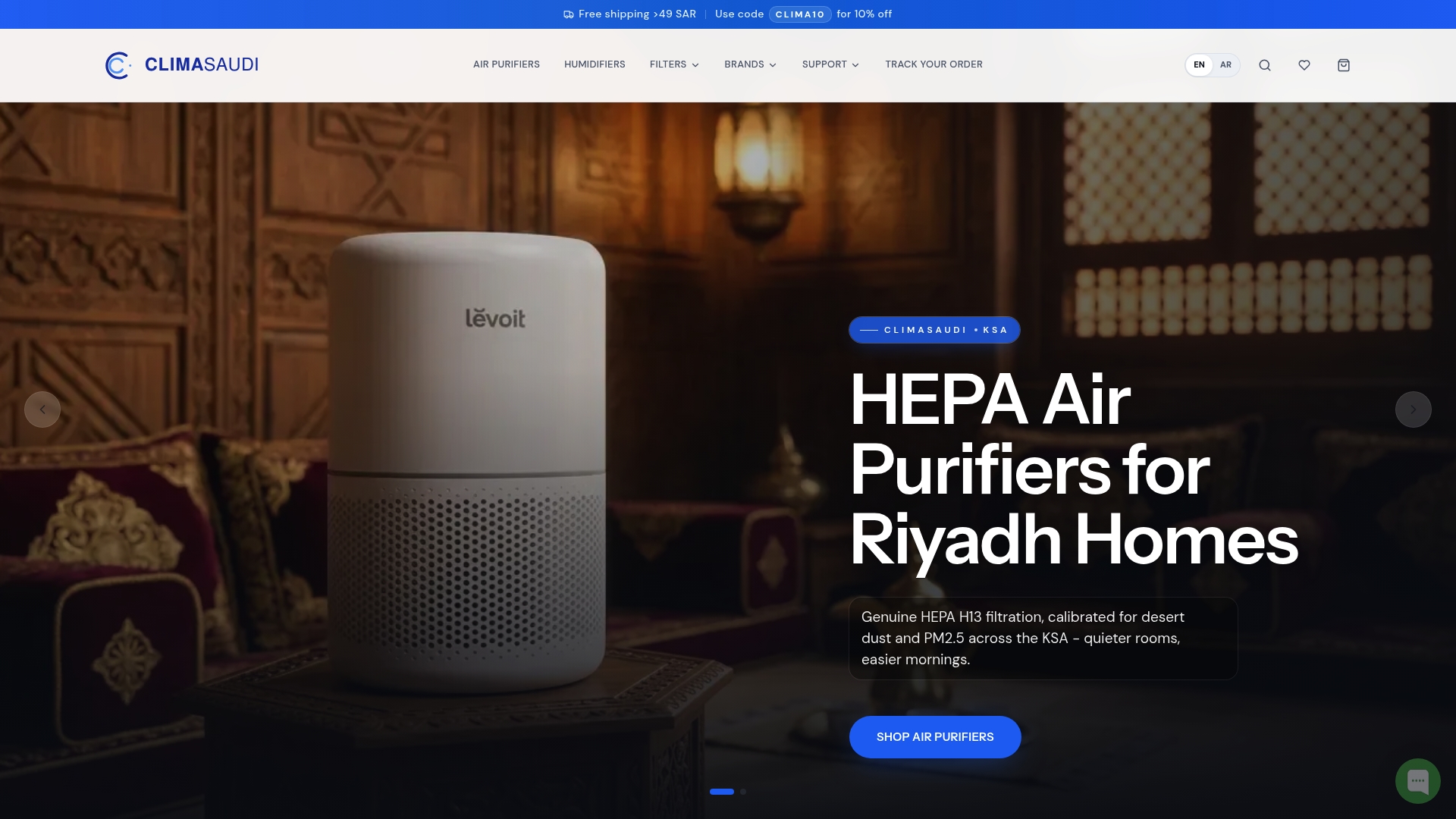
Whether you are equipping a single office floor or a multi-site institution, Climasaudi offers transparent SAR pricing, next-day delivery, and local customer support. You can browse the full range of air purifiers and filters to compare specifications and identify the right units for a bulk order. For tailored volume pricing and procurement support, contact Climasaudi directly.
FAQ
What discount can I expect from a bulk air purifier order?
Bulk orders typically reduce per-unit costs by 25%–50% depending on quantity. Dealer and enterprise programmes offer additional savings not available through standard retail channels.
Does buying air purifiers in bulk reduce long-term running costs?
Yes. Standardised equipment simplifies maintenance, and purchasing filters in bulk alongside units lowers ongoing consumable costs. ENERGY STAR certified units also reduce electricity expenses over the equipment lifespan.
What should a bulk air purifier cost model include?
A complete model covers purchase price, energy consumption, HEPA filter replacement intervals, maintenance labour, and disposal costs. Omitting any of these categories leads to underestimating the true cost of ownership.
When is the best time to place a bulk air purifier order?
Fiscal year-end and seasonal slow periods yield the deepest supplier discounts. Planning your procurement calendar around supplier cycles rather than only your internal budget cycle secures better terms.
What filtration standard should bulk-purchased air purifiers meet?
HEPA H13 filtration is the standard for commercial and institutional environments. It captures particles including PM2.5, desert dust, and biological contaminants relevant to Saudi Arabian indoor air quality conditions.