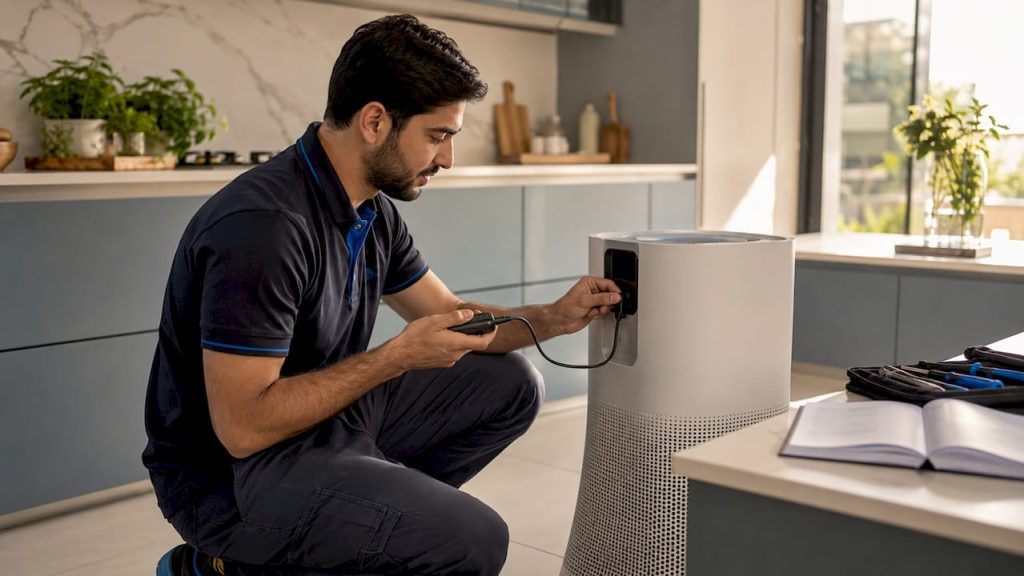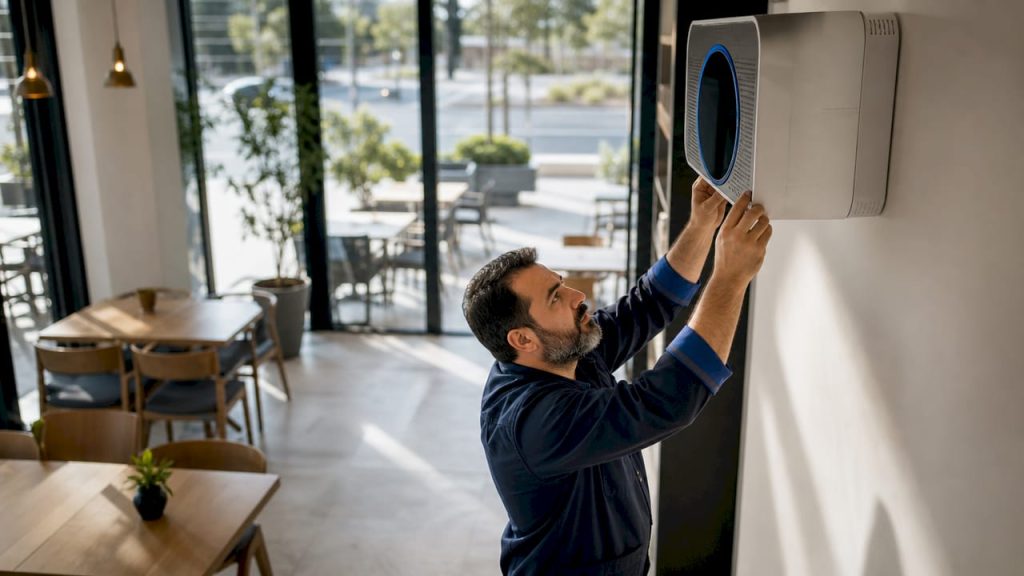
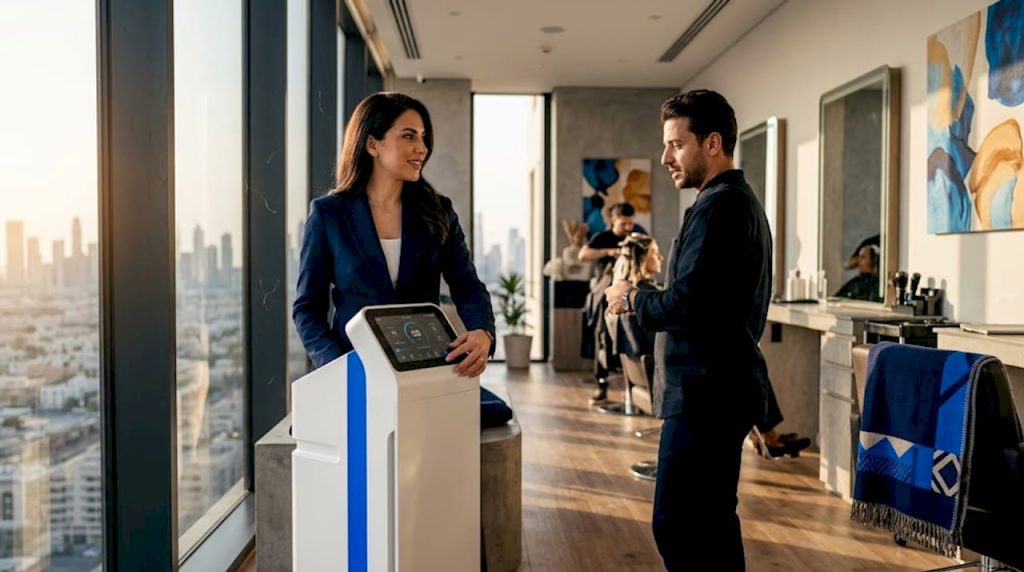
Salons in Saudi Arabia face a unique combination of indoor air challenges. Desert dust infiltrates through doors and ventilation systems, chemical fumes from hair dyes and wax treatments linger in enclosed spaces, and air conditioning units often strip out too much moisture. Your clients notice all of it, even if they never say so. Understanding the full salon air purifier benefits list helps you make informed decisions about which solutions are worth the investment and which are simply not enough on their own.
Table of Contents
- Reducing dust and allergen exposure in salons
- Controlling humidity for client comfort and mould prevention
- Eliminating odours and volatile chemicals with activated carbon filters
- Using source capture systems to reduce exposure at workstations
- Managing dust in Saudi Arabia’s salon environments
- How sensor-controlled smart purifiers enhance salon air quality management
- Comparison of air purifier features for salon use
- Why integrated air quality strategies are vital for Saudi salons
- Explore effective air purifiers and solutions for your Saudi salon
- Frequently asked questions
Key Takeaways
| Point | Details |
|---|---|
| Dust reduction | HEPA filters significantly reduce airborne dust and allergens when used continuously over several weeks. |
| Humidity balance | Maintaining 40–60% humidity prevents mould growth and respiratory discomfort in salon environments. |
| Odour and VOC removal | Activated carbon filters effectively remove chemical odours and volatile organic compounds common in salons. |
| Local source capture | Extraction systems at workstations protect staff by reducing exposure to dust and chemical fumes at breathing level. |
| Smart automation | Sensor-controlled air purifiers adapt speed to pollution levels, balancing comfort, noise, and energy use efficiently. |
Reducing dust and allergen exposure in salons
This is the most immediate benefit most salon owners think about, and for good reason. HEPA filtration (High Efficiency Particulate Air, the industry standard for particle capture) removes 99.97% of particles down to 0.3 microns, covering dust, pollen, skin cells, and pet dander. In a busy salon, these particles accumulate fast.
The visible difference takes time. Most users notice meaningful changes within one to four weeks of consistent use. That timeline matters when you are managing client expectations and staff comfort. Understanding the difference between an air purifier and a basic air filter helps you select the right equipment from the start.
Key benefits for dust and allergen control:
- Fewer airborne particles mean fewer sneezing episodes and irritated eyes for both clients and staff
- Less dust settling on surfaces reduces your daily cleaning workload noticeably
- Clients with allergies feel more at ease, which directly supports return visits and word of mouth
- Continuous filtration during business hours maintains consistent air cleanliness throughout the day
- Filter replacement on schedule (typically every six to twelve months) is essential to sustain these results
“A cleaner-looking salon is not just about surfaces. When the air feels fresh, clients associate that experience with quality and professionalism.”
Pro Tip: Place your air purifier away from walls and obstructions to allow unrestricted airflow on all sides. A unit blocked by furniture operates at a fraction of its rated capacity.
Controlling humidity for client comfort and mould prevention
Humidity is the factor most Saudi salon owners overlook, and it is one of the most important. Maintaining indoor relative humidity between 40% and 60% prevents both mould growth and respiratory irritation. Below that range, dry air causes throat discomfort and skin dryness. Above it, you risk condensation, mould spores, and bacterial growth.
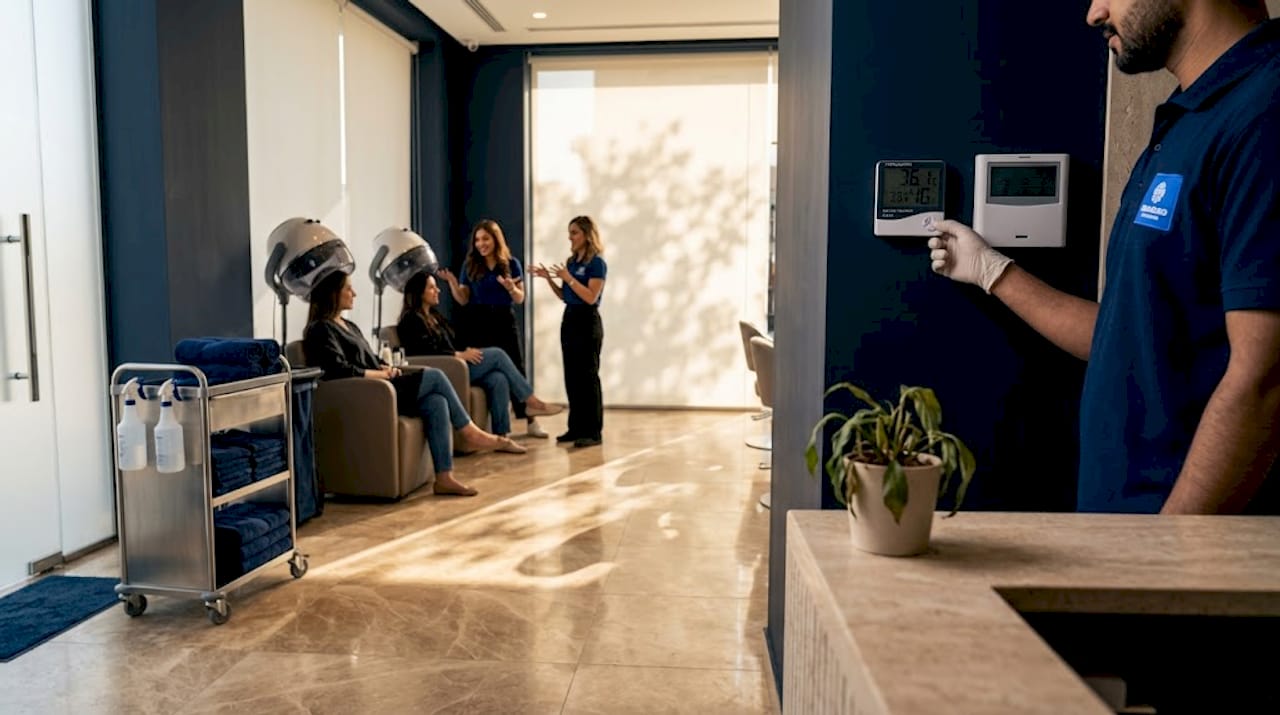
Saudi salons running heavy air conditioning throughout summer often drop indoor humidity well below 40%. That creates a dry, uncomfortable environment that clients feel physically. Pairing your air purifier with one of the humidifiers designed for salon use closes that gap efficiently.
Why humidity management matters alongside air purification:
- Air conditioning reduces humidity faster than most people realise, especially in sealed salon spaces
- Mould spores are biological particles; without humidity control, even the best HEPA filter faces a constant supply
- Balanced humidity supports healthier skin and hair during treatments, a genuine selling point for your clients
- A simple digital hygrometer (under SAR 50) gives you real-time readings so you are never guessing
- Combined purifier and humidifier units reduce equipment footprint and simplify daily management
Pro Tip: Set a humidity alert on your smart hygrometer for anything below 40% or above 60%. Acting early prevents the mould and comfort problems that are much harder to fix once they establish.
Eliminating odours and volatile chemicals with activated carbon filters
HEPA filters do not absorb odours. This is a critical gap that many salon owners discover after purchasing a purifier that only handles particles. Hair dye, keratin treatments, wax, and acetone from nail products all release volatile organic compounds (VOCs), gases that pass straight through HEPA media.
Activated carbon filters work through adsorption, a process where gas molecules bond to the porous carbon surface and are removed from circulation. The benefits of charcoal filtration in salon environments include absorption of waxing fumes, hair product chemicals, and other volatile vapours that make the air feel heavy. The result is noticeably fresher air without the need for synthetic fragrances.
What activated carbon filtration delivers in practice:
- Removes the chemical smell after keratin treatments without masking it with perfume
- Reduces staff headaches that often stem from prolonged VOC exposure during long shifts
- Protects sensitive equipment by lowering airborne chemical deposits on surfaces
- Improves client first impressions, since fresh air signals a clean, well-managed salon
- Carbon layers require replacement more frequently than HEPA filters, typically every three to six months depending on usage
A 3-in-1 air purifier with carbon filtration combines pre-filter, HEPA, and carbon layers in one unit, which is the most practical approach for most salons. You address particles, allergens, and odours without managing multiple separate systems.
Pro Tip: After heavy chemical treatments such as colouring or perming, run your purifier at maximum speed for 30 to 45 minutes to clear the VOC load quickly before the next client sits down.
Using source capture systems to reduce exposure at workstations
Whole-room air purification improves background air quality. But at a nail station or styling chair where fumes and dust are generated directly in front of a person’s face, you need localised extraction as well. This is where source capture systems make a real difference.
Source capture systems remove fumes immediately at the workstation, capturing fine dust and reducing chemical exposure at breathing level, which directly improves long-term respiratory health for your staff. Nail technicians are particularly at risk; acrylic dust and monomer vapours are concentrated at exactly the height where they breathe.
The advantages of source capture at salon workstations:
- Removes contaminants before they disperse into the room, making the whole-room purifier’s job easier
- Especially effective for nail dust, which includes fine acrylic and gel particles below 5 microns
- Reduces the chemical headache and fatigue that staff often report after full-day nail or wax sessions
- Creates a more professional and visibly clean workstation that clients appreciate and notice
- Works alongside workstation-level air purifiers to deliver layered protection throughout the salon
The combination of source capture at stations plus a HEPA and carbon purifier for the room is the most thorough approach to the advantages of salon air purifiers in a working environment.
Managing dust in Saudi Arabia’s salon environments
Outdoor air quality in Saudi cities is a direct factor in your indoor air quality. Studies of indoor and outdoor air in industrial areas of Dammam show that indoor dust levels reflect outdoor particulate pollution, making continuous filtration and regular housekeeping essential rather than optional. The same applies to Riyadh and Jeddah during seasonal dust storms.
| Environment | Typical particulate concern | Recommended intervention |
|---|---|---|
| Outdoor (storm season) | TSP exceeding WHO guidelines significantly | Seal entry points, run purifiers continuously |
| Indoor salon (air-conditioned) | Moderate PM2.5 and PM10 from human activity | HEPA purifier running during all business hours |
| Nail station (localised) | High fine dust (acrylic, gel) | Source capture plus room purifier |
| Reception and waiting area | Low to moderate settled dust | HEPA purifier, regular surface cleaning |
Practical dust management steps for Saudi salons:
- Run your air purifier throughout business hours, not just during treatments
- Seal door gaps and air conditioning vents with weather strips to reduce outdoor dust infiltration
- Maintain a regular filter inspection schedule and replace filters before they become visibly saturated
- Combine purification with weekly deep cleaning of surfaces, as settled dust re-enters the air during activity
- During sandstorm advisories, increase purifier fan speed and minimise unnecessary door openings
How sensor-controlled smart purifiers enhance salon air quality management
A purifier running at full speed all day creates noise. That noise affects the relaxed atmosphere you work hard to create. Smart purifiers with built-in air quality sensors solve this by adjusting automatically. Smart air purifiers increase fan speed during pollution spikes and reduce noise and energy consumption when air quality improves, keeping the environment comfortable without manual adjustment.
This matters practically during a busy Friday afternoon when multiple styling treatments run simultaneously. The sensor detects the VOC and PM2.5 spike, boosts the fan, cleans the air, and then returns to quiet operation without anyone touching the controls.
Reasons to choose sensor-controlled purifiers for your salon:
- Real-time PM2.5 readings give staff visible confirmation that air quality is being managed
- Automated speed control means you do not rely on staff remembering to adjust settings
- Quieter baseline operation preserves the calm atmosphere clients expect in a salon
- Lower energy use during off-peak hours reduces operating costs over the year
- A sensor-controlled model is a genuine upgrade for any salon running treatments across multiple stations
Pro Tip: Position your smart purifier where its sensor is not directly above a styling station. Localised spikes near the sensor trigger constant high-speed operation. A central room position gives the sensor a more representative read of overall air quality.
Comparison of air purifier features for salon use
Not every model suits every salon. Here is a side-by-side look at the features that matter most when evaluating the best air purifiers for salons.
| Feature | Why it matters | Essential or optional |
|---|---|---|
| HEPA H13 filtration | Captures fine particles, allergens, and skin cells | Essential |
| Activated carbon layer | Removes VOCs, odours, and chemical fumes | Essential for chemical treatment salons |
| Smart sensor control | Automates fan speed based on real-time air quality | Highly recommended |
| Source capture compatibility | Enables workstation-level extraction alongside room purification | Recommended for nail/wax stations |
| Noise level (dB at max) | Lower noise preserves relaxed salon atmosphere | Important |
| Filter replacement frequency | Affects annual running costs and maintenance workload | Important |
What to prioritise when selecting a salon air purifier:
- HEPA and carbon together. One without the other leaves a significant gap in protection.
- Correct room coverage. A unit rated for 20 square metres will not adequately filter a 60 square metre salon floor.
- Quiet operation. Models with a noise rating below 50 dB on medium speed are worth the extra investment.
- Easy filter access. If changing filters takes more than five minutes, it is less likely to be done on schedule.
Why integrated air quality strategies are vital for Saudi salons
Here is what experience in this industry confirms repeatedly: single-solution thinking is the most common and costly mistake salon owners make with air quality. A salon owner installs one HEPA purifier, notices some improvement, and considers the problem solved. Then clients still comment on chemical smells. Staff still report afternoon headaches. Mould appears behind a shelf near the air conditioning unit. Nothing is wrong with the purifier. The problem is that one tool was asked to do four jobs.
The effects of air purifiers in beauty salons are genuinely significant, but only when air purification is part of a broader strategy. Mapping your salon’s pollutant sources and combining local capture, HEPA filtration, and carbon filters delivers results that no single device achieves alone. That is not a sales point. It is a practical finding that experienced salon operators reach after trial and error.
Humidity is the most neglected variable. Humidity monitoring and control prevent mould growth and improve respiratory comfort, which is especially relevant in Saudi salons where air conditioning runs at full capacity for months at a time. A dry, particle-free salon is still an uncomfortable salon.
Smart automation removes the human variable. You cannot rely on staff to adjust purifier settings accurately during a busy shift. Sensor-controlled units make the right call automatically, which means consistent air quality regardless of how demanding the day becomes.
The full catalogue of indoor air quality solutions available today makes it possible to address every pollutant type your salon produces. Dust, allergens, VOCs, odours, humidity, and localised workstation fumes all have targeted solutions. The salons that combine them thoughtfully are the ones that clients describe as feeling different, cleaner, more professional, without always being able to say exactly why. The wellness benefits of clean salon air are felt before they are understood.
The question is not whether salons should use air purifiers. The question is how comprehensively you are willing to address what is actually in your air.
Explore effective air purifiers and solutions for your Saudi salon
You now have a clear picture of what salon air purification involves and why each layer of filtration matters. The next step is matching that knowledge to the right equipment for your specific space and treatments.
ClimaSaudi offers a full range of air purification solutions suited to Saudi salon environments, from compact units for reception areas to high-capacity models for large styling floors. The Blueair ComfortPure 3-in-1 T20i combines HEPA H13 filtration, activated carbon, and smart sensor control in a single unit, addressing particles, odours, and VOCs simultaneously. For salons managing both air quality and dry-air concerns, the range of salon humidifiers pairs naturally with purification systems to maintain healthy humidity throughout the day. All products are available with next-day delivery, transparent SAR pricing, and local customer support.
Frequently asked questions
How long does it take for an air purifier to reduce visible dust in a salon?
Visible dust reduction typically occurs within one to four weeks of continuous use, as HEPA filtration captures particles as small as 0.3 microns across successive air exchanges.
Why is humidity control important alongside air purification in salons?
Maintaining 40 to 60% indoor humidity prevents mould growth and respiratory irritation, complementing particle filtration to deliver genuinely healthy salon air rather than just filtered-but-dry air.
Can air purifiers remove salon odours and chemical fumes?
HEPA filters alone cannot. Activated carbon filtration adsorbs odours and volatile organic compounds from hair products, wax, and dyes, which is why carbon is essential for any salon running chemical treatments.
What is the advantage of source capture systems at salon workstations?
Source capture removes fumes immediately at the breathing level near nail or styling stations, reducing chemical and dust exposure before it disperses into the room and reaches staff lungs repeatedly over a full shift.
Are smart air purifiers useful in salons?
Yes. Sensor-controlled smart purifiers adjust fan speed automatically in response to air quality changes, delivering stronger filtration during chemical treatments and quieter, energy-efficient operation when the salon is between clients.
Recommended
- City-specific air purifier features for Saudi homes — Blog | ClimaSaudi
- Air Purifiers, Humidifiers & HEPA Filters in Saudi Arabia | ClimaSaudi
- Air purifier vs air filter: what works for Saudi homes? — Blog | ClimaSaudi
- Buy Blueair ComfortPure 3-in-1 T20i Air Purifier in Saudi Arabia | Best Price SAR 1,503 | ClimaSaudi