Sensors in air purifiers are devices that detect airborne particles and gases, triggering intelligent adjustments to maintain healthier indoor air. The EPA defines sensors as components that convert air stimuli into signals and activate equipment responses when pollutant levels exceed set thresholds. In practice, this means your purifier does not run at full speed all day. It reads the air, responds to what it finds, and adjusts accordingly. Understanding the role of sensors in air purifiers helps you choose the right device and get the most from it, particularly when managing allergens, dust, and volatile organic compounds (VOCs) in your home.
How do sensors measure different air pollutants and environmental conditions?
Air purifier sensors fall into several distinct categories, each targeting a different class of pollutant or environmental variable. Knowing which sensor type a purifier uses tells you a great deal about what it can and cannot detect reliably.
Particulate matter (PM) sensors are the most common type found in residential purifiers. They work on an optical light-scattering principle: a laser or LED beam passes through sampled air, and particles scatter the light in measurable patterns. The sensor estimates particle mass concentration from that scatter signal. This makes PM sensors effective proxies for airborne allergens and dust, though they cannot identify specific allergen types. A PM2.5 reading tells you there are fine particles present; it does not tell you whether those particles are pollen, pet dander, or desert dust.
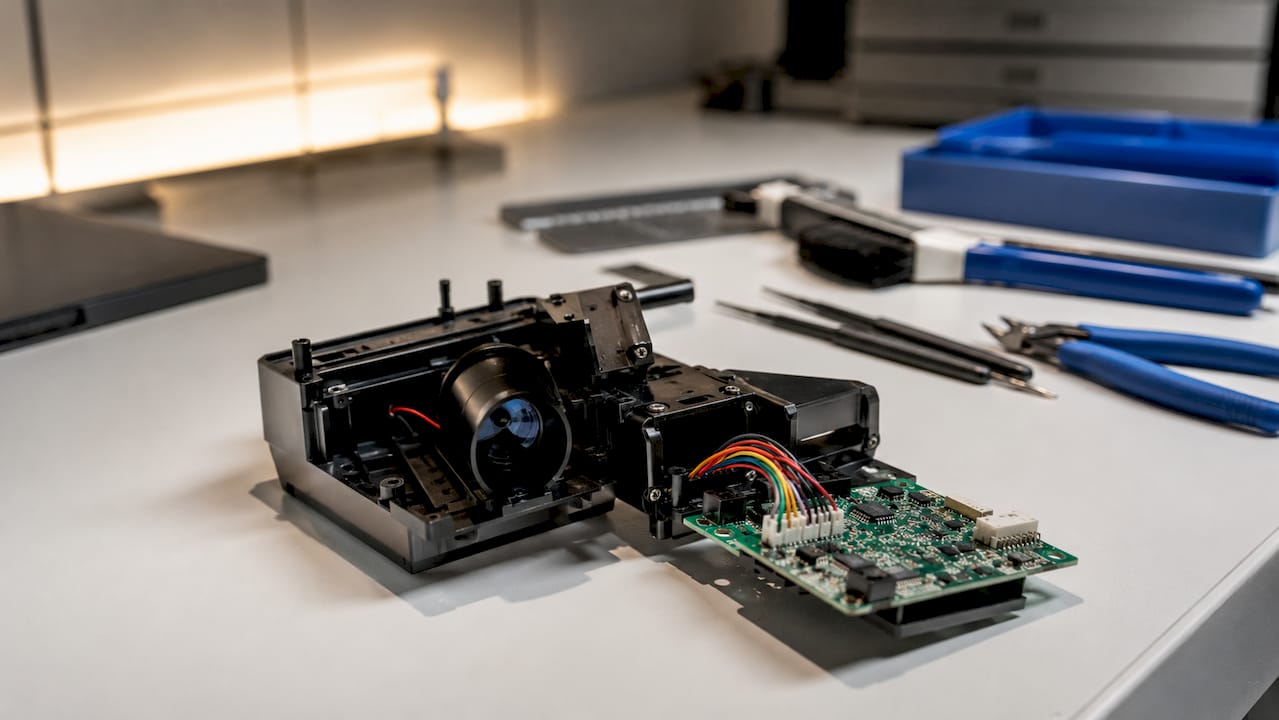
VOC sensors operate differently. Most use metal-oxide semiconductor (MOS) technology, where a heated sensing element changes electrical resistance when it contacts certain gases. These sensors respond to a broad range of compounds, including cooking fumes, cleaning product vapours, and off-gassing from furniture. The limitation is cross-sensitivity: a MOS sensor reacts to humidity and temperature changes as well as to actual VOCs, which can produce misleading readings without proper compensation algorithms.
Humidity and temperature sensors are often bundled with PM and VOC sensors in multi-parameter modules. The Sensirion SEN54, for example, measures PM, VOCs, humidity, and temperature in a single unit, with humidity accuracy of ±4.5% and temperature accuracy of ±0.45°C. These readings matter because high humidity affects both PM sensor output and VOC sensor behaviour, making environmental monitoring a functional necessity rather than a bonus feature.
| Sensor type | Target pollutant | Measurement method | Typical accuracy |
|---|---|---|---|
| PM optical sensor | Dust, PM2.5, PM10 | Light scattering | ±25 µg/m³ (PM4/PM10) |
| MOS VOC sensor | VOCs, gases | Resistance change | Moderate, drift-prone |
| Humidity sensor | Relative humidity | Capacitive or resistive | ±4.5% RH |
| Temperature sensor | Ambient temperature | Thermistor or digital | ±0.45°C |
Pro Tip: When comparing purifiers, check whether the product lists specific sensor models or specifications. Vague terms like “air quality sensor” often indicate a single MOS chip with limited pollutant discrimination.
Why does sensor calibration matter for purifier performance?
Sensor accuracy is not fixed at the factory. It shifts over time and varies by location, and this directly affects how well your purifier responds to real air quality events.
For PM sensors, a Springer Nature study found that US-wide calibration models achieved an RMSE of 1.40 µg/m³ and an R² of 0.67, while site-specific calibration produced meaningfully stronger agreement with reference instruments. This matters because particle characteristics differ by location. In Riyadh or Dammam, desert dust particles have different optical properties than urban traffic particles in European cities. A purifier calibrated on data from a different region may under-report or over-report local PM concentrations, causing the auto-mode to respond too slowly or too aggressively.
VOC sensor calibration is even more demanding. A 2026 study published in Atmospheric Measurement Techniques found that MOS sensor drift and cross-sensitivity to humidity and temperature are persistent challenges, and that a two-step colocation calibration strategy significantly improves field accuracy and model transferability. In plain terms, a VOC sensor that worked well in winter may give different readings in summer simply because the ambient temperature changed.
The practical implications for users are straightforward:
- Purifiers with manufacturer-supplied calibration algorithms perform better than those relying on raw sensor output alone.
- Sensors near coastal areas like Jeddah face higher humidity interference, which can skew VOC readings without compensation.
- Sensor drift means readings may become less reliable after 12 to 24 months of continuous use, depending on the sensor quality.
- Checking whether a manufacturer updates firmware or calibration data over time is a reasonable question to ask before purchasing.
Understanding local air quality factors in your city is a practical first step toward interpreting your purifier’s sensor data accurately.
How do sensors enable air purifiers to adapt automatically?
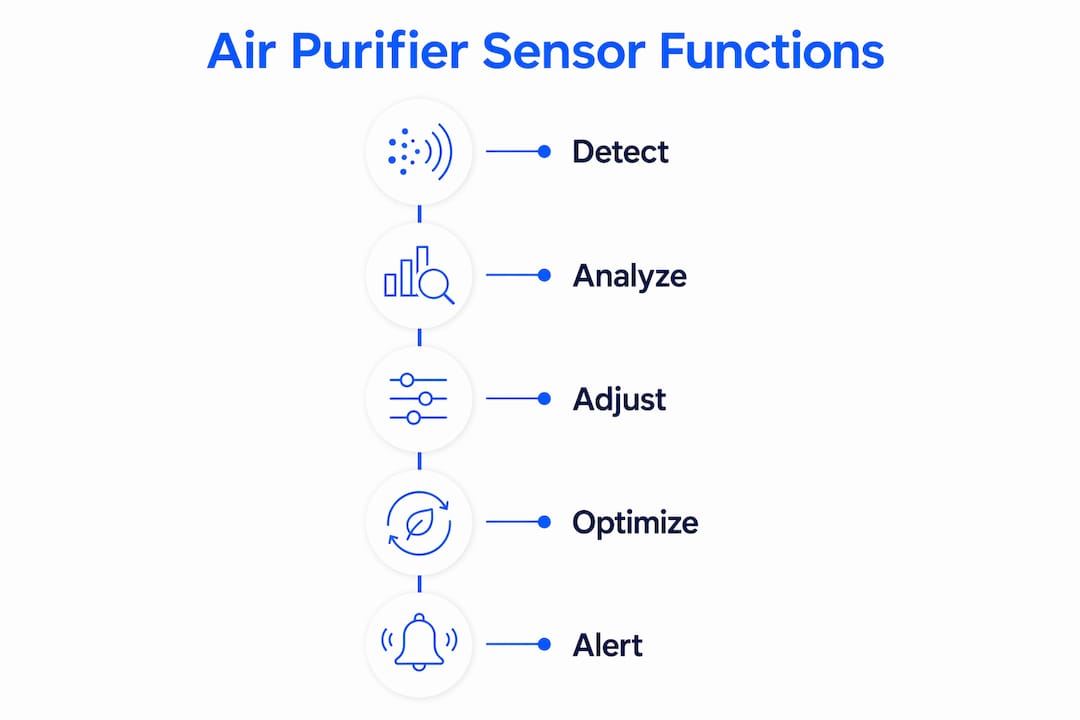
The core function of sensors in air filtration is not measurement for its own sake. It is control. Sensors serve as feedback triggers, turning purifiers on or off and adjusting fan speeds when pollutant concentrations cross pre-set thresholds. This feedback loop is what makes auto-mode operation genuinely useful rather than a marketing label.
Consider a practical scenario: you fry food in your kitchen. PM2.5 levels spike within seconds. A sensor-equipped purifier detects the rise, shifts to high fan speed, and begins drawing contaminated air through its HEPA H13 filter. Once levels return to baseline, the fan drops back to a quieter setting. Without a sensor, the purifier would either run at full speed constantly, wasting energy, or sit at a low setting while the air quality deteriorates.
Consumer Reports notes that mechanical filters handle particulates while activated carbon targets gases, and sensor integration enables the purifier to adjust its mode accordingly. This distinction matters: a PM spike from dust calls for maximum airflow through the HEPA layer, while a VOC event from cleaning products benefits from sustained carbon filter contact time at moderate speed.
Key sensor-driven functions in a well-designed purifier include:
- Automatic fan speed adjustment based on real-time PM2.5 or PM10 readings.
- VOC threshold alerts that trigger higher fan speeds or activate carbon filtration modes.
- Sleep mode activation when sensors detect clean air during low-activity hours.
- App notifications when pollutant levels exceed user-defined limits.
- Energy saving through reduced operation during periods of genuinely clean air.
Pro Tip: Place your purifier where air circulates freely, not tucked into a corner. Sensors near purifier intakes react quickly to local air but may not capture conditions across the whole room without adequate airflow mixing.
Learning more about auto mode operation can help you configure your device for the best results in your specific space.
What should you know when choosing a sensor-equipped purifier?
Selecting a purifier based on sensor capability requires matching the sensor type to your primary indoor air concern. Not every sensor-equipped model addresses every pollutant category with equal reliability.
-
Identify your main pollutant type. If desert dust and PM2.5 are your primary concern, prioritise a purifier with a well-specified optical PM sensor and HEPA H13 filtration. If cooking fumes, cleaning products, or furniture off-gassing are the issue, a model with a dedicated VOC sensor and activated carbon filter is more appropriate.
-
Check for multi-parameter sensing. Purifiers that measure PM, VOCs, humidity, and temperature together give a more complete picture of indoor conditions. Single-parameter sensors may miss important interactions, such as humidity amplifying VOC sensor readings.
-
Consider sensor placement in the room. Sensor readings near purifier intakes react quickly but may not represent whole-room conditions accurately if airflow is limited. For larger rooms, a purifier sized correctly for the space will circulate air past the sensor more frequently, improving representativeness. Climasaudi’s sizing guide for 2026 covers this in detail.
-
Look for app connectivity and threshold transparency. Consumer Reports recommends preferring purifiers that display actual pollutant concentration outputs rather than vague colour indicators. Seeing a PM2.5 reading of 35 µg/m³ is more useful than a red light with no context. Connected purifiers with app monitoring allow you to track trends over time and verify that the sensor is responding to real pollution events.
-
Verify sensor response with real events. After purchase, test the purifier by burning a candle or cooking something with strong fumes near the sensor. A reliable sensor-based system should respond within 60 seconds, consistent with the Sensirion SEN54 response time specification. If the purifier does not react, the sensor may be poorly positioned or the threshold may be set too high.
For households managing allergens specifically, pairing a sensor-equipped purifier with allergen-reducing cleaning habits produces measurably better results than either approach alone.
Key takeaways
Sensors in air purifiers function as feedback controllers, not precision instruments, and their effectiveness depends on sensor type, calibration quality, and correct placement within the room.
| Point | Details |
|---|---|
| Sensors trigger responses, not just readings | Purifiers act when pollutant thresholds are crossed, not based on continuous precise measurement. |
| Sensor type must match your pollutant | PM sensors suit dust and allergens; VOC sensors address gases and cooking fumes. |
| Calibration affects real-world accuracy | Site-specific calibration improves PM sensor reliability, especially in regions with distinct particle profiles. |
| Placement influences whole-room performance | Sensors near intakes react fast but may not represent room-wide air quality without adequate airflow. |
| App connectivity adds long-term value | Purifiers displaying actual concentration data allow you to verify sensor reliability over time. |
Why sensor quality deserves more attention than it gets
I have spent considerable time reviewing air purifier specifications, and the sensor section is consistently the most under-explained part of any product listing. Manufacturers list “air quality sensor” as a feature without specifying whether it is a single MOS chip or a calibrated multi-parameter module. That gap matters enormously in practice.
My honest view is that the industry has moved faster on filtration technology than on sensor transparency. HEPA H13 certification is well-defined and verifiable. Sensor accuracy claims are rarely backed by independent data. Until that changes, the most reliable approach is to test your purifier’s sensor response yourself using a known pollution event, as described above, and to treat colour-coded air quality indicators with healthy scepticism unless the underlying concentration data is also visible.
The future direction I find most promising is machine learning calibration, as explored in the 2026 Atmospheric Measurement Techniques study on VOC sensors. Algorithms that adapt to local conditions over time could significantly close the gap between low-cost consumer sensors and reference-grade instruments. For now, choosing a purifier from a brand that publishes firmware updates and sensor specifications is the most practical safeguard available to you.
— Pauline
Sensor-equipped air purifiers from Climasaudi
If you are ready to move from understanding sensors to acting on that knowledge, Climasaudi offers a curated range of purifiers built with integrated sensing and HEPA H13 filtration for Saudi homes.
The Blueair Blue Max 3450i features sensor-based auto mode that adjusts fan speed in real time based on detected PM levels, making it well-suited for larger living spaces in Riyadh or Jeddah. For a combined purification and humidity solution, the Blueair ComfortPure 3-in-1 T20i integrates multi-parameter sensing with HEPA filtration and humidification in a single unit. Browse the full range at Climasaudi’s product catalogue, with next-day delivery available across major Saudi cities and transparent SAR pricing throughout.
FAQ
What is the role of sensors in air purifiers?
Sensors detect airborne pollutants such as PM2.5, VOCs, and humidity, then trigger purifier responses such as fan speed changes when concentrations exceed set thresholds. They act as feedback controllers rather than precision measurement instruments.
What types of sensors are found in air purifiers?
The most common types are optical PM sensors for particulate matter, metal-oxide VOC sensors for gases, and humidity and temperature sensors. Multi-parameter modules like the Sensirion SEN54 combine all four in a single unit.
How accurate are air purifier sensors?
Accuracy varies by sensor type and calibration. PM sensors show stronger performance with site-specific calibration, while VOC sensors are prone to drift and cross-sensitivity to humidity and temperature without compensation algorithms.
Does sensor placement affect purifier performance?
Yes. Sensors positioned near purifier intakes respond quickly to local air but may not reflect whole-room conditions accurately. Adequate room airflow and correct purifier sizing improve how representative the sensor reading is for the entire space.
Are smart air purifiers with app monitoring worth it?
Purifiers that display actual pollutant concentrations through an app give you verifiable data rather than vague colour indicators. This allows you to track trends, set custom thresholds, and confirm the sensor is responding correctly to real pollution events in your home.