Most people assume that if a product says “HEPA,” it works the same as any other HEPA filter on the market. That assumption can cost you clean air. In Saudi Arabia, where dust levels are consistently high and urban pollution adds another layer of concern, choosing a filter with the wrong rating means you could be breathing in fine particles your device was never truly equipped to block. Understanding how HEPA ratings actually work, and what separates a genuine commercial-grade filter from a lookalike, is one of the most practical steps you can take to protect your family’s health at home.
Table of Contents
- What does a commercial HEPA filter rating mean?
- How commercial HEPA ratings compare to standard filters
- Why HEPA filter ratings matter for Saudi homes
- How to choose the right commercial HEPA filter for your home
- A fresh perspective on HEPA filter ratings: what most buyers overlook
- Find the best commercial HEPA filters and air purifiers for your Saudi home
- Frequently asked questions
Key Takeaways
| Point | Details |
|---|---|
| HEPA ratings matter | Filter efficiency and true performance depend on the commercial HEPA rating, not just the label. |
| Saudi context is unique | High dust and pollutants demand higher HEPA standards for homes in Saudi Arabia. |
| Comparison is critical | Commercial HEPA filters outperform ‘HEPA-type’ filters, making real testing and certification important. |
| Choose wisely | Select filters based on rating, compatibility, and trusted supplier—not just advertising claims. |
| Regular replacement required | Changing HEPA filters on schedule is essential for maintaining indoor air quality. |
What does a commercial HEPA filter rating mean?
HEPA stands for High-Efficiency Particulate Air. It describes a type of mechanical filter that physically traps particles as air passes through a dense mat of fibres. But the term itself does not guarantee any single level of performance. The rating system is what tells you exactly how efficient a filter is.
Commercial HEPA ratings are based on laboratory testing that measures how effectively a filter captures particles at their most penetrating size, which is 0.3 microns in diameter. This is the size at which particles are hardest to trap, behaving in ways that allow them to slip past fibres that would catch both larger and smaller particles. The filtration efficiency figure you see, such as 99.97%, represents the filter’s performance at this most challenging particle size.
Here is a summary of how commercial HEPA grades are classified:
| Filter grade | Minimum efficiency at 0.3 microns | Common use case |
|---|---|---|
| H10 | 85% | Basic industrial filtration |
| H11 | 95% | Industrial air handling |
| H12 | 99.5% | Commercial environments |
| H13 | 99.95% | Residential and medical settings |
| H14 | 99.995% | Cleanrooms and critical care |
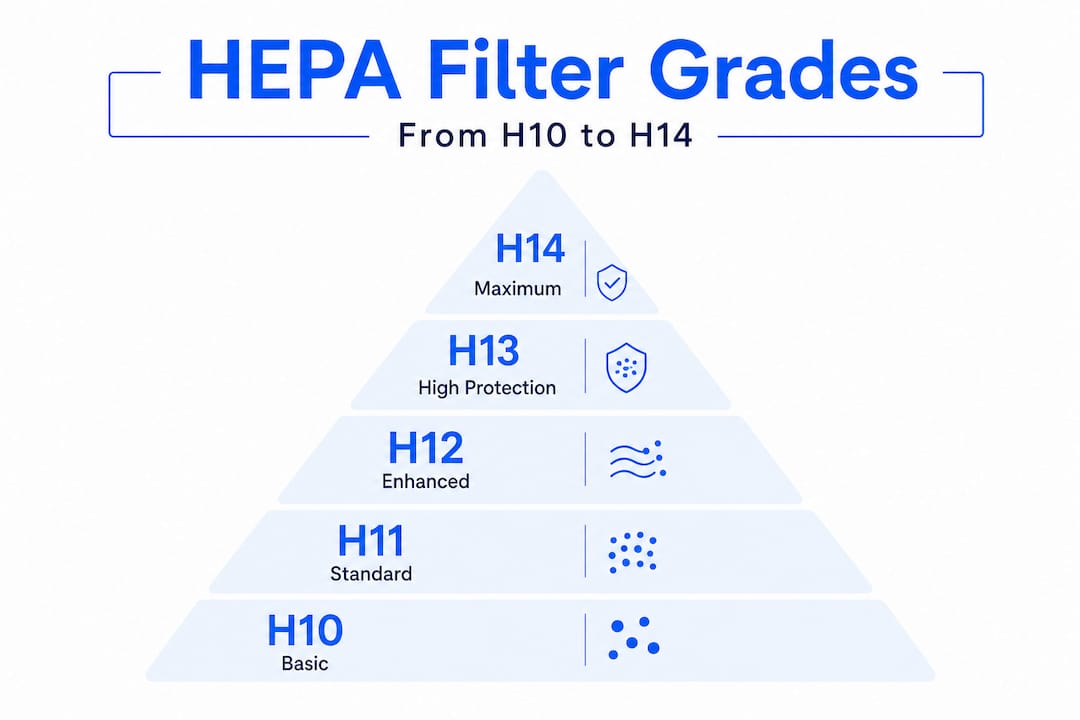
For most Saudi homes, H13 is the minimum grade worth considering. H14 offers even higher protection, but the practical difference in everyday residential use is less significant than the gap between H13 and lower grades.
What truly sets commercial ratings apart from consumer-grade claims is the testing process. Commercial filters undergo standardised EN1822 testing, which evaluates the most penetrating particle size for each individual filter. Consumer products often cite HEPA efficiency based on average performance across a particle size range, which is less precise and often overstated.
Key features of commercial HEPA filter ratings:
- Tested at the most penetrating particle size, not an average
- Individual filter certification, not batch sampling
- Consistent construction standards with tighter tolerances
- Documented efficiency figures backed by traceable test data
“A filter rated H13 must stop at least 99.95% of all particles at 0.3 microns. Every filter, not a sample. That is what ‘commercial grade’ means in practice.”
Understanding this distinction matters before you spend money on an air purifier. The rating on the label tells you what that device can realistically deliver in your home.
How commercial HEPA ratings compare to standard filters
Having outlined what a commercial HEPA rating actually is, it helps to see how these ratings compare to standard filters you might encounter when shopping for air purifiers in Saudi Arabia.
The most important distinction is between true HEPA, commercial HEPA, and terms like “HEPA-type” or “HEPA-like.” These lookalike labels are not regulated in the same way, and they do not meet the same performance thresholds.
| Filter type | Efficiency | Particle size tested | Certification |
|---|---|---|---|
| HEPA-type / HEPA-like | 85–99% | Often unspecified | Usually none |
| Consumer HEPA | 99.97% | 0.3 microns (batch tested) | Varies |
| Commercial HEPA H12 | 99.5% | 0.3 microns (individual) | EN1822 or equivalent |
| Commercial HEPA H13 | 99.95% | 0.3 microns (individual) | EN1822 or equivalent |
| Commercial HEPA H14 | 99.995% | 0.3 microns (individual) | EN1822 or equivalent |
The difference between 99% efficiency and 99.95% may seem small on paper. But consider what it means in real numbers. If 10,000 particles enter the filter, a 99% filter lets 100 through. An H13 filter lets only 5 through. Over hours of continuous use in a dusty home, that gap becomes very significant.
Several important points to note when comparing filters:
- Avoid any filter that says “HEPA-type” or “HEPA-like” unless the manufacturer provides independent test data
- Look for the H-grade number, not just the word HEPA
- Confirm the test standard used (EN1822 is the recognised European standard, widely adopted internationally)
- Ask for filter documentation before purchasing, particularly from online marketplaces
Pro Tip: When you receive an air purifier, look inside the box for a filter test certificate or documentation sheet. Reputable commercial HEPA products include this. If your packaging contains no such certificate, that is a red flag about the filter’s claimed grade.
Saudi homes face specific challenges that make this comparison more than academic. Desert dust in Riyadh can exceed WHO PM2.5 guidelines on many days throughout the year. Coastal areas like Jeddah also deal with high humidity that can affect filter performance over time. Choosing a genuine commercial-grade filter protects you against both fine dust and the particulates that come with high urban traffic pollution.
Why HEPA filter ratings matter for Saudi homes
Understanding why these ratings matter makes it easier to appreciate the practical impact they have on daily life in Saudi Arabia.
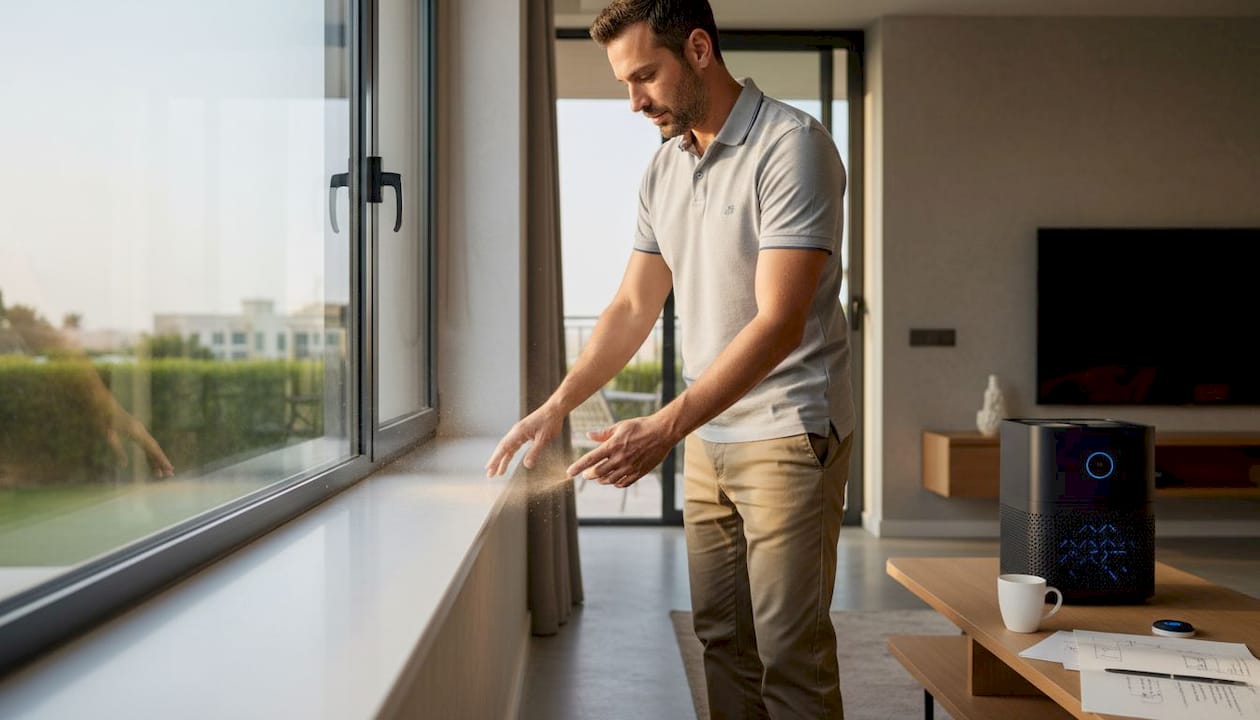
Saudi Arabia’s climate is one of the most demanding environments for indoor air quality anywhere in the world. Riyadh, Jeddah, and Dammam all experience regular dust events. Fine desert particulates, known as PM2.5 and PM10, enter homes through ventilation gaps, open windows, and even sealed door frames during sandstorms.
Here is why ratings are particularly important for Saudi households:
- Sandstorm season brings intense particle loads that quickly overwhelm lower-rated filters, often within hours of a storm event.
- Allergy sufferers in Saudi Arabia, particularly those sensitive to dust mites and pollen, need a filter rated at H13 or above to see meaningful symptom relief.
- Urban pollution from vehicle emissions adds ultrafine particles below 0.3 microns that require high-efficiency filtration to capture.
- Year-round dust means filters are under constant stress, making initial quality and performance rating even more critical.
- Indoor cooking and cleaning generate particles that accumulate alongside outdoor dust, increasing total particulate load.
Consider a practical example. During a sandstorm in central Riyadh, outdoor PM2.5 levels can spike to 150 micrograms per cubic metre or higher. Even with windows closed, fine particles infiltrate living spaces. An air purifier equipped with a true H13 HEPA filter running on its highest setting can reduce indoor PM2.5 by over 90% within an hour. A device fitted with a HEPA-type filter may reduce levels by only 60 to 70%, leaving a significant amount of harmful particulate circulating in the air you breathe.
For families with children, elderly relatives, or anyone with asthma or allergic rhinitis, that difference directly affects health outcomes. Choosing the correct rating is not a premium choice; for cleaner air at home in the Saudi climate, it is a basic requirement.
How to choose the right commercial HEPA filter for your home
Armed with the knowledge of why filter ratings matter, the focus now shifts to practical selection. These steps will help you make a confident choice.
- Identify the minimum grade you need. For standard Saudi homes in dust-prone cities, H13 is the recommended minimum. If a family member has severe respiratory conditions, consider H14.
- Match the filter to your room size. An air purifier is rated for a specific floor area. Using an undersized unit in a large villa living room, even with an H13 filter, will not deliver the clean air changes per hour you need.
- Check your family’s specific health needs. Asthma, allergies, and skin conditions all benefit from higher-efficiency filtration. Talk to your GP about recommended air quality targets if you have a diagnosed condition.
- Request independent test documentation. Any reputable air purifier sold in Saudi Arabia should come with, or link to, verifiable test results for its HEPA filter grade.
- Avoid vague marketing language. “Medical grade,” “hospital grade,” and “99.9% effective” without a stated H-grade and testing standard are claims that warrant scepticism.
- Ensure replacement filters are available locally. A filter that needs replacing every six months is useless if you cannot source a compatible replacement in Riyadh or Jeddah.
- Plan your maintenance schedule. A genuine H13 filter used in high-dust conditions will need replacement more frequently than in lower-particulate environments.
Pro Tip: When in doubt, check whether the air purifier you are considering uses a factory-sealed HEPA filter unit. Filters that are pre-assembled into sealed cartridges, such as those found in the Blueair Blue Max 3350i air purifier, reduce the risk of air bypassing the filter media, which is a common problem with poorly fitted third-party filters.
Additional factors worth considering:
- Pre-filters: A quality pre-filter extends the life of your HEPA filter by capturing larger dust particles first
- Activated carbon layer: Important in Saudi homes where cooking odours and VOCs are a concern alongside dust
- Noise level: For bedrooms, look for purifiers that maintain effective filtration while running quietly
- Smart sensors: PM2.5 sensors that automatically adjust fan speed ensure your H13 filter is always working at the right intensity
A fresh perspective on HEPA filter ratings: what most buyers overlook
The most common mistake we see is not buying the wrong grade. It is buying the right grade in the wrong product. An H13 filter inside a poorly designed air purifier housing, one with gaps between the filter frame and the casing, will allow unfiltered air to bypass the filter entirely. You end up paying for H13 performance and getting something far worse.
This is sometimes called filter bypass, and it is almost impossible to detect without professional testing equipment. The air quality monitor in your room might still show improving PM2.5 levels after a storm, but that improvement could be from natural particle settling rather than genuine filtration. You would have no way of knowing unless the air purifier itself was properly designed and sealed.
Marketing language compounds this problem. Terms like “medical grade” and “clinical HEPA” are unregulated in most markets, including Saudi Arabia. They describe nothing specific. Alongside this, many imported devices sold on marketplace platforms arrive without genuine H-grade certification, yet carry HEPA labelling that creates false confidence.
The HEPA filter performance in real homes is also affected by replacement timing. A filter that has been running in Riyadh through two sandstorm seasons without replacement is no longer performing at its rated efficiency, even if it still looks intact. In the Saudi climate, adhering to replacement schedules is not optional. The filter degrades in ways you cannot see, and it may also harbour accumulated biological material.
Our recommendation: trust brands that publish individual filter certificates, provide accessible local replacement stock, and build purifiers with sealed filter housings. Rating numbers matter. But the system around those numbers matters just as much.
Find the best commercial HEPA filters and air purifiers for your Saudi home
Learning about HEPA ratings gives you a genuine advantage when shopping. Now the practical step is finding products that actually deliver on what they promise.
At ClimaSaudi, every air purifier and HEPA filter we stock is selected with Saudi climate conditions in mind. Our range includes products with independently certified H13 filtration, available for next-day delivery across Riyadh, Jeddah, and Dammam. You can browse our full selection of HEPA filters and air purifiers with transparent SAR pricing and real product documentation. For specific room needs, options like the Blueair Blue 3610 air purifier offer certified filtration in a quiet, energy-efficient design. If you need a genuine replacement filter, the Dyson 360 Glass HEPA + Carbon filter is a strong option for existing Dyson users. Our local support team is available to help you match the right product to your home.
Frequently asked questions
What is the difference between HEPA, H13, and H14 filters?
HEPA is the broad standard for high-efficiency air filtration; H13 and H14 are specific grades within that standard, with H14 offering higher efficiency and trapping a greater proportion of particles at 0.3 microns.
Do HEPA filters remove viruses and bacteria from the air?
High-rated HEPA filters such as H13 and H14 can capture most airborne bacteria and a significant proportion of larger virus-carrying particles, but their effectiveness depends on filter quality, the air purifier’s design, and consistent use.
How often should I replace commercial HEPA filters in Saudi homes?
In most Saudi homes, replacement every six to twelve months is a reasonable guide, but heavy dust exposure during sandstorm seasons may require more frequent changes; always follow the manufacturer’s specific recommendation for your model.
Can I use commercial HEPA filters in any air purifier?
No; commercial-grade HEPA filters are designed for specific air purifier models, and using an incompatible filter can leave gaps in the housing that allow unfiltered air to bypass the media entirely, reducing effectiveness significantly.
Recommended
- How HEPA filters trap allergens for cleaner air at home — Blog | ClimaSaudi
- Air Purifiers, Humidifiers & HEPA Filters in Saudi Arabia | ClimaSaudi
- Buy Air Purifiers in Riyadh Saudi Arabia | Best Price SAR – ClimaSaudi
- Buy Blueair Classic 400 Series Particle Filter in Saudi Arabia | Best Price SAR 235 | ClimaSaudi