If you live in Riyadh, Jeddah, or Dammam, you already know that indoor air is not automatically clean air. Desert dust, seasonal sandstorms, and high humidity create a constant load of airborne particles that ordinary filters cannot handle. To truly understand HEPA H13 filtration is to understand why so many health-conscious households are upgrading their purifiers. This guide covers what H13 actually means, how it captures harmful particles, and how to choose and maintain a certified H13 purifier so that your home air is genuinely cleaner, not just marketed that way.
Table of Contents
- Key takeaways
- What HEPA H13 filtration actually means
- How HEPA H13 filters trap particles
- Choosing and using a HEPA H13 air purifier
- Common misconceptions about HEPA H13
- My honest take on HEPA H13 for Saudi homes
- Breathe cleaner air with Climasaudi
- FAQ
Key takeaways
| Point | Details |
|---|---|
| H13 efficiency benchmark | HEPA H13 filters capture 99.95% of particles at 0.3 microns, the hardest size to trap. |
| Not all HEPA labels are equal | “HEPA-type” filters may achieve only 85–95% efficiency and do not meet certified H13 standards. |
| Sizing matters as much as grade | A certified H13 filter in an undersized purifier will not clean your room effectively. |
| HEPA alone does not remove gases | Pair HEPA H13 with activated carbon to address VOCs and odours alongside particles. |
| Maintenance determines real performance | Filter efficiency drops over time; timely replacement and pre-filter cleaning are non-negotiable. |
What HEPA H13 filtration actually means
HEPA stands for High Efficiency Particulate Air. It is not a brand name. It is a performance classification defined by filtration standards that specify exactly how much a filter must capture before it earns the label.
The H13 grade is part of the European EN 1822 standard for high-efficiency air filters. To qualify, a filter must capture at least 99.95% of particles at the most penetrating particle size, or MPPS. That size is 0.3 microns. It sounds small, and it is. For comparison, a human hair is roughly 70 microns wide. The 0.3 micron threshold is not arbitrary. It represents the worst-case particle size for filter testing, meaning particles both larger and smaller than this are actually captured at even higher rates.
Here is where many buyers get confused:
- True HEPA H13: Certified under EN 1822 at 99.95% efficiency at MPPS. This is the real standard.
- HEPA H14: One grade higher than H13, rated at 99.995% efficiency. Used in cleanrooms and medical settings.
- “HEPA-type” or “HEPA-like”: Marketing terms with no binding certification. These filters achieve only 85–95% efficiency, which means orders of magnitude more particles pass through compared to genuine H13.
The US Department of Energy defines its own HEPA standard at 99.97% efficiency, which sits between the European H13 and H14 grades. When you see MERV ratings on HVAC filters, those address larger particles and do not guarantee performance at the 0.3 micron MPPS benchmark at all.
Pro Tip: Before buying, look for the filter’s printed test certificate. A genuine H13 filter will state its EN 1822 classification and the specific efficiency result at MPPS. If the packaging only says “HEPA-type”, that is not a certified H13 filter.
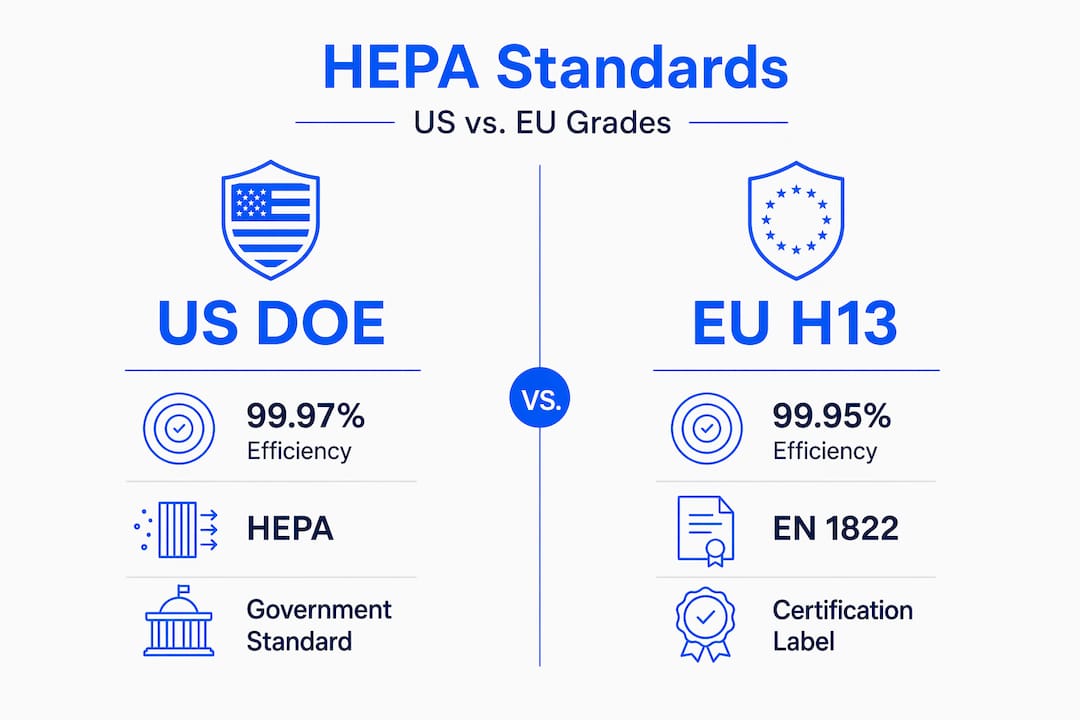
Understanding what HEPA ratings mean before you shop will save you money and protect your health far more reliably than trusting marketing language.
How HEPA H13 filters trap particles
A common misconception is that HEPA filters work like a sieve, simply blocking particles that are too large to pass through the fibres. The reality is more sophisticated. HEPA filters capture particles through four distinct physical mechanisms, each dominating at a different particle size range.
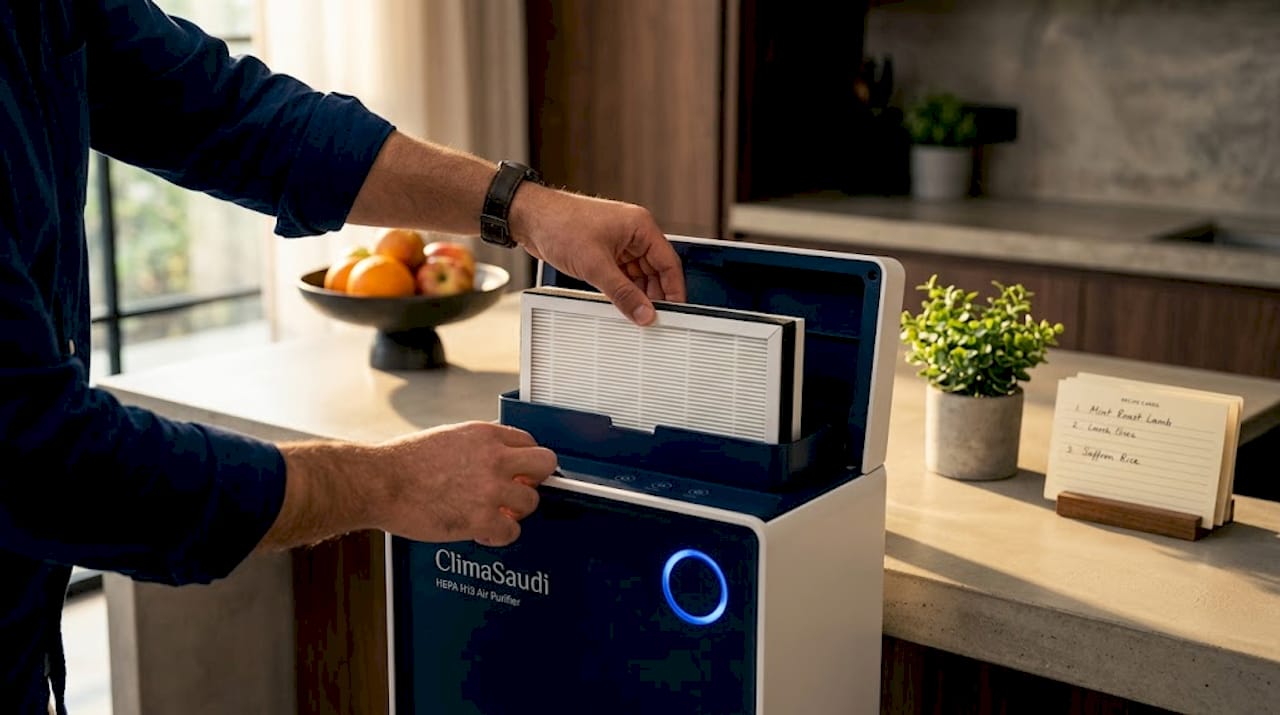
Impaction occurs when larger, heavier particles cannot follow the airstream around fibres and collide directly with them. Interception catches medium-sized particles that follow the airstream closely enough to make contact with a fibre as they pass. Diffusion is what makes the filter so effective at small particle sizes. Particles below roughly 0.1 microns move erratically due to Brownian motion and are more likely to collide with fibres. Electrostatic attraction adds a further layer, pulling charged particles toward oppositely charged fibres.
Because diffusion becomes stronger as particles get smaller, and impaction becomes stronger as particles get larger, the 0.3 micron MPPS sits in the gap between these effects. That is exactly why it is used as the worst-case test point. The 0.3 micron benchmark guarantees the filter’s minimum performance; everything outside that size is handled even more efficiently.
In practical terms, a certified H13 filter captures the following types of pollutants:
- Pollen (10–100 microns): Captured with very high efficiency via impaction and interception.
- Dust mite allergens (0.5–10 microns): Captured reliably at H13 grade.
- Pet dander (2.5–10 microns): Trapped effectively by interception and impaction.
- Mould spores (2–20 microns): Removed before they can settle on surfaces.
- Bacteria (0.3–5 microns): Captured at the MPPS efficiency level or above.
- Fine smoke particles and PM2.5 (below 2.5 microns): Addressed through diffusion and interception.
- Airborne virus particles (0.02–0.3 microns): Small particles captured through diffusion at efficiency levels exceeding 99.95%.
One important limitation: HEPA does not remove gases, VOCs, formaldehyde, or odours. These pass through the fibre matrix entirely. For complete protection, particularly in spaces with cleaning products, cooking fumes, or cigarette smoke, a combined HEPA and activated carbon stage is the correct approach.
Pro Tip: If your main concern is allergens and dust, a certified HEPA H13 filter addresses the problem directly. If odours or chemical off-gassing are also an issue, choose a purifier that includes a substantial activated carbon layer, not a token carbon pre-filter sheet.
Filter efficiency does not stay constant. Electrostatic charge diminishes over the filter’s lifespan, meaning an old filter may not perform at its rated level even if it still looks clean. This is why replacement schedules matter.
Choosing and using a HEPA H13 air purifier
Buying a certified H13 filter in a poorly sized or cheaply built unit is one of the most common mistakes shoppers make. Here is a structured approach to getting this right.
- Calculate your room volume. Multiply floor area by ceiling height. A 20 square metre room with a 3 metre ceiling has 60 cubic metres of air.
- Determine your target ACH. ACH stands for Air Changes per Hour. The practical target for allergy and respiratory health is 4 to 8 ACH. For dust-heavy environments in Saudi Arabia, aim for the higher end.
- Match the CADR rating. Clean Air Delivery Rate (CADR) tells you how many cubic metres of clean air the unit delivers per hour. Divide your room volume by your target ACH to find the minimum CADR you need. For the example above at 6 ACH: 60 × 6 = 360 m³/h.
- Check for certified H13 labelling. Look for EN 1822 classification, not “HEPA-type.” True HEPA certification is the standard to verify.
- Assess the carbon stage. If chemical pollutants or cooking odours are a concern, confirm the unit has a meaningful activated carbon layer.
- Consider H13 versus H14. Certified H13 filters are the practical benchmark for home use, balancing performance and cost effectively. H14 adds marginal filtration improvement but increases airflow resistance and price, which rarely benefits a residential setting.
| Grade | Efficiency at 0.3 microns | Best use case |
|---|---|---|
| HEPA H11 | 95% | General ventilation |
| HEPA H13 | 99.95% | Home air purification |
| HEPA H14 | 99.995% | Medical and cleanroom settings |
| HEPA-type | 85–95% (unverified) | Not recommended |
Why do H13 filters outperform H11 for allergy sufferers so significantly? The difference between 95% and 99.95% efficiency means the H13 allows 100 times fewer particles to pass. For someone with asthma or dust mite sensitivity, that difference is the gap between symptomatic and symptom-free mornings.
Pro Tip: Run your purifier on a higher setting for 30 minutes when you first enter a room, then drop to a quieter setting for continuous maintenance. This builds a clean baseline quickly without sustained high noise levels.
On maintenance: clean the pre-filter every two to four weeks and replace the H13 HEPA filter according to the manufacturer’s schedule, typically every 6 to 12 months. Pre-filter maintenance extends the life of the H13 stage by stopping larger particles before they reach and clog the fine fibres.
Common misconceptions about HEPA H13
Despite growing awareness, several persistent misunderstandings trip up buyers every year.
All HEPA labels mean the same thing. They do not. The label “HEPA” alone carries no legal protection in many markets. “HEPA-type” and “HEPA-like” products have been measured achieving as little as 85% efficiency, which leaves a significant proportion of allergens and fine particles uncaptured.
A great filter in a small unit is enough. It is not. Effective air purification requires both filter efficiency and sufficient CADR. A certified H13 filter in a purifier rated for 15 square metres cannot adequately clean a 40 square metre open-plan living room.
Sealed housing is a detail, not a priority. Actually, bypass leaks through poor seals can dramatically reduce whole-unit filtration efficiency. Air will always take the path of least resistance. If the filter is not sealed tightly into its housing, unfiltered air bypasses the filter entirely. This is particularly common in budget units.
HEPA filters remove odours. They do not. HEPA addresses particulate matter only. Cooking smells, paint fumes, and cigarette odours are gaseous and pass straight through. Only activated carbon addresses these.
A certified HEPA H13 filter removes the particles that trigger allergies and respiratory symptoms. What it cannot do is replace a carbon filter for gases or substitute for correct room sizing. Both matter.
Signs your filter needs replacing sooner than the scheduled interval include reduced airflow from the unit, increased noise as the motor works harder, and a persistent dusty smell even when the purifier is running. Do not wait for a visible colour change on the filter surface; by that point, performance has already declined.
My honest take on HEPA H13 for Saudi homes
I’ve looked at a lot of air purifiers, and the single most reliable predictor of whether someone’s indoor air actually improves is not their budget. It is whether they bought a certified H13 unit matched to the correct room size.
In my experience, the marketing on air purifiers is genuinely misleading. Terms like “HEPA-type” and “advanced filtration technology” appear on products that do not come close to H13 performance. I’ve seen allergy sufferers spend months using these purifiers and wondering why their symptoms persist.
What I’ve found actually works is straightforward: verify the EN 1822 H13 classification, calculate your room’s CADR requirement before buying, and pair your H13 unit with activated carbon if odours are a concern. Noise is worth factoring in too. A unit that runs quietly at 4 to 6 ACH will be used consistently. A loud one gets switched off.
One thing most buyers overlook: pre-filter cleaning. It takes two minutes every few weeks and extends your expensive H13 filter’s life significantly. Skipping it is one of the most common reasons people report their purifier losing effectiveness before the replacement schedule is due. Understanding how to trap allergens at home and maintaining your filter properly are two sides of the same commitment to cleaner air.
— Pauline
Breathe cleaner air with Climasaudi
If you’re ready to act on what you’ve just learned, Climasaudi makes it straightforward.
Climasaudi stocks a curated range of certified HEPA H13 purifiers suited to apartments, villas, and offices across Saudi Arabia, with models sized for small bedrooms through to large open-plan spaces. Every product meets verified filtration standards, with transparent SAR pricing and next-day delivery available across Riyadh, Jeddah, and Dammam. The Blueair Blue 3610 is a popular choice for medium-sized rooms, while the Blueair ComfortPure T20i combines True HEPA filtration with an activated carbon stage for comprehensive coverage. Genuine replacement filters are stocked locally, and the Climasaudi support team is available to help you match the right unit to your space.
FAQ
What is HEPA H13 filtration?
HEPA H13 filtration is a certified air filter standard that captures at least 99.95% of airborne particles at 0.3 microns, the most penetrating particle size. It is defined by the European EN 1822 standard and is widely used in home air purifiers for allergen and particle removal.
What is the difference between HEPA H13 and H14?
HEPA H13 captures 99.95% of particles at 0.3 microns, while HEPA H14 achieves 99.995% at the same size. H14 is primarily used in medical and cleanroom environments; for home use, H13 offers the right balance of performance and cost.
Do HEPA H13 filters remove odours and gases?
No. HEPA H13 filters remove particles only and do not capture gases, VOCs, or odours. For comprehensive filtration that includes odour removal, choose a purifier that pairs an H13 filter with an activated carbon stage.
How often should I replace a HEPA H13 filter?
Most manufacturers recommend replacing H13 filters every 6 to 12 months, depending on usage and air quality conditions. Cleaning the pre-filter regularly extends H13 filter life and maintains consistent performance between replacements.
How do I know if a purifier has a genuine H13 filter?
Look for the EN 1822 H13 classification printed on the filter itself or in the product documentation. If the product only states “HEPA-type” or “HEPA-like” without a specific grade and standard, it does not meet certified H13 performance levels.
Recommended
- Why HEPA H13 filters outperform H11 for cleaner air — Blog | ClimaSaudi
- Why clinics require HEPA filtration for patient safety — Blog | ClimaSaudi
- How HEPA filters trap allergens for cleaner air at home — Blog | ClimaSaudi
- What is true HEPA certification? A guide for Saudi homeowners — Blog | ClimaSaudi