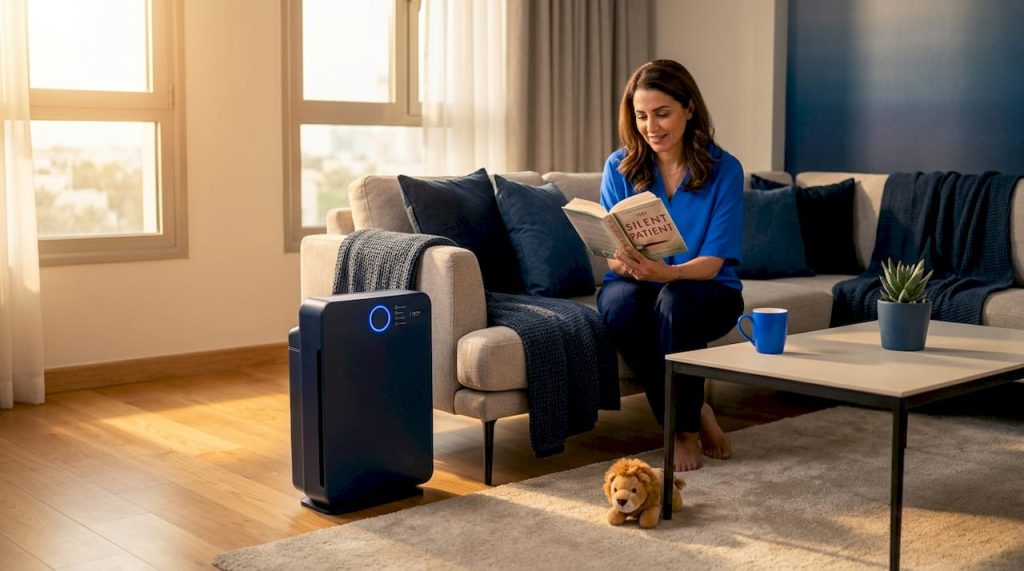
Choosing an air purifier for your bedroom or living room in Riyadh, Jeddah, or Dammam is not just about filtration power. The noise it makes matters enormously, especially if you have allergies, asthma, or any respiratory condition that already disrupts your sleep. A machine that hums, rattles, or roars at full speed can undo the very health benefits it promises. This guide walks you through exactly how to compare noise levels using real data, so you can find a model that keeps your air clean and your home genuinely peaceful.
Table of Contents
- Why air purifier noise levels matter for your health
- How air purifier noise is measured
- Comparing noise levels of top air purifiers
- How to choose the right quiet air purifier for your home
- The truth about air purifier noise claims
- Explore quiet air purifiers and solutions in Saudi Arabia
- Frequently asked questions
Key Takeaways
| Point | Details |
|---|---|
| Prioritise low decibel models | Choose air purifiers that stay below 30 dB on low for sleep-friendly use. |
| Trust independent noise tests | Lab-tested noise data gives a more honest picture than manufacturer specs alone. |
| Compare all fan speeds | Check noise ratings at every setting, as the quietest speed is rarely the one you use most. |
| Balance power and silence | Select units that combine strong filtration with acceptable sound levels for your space. |
Why air purifier noise levels matter for your health
Sleep quality and air quality are closely linked. When you sleep in a room with poor air, your body works harder to breathe, which fragments your rest. But if the solution to poor air is a loud machine running all night, you face a different problem entirely.
Excessive noise raises cortisol levels and keeps the nervous system in a mild state of alert. For someone already managing allergies or asthma, that added stress can worsen symptoms. Interrupted sleep also weakens immune function, making the body less able to handle allergens and airborne irritants. This is particularly relevant in Saudi Arabia, where desert dust, sand particles, and seasonal shamal winds push fine particulate matter indoors regularly.
Sound levels below 30 dB are widely recommended for sleeping environments. To put that in context, a whisper is roughly 30 dB, and a quiet library sits around 40 dB. Many air purifiers on the market exceed 50 dB at medium or high speed, which is closer to the noise level of a normal conversation. Running such a unit in a bedroom is counterproductive for anyone sensitive to sound.
The key takeaway here is straightforward:
For allergy and respiratory sufferers, a quiet air purifier is not a luxury. It is a health requirement. Quietest models under 25 to 30 dB on low speed are ideal for bedrooms, and independent tests give a far more accurate picture than manufacturer ratings alone.
When you browse air purifiers in Saudi Arabia, always look beyond the marketing claims. The noise figure printed on the box is rarely the full story.
- Noise above 40 dB at night can fragment sleep cycles, reducing restorative deep sleep.
- Allergy sufferers need consistent airflow throughout the night, meaning the purifier must run continuously at a tolerable volume.
- Children and elderly residents are especially sensitive to ambient noise during sleep.
- In open-plan villas or large apartments, a noisy unit in one room can disturb adjoining spaces.
With a clear understanding of why noise matters, it is important to learn how noise is actually measured and compared.
How air purifier noise is measured
Noise is measured in decibels, written as dB or dB(A). The “A” weighting adjusts the measurement to reflect how human ears perceive sound, making it the most relevant scale for everyday environments. A difference of just 10 dB sounds roughly twice as loud to the human ear, which is why the gap between 30 dB and 50 dB is far more significant than it appears numerically.

Standard testing places a decibel metre approximately 3 feet (about 1 metre) away from the unit in a quiet room. The tester records readings at every fan speed: low, medium, high, and turbo where applicable. This matters because testing methodology involves measuring all speeds, yet manufacturers often only list the low speed figure, which can be misleading for real-world use.
CNET, one of the most respected consumer technology testing organisations, weights noise at 20% of their overall air purifier score. They measure noise as an average across low, medium, and high speeds in a sound-controlled studio environment. This approach gives a far more honest picture of how a unit will behave during normal daily operation.
Pro Tip: When reading a product specification sheet, always look for noise data at medium speed. That is the speed most people use during the day, and it reflects real-world performance far better than the “sleep mode” figure that brands typically highlight.
| Fan speed | Typical dB range | Real-world comparison |
|---|---|---|
| Low / sleep | 20 to 35 dB | Whisper, rustling leaves |
| Medium | 35 to 48 dB | Quiet office, background music |
| High | 48 to 58 dB | Normal conversation |
| Turbo | 55 to 65 dB | Busy restaurant, loud fan |
Understanding this table helps you evaluate your air purifier choices with far more confidence. A model that lists “30 dB” on the box may well reach 55 dB at high speed, which is the speed it needs to run during a heavy dust event or when you first switch it on in a dusty room.
Now that you understand how noise is measured, let us see how leading air purifiers compare on actual sound levels.

Comparing noise levels of top air purifiers
Real test data from independent sources paints a very different picture from manufacturer brochures. Here is a side-by-side comparison of models that appear frequently in verified testing reports.
| Model | Low dB | Medium dB | High dB | Turbo dB | Room size |
|---|---|---|---|---|---|
| Universal HAP607 | 22 | 36 | 44 | 50 | Medium |
| Coway Airmega Mighty | 24.4 | 39.2 | 48.5 | 53.8 | Medium |
| Levoit Core 400S | 24 | approx. 40 | 58 | N/A | Large |
| Blueair Pure 211i Max | approx. 26 | approx. 42 | approx. 52 | N/A | Large (635 sq ft) |
Looking at this data, a few things stand out immediately.
-
The Universal HAP607 is among the quietest tested, with 22 dB on low and a relatively controlled 50 dB at turbo. For light sleepers or those with severe allergies, this is a strong candidate.
-
The Coway Airmega Mighty delivers 24.4 dB on low, which is genuinely whisper-quiet. Its medium speed at 39.2 dB remains comfortable for daytime use in a bedroom or study.
-
The Levoit Core 400S matches the Coway at 24 dB on sleep mode but climbs to 58 dB at high speed. This is a meaningful jump. For large rooms in Saudi villas where you need to run the unit hard during dusty periods, you need to factor that in.
-
The Blueair Pure 211i Max covers a large 635 square feet and remains relatively quiet despite its size. Blueair has a strong reputation for balancing coverage with controlled noise output. You can read more about specific models in our Blueair generations comparison.
For those considering Levoit specifically, our guide on choosing Levoit in Saudi Arabia covers filtration performance alongside noise considerations in detail. If you need a large-room option with quiet operation, the Blueair Blue Max 3450i is also worth reviewing.
Key statistic: The difference between the quietest model (Universal HAP607 at 22 dB on low) and a typical mid-range unit at medium speed (around 45 dB) represents a perceived loudness difference of more than four times. That is not a minor distinction for someone with asthma trying to sleep.
For allergy and respiratory sufferers, models that stay below 30 dB on low are not just preferable. They are the only realistic option for overnight use. Any model that exceeds 35 dB on low will likely become noticeable in a quiet bedroom, particularly in the early hours when ambient noise drops further.
Armed with comparison data, you can now use this information to choose the perfect air purifier for your needs.
How to choose the right quiet air purifier for your home
Selecting the right model involves more than picking the lowest dB figure. Here is a practical step-by-step process tailored for Saudi homes.
-
Measure your room. Coverage matters. A unit designed for 20 square metres running in a 40 square metre room will need to operate at high speed constantly, which means maximum noise. Match the unit’s Clean Air Delivery Rate (CADR) to your actual room size so it can clean the air effectively at low or medium speed.
-
Identify your primary concern. Desert dust and PM2.5 particles require strong HEPA H13 filtration. Coastal humidity in Jeddah may call for additional moisture management. Knowing your priority helps you avoid over-specifying a unit that then runs louder than necessary.
-
Check dB ratings at all speeds. Never rely solely on the “sleep mode” or “low” figure. Ask for medium and high speed data. Consumer Reports rates noise separately at both low and high speeds alongside particle removal performance, and top brands like Blueair consistently score well in this balanced assessment.
-
Seek independent test results. Look for reviews from CNET, Consumer Reports, or specialist testing sites rather than relying on the product page alone. These sources test at multiple speeds in controlled conditions.
-
Consider auto mode carefully. Many modern purifiers include an air quality sensor and auto mode. When pollution spikes, the fan ramps up automatically. This is useful during the day but can be disruptive at night. Check whether the unit allows you to cap the fan speed during sleep hours.
-
Prioritise brands with a track record. Blueair, Coway, and Levoit have consistent independent test data available. Reviewing the Blueair Max features or reading our broader Blueair for homes guide gives you verified performance context before you buy.
Pro Tip: If you share a bedroom with a partner or child who is sensitive to noise, aim for a model that stays below 25 dB on low. That is the threshold where most people stop noticing the unit is running at all, even in a very quiet room at night.
Now you can make a well-informed choice and get the most from your investment.
The truth about air purifier noise claims
Here is something most product guides will not tell you directly: the noise figure on the box is almost always the best-case scenario, not the typical experience.
Manufacturers are not being dishonest in a technical sense. They are simply listing the lowest possible reading under the most favourable conditions. But manufacturers often only list low speed, which is misleading for real use. In practice, most air purifiers spend the majority of their working life at medium speed or higher, particularly in Saudi homes where dust levels are elevated and the unit needs to work harder to maintain clean air.
There is another factor that buyers rarely consider: noise perception changes with frequency, not just volume. A unit that produces a low-frequency hum at 38 dB can feel more intrusive than a white-noise style fan at 42 dB. This is why reading independent reviews that describe the quality of the sound, not just the number, is genuinely valuable.
We have spoken with many customers across Riyadh and Dammam who purchased a unit based on a “30 dB” claim, only to find it noticeably loud at the speed needed to actually clean their room. The lesson is consistent: verify the medium-speed figure, check independent sources, and read user reviews from people who have tested the unit in real home conditions.
Savvy buyers in Saudi Arabia are increasingly asking for test reports and verified reviews before purchasing. That is exactly the right approach. You can always read our Levoit overview for an example of how we present verified performance data alongside noise ratings to help you make a grounded decision.
Explore quiet air purifiers and solutions in Saudi Arabia
With guidance in hand, it is time to take the next step towards a quieter and healthier home.
At ClimaSaudi, we stock a carefully selected range of air purifiers tested for real-world performance in Saudi conditions. Whether you are dealing with desert dust in Riyadh, coastal humidity in Jeddah, or industrial air quality concerns in Dammam, we have options that balance strong HEPA H13 filtration with genuinely low noise output.

Browse the Blueair Blue 211i Max for large-room quiet performance, or explore the Blueair Blue 3610 for a compact, bedroom-friendly option. Every product listing includes honest noise data at multiple speeds, transparent SAR pricing, and next-day delivery across Saudi Arabia. Visit the full range at ClimaSaudi to find the right match for your home, or use our Air Match tool to get a personalised recommendation based on your room size and air quality concerns.
Frequently asked questions
What is a safe noise level for air purifiers in bedrooms?
Air purifiers with noise levels below 30 dB on low are best for undisturbed sleep and allergy relief. Models under 25 to 30 dB on low speed are considered whisper-quiet and ideal for sensitive sleepers.
How are air purifier noise ratings measured?
Noise is measured in dB(A) using a decibel metre from a standard distance, usually 3 feet, at each fan speed. Testing at all speeds in a quiet room gives the most accurate and useful noise profile.
Are manufacturer noise specs reliable?
Not always. Manufacturers often list only the low speed figure, which does not reflect normal operating conditions. Independent tests from sources like CNET or Consumer Reports are far more trustworthy.
What models are considered the quietest?
Universal HAP607, Coway Airmega Mighty, and Levoit Core 400S are among those with the lowest tested noise levels. These models range from 22 dB on low up to 58 dB at high speed, so always check the full speed range before buying.
Recommended
- مقارنة سريعة بين أجيال blueair air purifier — Blog | ClimaSaudi
- Buy Blueair ComfortPure 3-in-1 T20i Air Purifier in Saudi Arabia | Best Price SAR 1,503 | ClimaSaudi
- دليل شامل لاختيار levoit air purifier المثالي — Blog | ClimaSaudi
- Buy Blueair Mini Restful Sunrise Clock Air Purifier in Saudi Arabia | Best Price SAR 483 | ClimaSaudi