Walk into any home appliance shop in Riyadh or browse online, and you will see “HEPA” printed across dozens of air purifiers. But understanding what is true HEPA certification — and what separates a genuinely certified filter from a clever marketing label — can be the difference between clean air and a false sense of security. In Saudi homes, where desert dust, fine sand particles, and coastal humidity create persistent air quality challenges, that distinction matters more than most people realise.
Table of Contents
- What is true HEPA certification and why it matters
- How HEPA certification is tested and verified
- Common misconceptions about HEPA certification and true filter performance
- Practical tips for verifying true HEPA certification when buying filters in Saudi Arabia
- Understanding HEPA certification in the context of Saudi Arabia’s indoor air challenges
- What most people miss about true HEPA certification and effective air quality control
- Find certified true HEPA air purifiers and filters for your Saudi home today
- Frequently asked questions
Key Takeaways
| Point | Details |
|---|---|
| True HEPA standard | True HEPA means removing 99.97% of particles at 0.3 microns, verified by strict testing. |
| Avoid HEPA-type claims | HEPA-type or HEPA-like labels lack certification and typically have lower filtration efficiency. |
| Check certification details | Look for explicit efficiency ratings or recognized standards, not just ‘HEPA’ on packaging. |
| Consider whole-room factors | Filter performance must match room size and be combined with ventilation and humidity control. |
| Saudi indoor air needs | Dust and humidity require both certified HEPA filtration and moisture control for effective air quality. |
What is true HEPA certification and why it matters
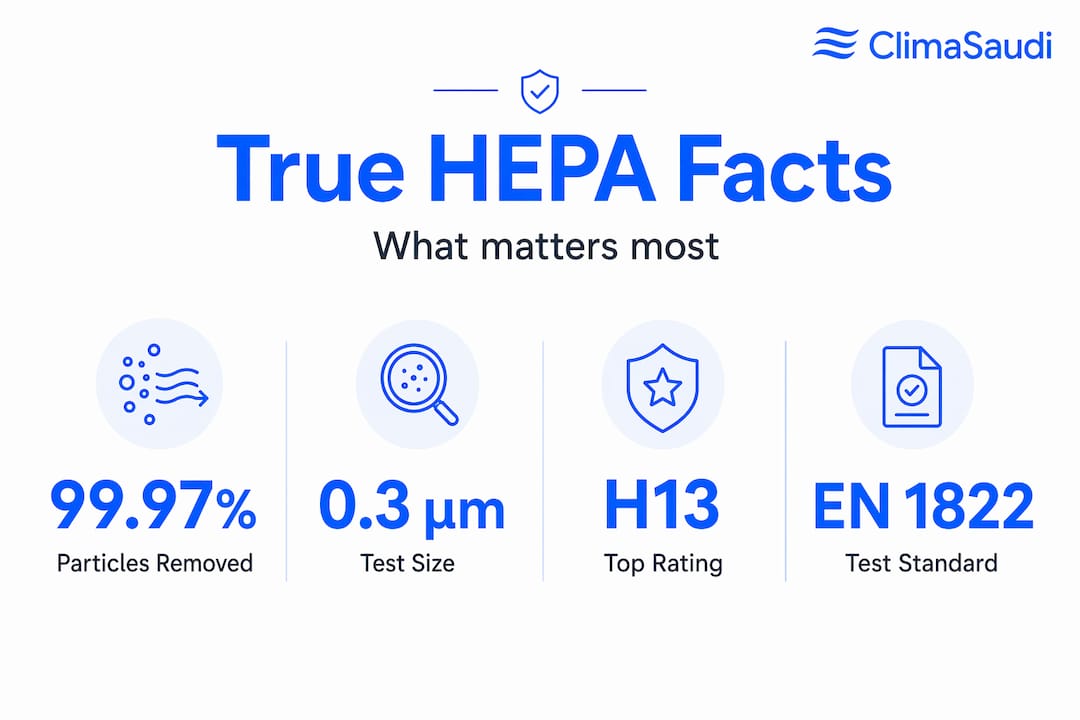
True HEPA certification is not a brand name. It is a performance standard. A filter earns the “true HEPA” designation only when it captures at least 99.97% of particles at 0.3 microns in size. That specific particle size, known as the Most Penetrating Particle Size (MPPS), is deliberately chosen because it is the hardest for filters to trap. Passing that test is what makes a filter genuinely certified.
Contrast that with terms like “HEPA-type” or “HEPA-like.” These are marketing labels without standardised meaning, not certifications. A product carrying those labels may filter only 85% or 90% of airborne particles, sometimes less. That gap matters enormously when you are trying to remove allergens, fine dust, or PM2.5 particles from your home.
Here is what true HEPA certification actually guarantees:
- Removal of at least 99.97% of particles at 0.3 microns
- Independent testing to a recognised standard, not the manufacturer’s own claims
- Confidence that allergens such as dust mite debris, pollen, and mould spores are effectively captured
- Better performance on particles smaller than 0.3 microns and larger than 0.3 microns, since 0.3 microns is the worst-case size
“Not all particles are equally difficult to capture. The 0.3 micron threshold represents the greatest filtration challenge. True HEPA filters actually perform better at capturing particles that are either smaller or larger than this size.”
Understanding the HEPA filter ratings guide at the outset saves you from buying a product that sounds impressive but underdelivers.
How HEPA certification is tested and verified
Certification does not come from printing a label. It follows a strict, independent testing process. Here is how it works in practice:
- Filter media is challenged with aerosol particles at 0.3 microns under controlled conditions, measuring what percentage passes through.
- The filter must achieve 99.97% particle removal (or better) to meet the US Department of Energy standard, which is the benchmark most commonly referenced.
- European standard EN 1822 classifies filters into H13 and H14 grades. H13/H14 grades meet or exceed true HEPA efficiency, with H14 providing even higher performance suited for medical environments.
- Results must be documented by the testing laboratory, not just claimed on packaging.
- Medical-grade HEPA filters (often H14 or higher) offer marginal additional efficiency at a significant cost premium, which is rarely necessary for residential use.
What you should look for when reading product specifications:
- A numeric efficiency figure: “99.97% at 0.3 µm” or “H13 EN 1822 certified”
- Reference to a recognised testing standard (US DOE, EN 1822, or equivalent)
- Avoid any product that only states “HEPA-type,” “HEPA-grade,” or “HEPA-like” without attaching a verified efficiency number
Pro Tip: If a product description does not state the particle size and efficiency percentage together, treat the HEPA claim with caution. Genuine manufacturers are transparent about test data because it proves their filter performs.
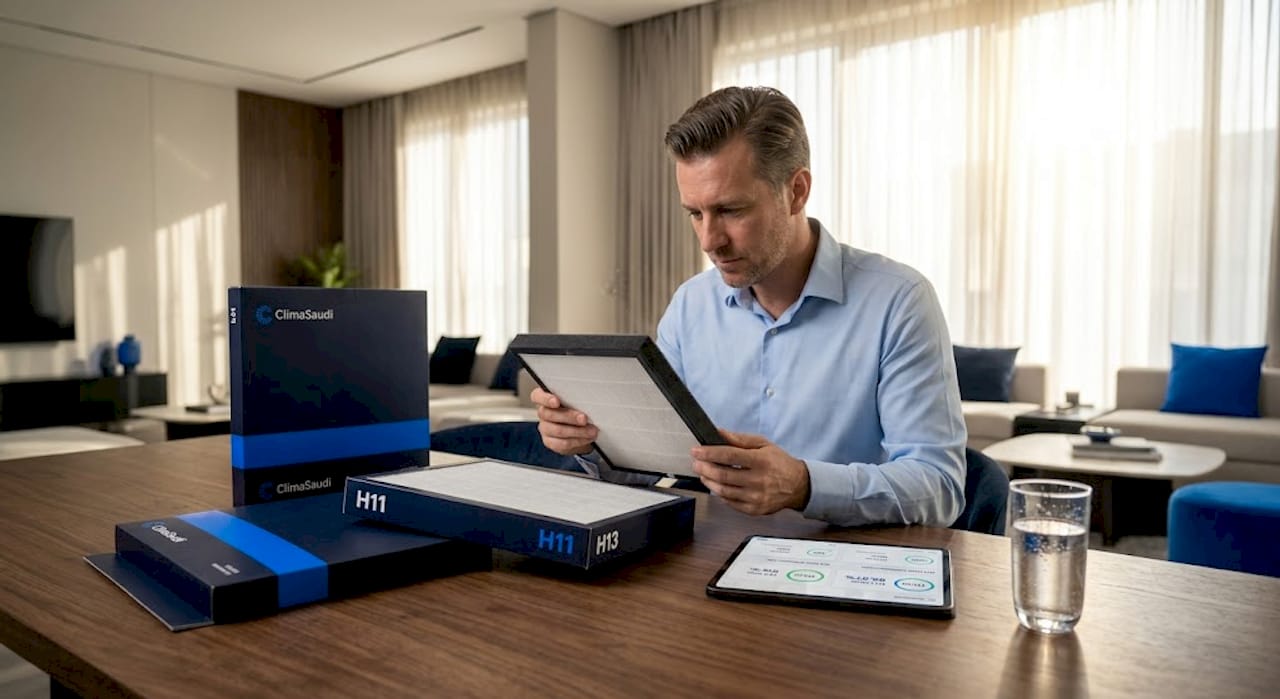
For Saudi homes, HEPA H13 vs H11 filters represent a meaningful performance difference, particularly during dusty seasons in cities like Riyadh and Dammam.
Common misconceptions about HEPA certification and true filter performance
Many homeowners assume that any filter with “HEPA” on the box will clean their air effectively. That assumption leads to real-world disappointment. Here are the most common misunderstandings worth addressing.
Misconception 1: “HEPA filters only target 0.3 micron particles.”
The opposite is true. The 0.3 micron size is the most difficult size to capture, so it is used as a challenge threshold. True HEPA filters capture both larger particles (dust, pollen, pet dander) and smaller particles (some bacteria, fine combustion particles) at even higher efficiencies. The certification test simply proves performance at the hardest point.
Misconception 2: “Certification is enough — the air in my room will be clean.”
Filter efficiency and room air cleaning are not the same thing. Clean Air Delivery Rate (CADR) measures how quickly a purifier cleans a specific room volume. A certified true HEPA filter inside an underpowered unit may take hours to meaningfully reduce particle levels in a large room. Always match CADR to room size.
Misconception 3: “All true HEPA labels are trustworthy.”
Without documentation, a label is just printing. Some manufacturers claim true HEPA performance without third-party testing to support it. This is particularly relevant in markets where certification enforcement is inconsistent.
“Indoor air quality benefit depends on both filter efficiency and CADR. HEPA media alone does not guarantee that your room’s air is cleaned quickly enough to protect your health.”
- Filter efficiency (99.97%) tells you how well particles are captured
- CADR tells you how fast clean air is delivered to your room
- Both figures together determine real-world performance
Knowing how HEPA filters trap allergens helps you interpret these numbers with greater confidence.
Practical tips for verifying true HEPA certification when buying filters in Saudi Arabia
Knowing the science is useful. Applying it at the point of purchase is what protects your family. Follow these steps when evaluating any air purifier or replacement filter:
- Check the specification sheet for a numeric efficiency rating. Look for “99.97% at 0.3 µm” or an H13 EN 1822 reference. If you cannot find this figure, ask for it.
- Avoid vague labels. Steer clear of products labelled only as “HEPA-type,” “HEPA-style,” or “HEPA-like.” These terms carry no performance guarantee.
- Cross-reference the standard. US DOE and European EN 1822 are the two most widely recognised frameworks. Either is a credible reference point.
- Check CADR values for your room size. A certified filter in an undersized unit will not clean a large villa bedroom effectively.
- Look for additional certifications for Saudi use. CARB (California Air Resources Board) certification confirms the unit produces no harmful ozone, which matters in enclosed Saudi interiors.
- Account for humidity control. A true HEPA purifier removes particles, not moisture. In Jeddah and other coastal cities, pairing filtration with a dehumidifier addresses the full range of air quality concerns.
| Filter label | Certified efficiency | Testing standard | Suitable for Saudi homes |
|---|---|---|---|
| True HEPA | 99.97% at 0.3 µm | US DOE / EN 1822 H13+ | Yes |
| HEPA H13 | 99.95% at MPPS | EN 1822 | Yes |
| HEPA H14 | 99.995% at MPPS | EN 1822 | Yes (overkill for most homes) |
| HEPA-type | Unspecified | None | Not recommended |
| HEPA-like | Unspecified | None | Not recommended |
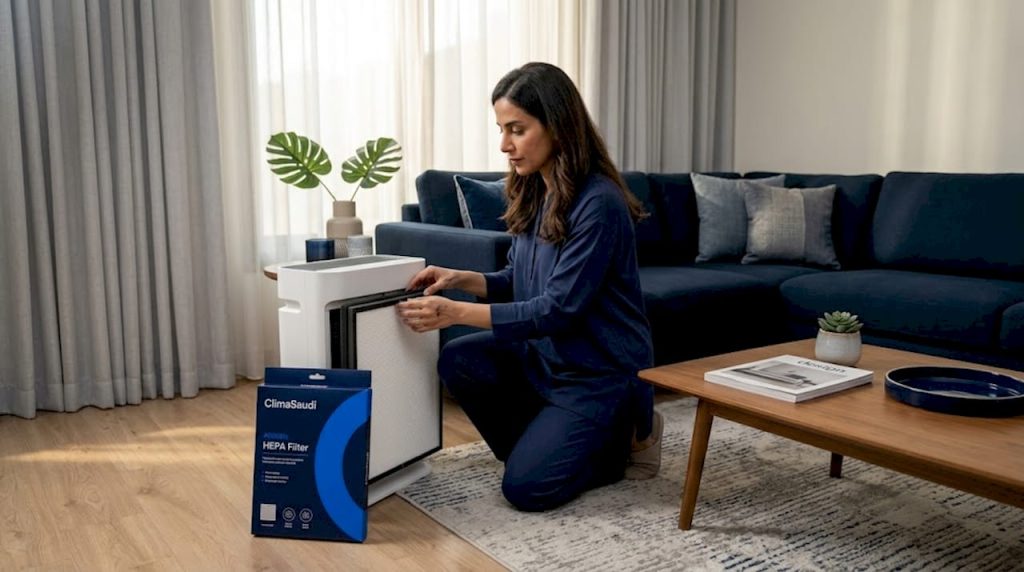
Pro Tip: Always replace filters on the manufacturer’s recommended schedule. A degraded true HEPA filter loses efficiency over time, particularly in Saudi environments where dust loading is high. Check HEPA filter ratings to understand when performance declines.
Investing in HEPA H13 filter advantages over lower-grade options makes a measurable difference in homes regularly exposed to fine desert particulates.
Understanding HEPA certification in the context of Saudi Arabia’s indoor air challenges
Saudi homes face air quality pressures that most European or North American guides do not account for. Desert dust events can push indoor PM2.5 levels sharply upward even with windows closed. Coastal humidity in cities like Jeddah and Al Khobar encourages mould spore growth and dust mite proliferation. High temperatures drive longer periods spent indoors, increasing exposure to recirculated air.
True HEPA filtration addresses airborne particles effectively. But as EPA guidance confirms, even certified filters cannot resolve persistent allergens without controlling indoor humidity and tackling dust at its source. A comprehensive approach includes:
- Certified HEPA H13 filtration for particle removal
- Dehumidifier use in coastal or humid inland areas to reduce mould and dust mite conditions
- Regular cleaning of floors, soft furnishings, and air conditioning filters to reduce the particle load your purifier must handle
- Adequate ventilation during periods of lower outdoor pollution to dilute indoor pollutants
- Air purifiers with activated carbon layers where VOCs or cooking odours are also a concern
Pro Tip: In Riyadh’s drier climate, a humidifier may actually improve indoor comfort and reduce irritation from overly dry air during winter months. The goal is balanced humidity, not just low humidity. Explore air purifier features for Saudi homes to match your city’s specific conditions.
What most people miss about true HEPA certification and effective air quality control
Here is an uncomfortable truth about the air purifier market: certification labels are easy to print and hard for consumers to verify on the shop floor. Most buyers read “HEPA” and feel reassured. Manufacturers know this, and some exploit it.
The 99.97% at 0.3 µm benchmark is a laboratory result. In practice, a filter’s real-world performance also depends on how well it fits within the unit’s housing. A poorly sealed filter frame, even with certified media, allows unfiltered air to bypass the filter entirely. No certification label will tell you this. Request or confirm documentation proving the 99.97% threshold before you trust a product, not just the front of the box.
We also see homeowners invest in certified filters and then place their purifier in a corner, doors closed, with no attention to airflow patterns. Filtration works when air cycles through the unit regularly. A well-chosen unit with validated CADR for your room size will outperform a higher-spec model placed badly every time.
Humidity is the other variable that most guides gloss over. In Saudi Arabia’s coastal regions, a HEPA filter working perfectly can still leave you with worsening allergy symptoms if humidity is pushing above 60%, because mould and dust mites thrive at those levels. Filtration and humidity control are not competing priorities. They are complementary ones.
Read more about the practical trade-offs in our guide to air purifier vs air filter for Saudi homes to decide what combination suits your space.
Find certified true HEPA air purifiers and filters for your Saudi home today
If you are ready to move from understanding to action, ClimaSaudi offers a range of certified true HEPA air purifiers and replacement filters selected specifically for Saudi Arabian home conditions. Every product listed meets verified filtration standards, with clear specifications you can trust.
The Blueair ComfortPure 3-in-1 T20i combines certified HEPA filtration with additional features suited for larger rooms, while the Blueair Blue 3610 offers reliable H13-grade performance at an accessible price point. Both are available from local stock with next-day delivery across Riyadh, Jeddah, and Dammam. Browse the full ClimaSaudi air purifiers and filters range to find the right match for your room size and air quality needs, with SAR pricing and local customer support included.
Frequently asked questions
What does ‘true HEPA certification’ mean for a filter?
True HEPA certification means a filter has passed independent testing confirming it removes at least 99.97% of particles at 0.3 microns, the hardest size to capture, giving you verified rather than claimed performance.
Are ‘HEPA-type’ filters as effective as true HEPA?
No. “HEPA-type” is not a standard and does not meet the 99.97% efficiency requirement, meaning these filters typically capture significantly fewer particles and should not be relied upon for serious air quality management.
How can I verify if a filter is genuinely true HEPA?
Look for explicit specifications showing 99.97% efficiency at 0.3 microns or EN 1822 H13 certification; if the product only uses vague terms like “HEPA-like” without a numeric efficiency figure, the claim is unverified.
Does HEPA certification guarantee good indoor air quality on its own?
No. Certification confirms filter efficiency, but CADR and room size determine how quickly clean air reaches you, and humidity control plus regular cleaning are essential for comprehensive results.
Why is humidity control important alongside HEPA air filtration in Saudi homes?
High humidity encourages mould growth and dust mite activity that worsens allergy symptoms; even certified HEPA filtration cannot compensate for elevated moisture levels, making dehumidification an essential part of any effective indoor air quality plan in humid Saudi cities.