Living in Saudi Arabia means your air purifier works harder than most. Desert dust, seasonal sandstorms, and high occupancy levels all accelerate how quickly a HEPA filter becomes overloaded. Yet most homeowners and renters either replace filters too late or skip steps that matter. This HEPA filter replacement checklist gives you a clear, sequential process to follow, so your purifier keeps delivering clean air rather than simply running and using electricity while doing very little.
Table of Contents
- Key takeaways
- 1. Your HEPA filter replacement checklist: why it starts with knowing your environment
- 2. Signs of HEPA filter wear you should check first
- 3. Step-by-step HEPA filter installation guide for a safe, correct change
- 4. Comparing HEPA filter types and replacement schedules for Saudi homes
- 5. Maintaining HEPA filters and maximising air quality in your Saudi home
- My honest take on HEPA filter maintenance in Saudi homes
- Find genuine HEPA filters and purifiers for Saudi homes at Climasaudi
- FAQ
Key takeaways
| Point | Details |
|---|---|
| Replace by environment, not just time | High-dust Saudi homes may need HEPA replacement every 6 to 8 months, not the standard 12. |
| Inspect the back face of the filter | A grey or brown back face means the filter is saturated and must be replaced immediately. |
| Never wash a HEPA filter | Water and vacuuming permanently damage the filter media and reduce its efficiency. |
| Indicator lights are reminders, not sensors | Always combine light alerts with a visual inspection and a smell check before replacing. |
| Clean pre-filters every 2 to 4 weeks | Regular pre-filter cleaning extends HEPA lifespan significantly in dusty conditions. |
1. Your HEPA filter replacement checklist: why it starts with knowing your environment
Before you open the device, you need to understand what conditions your filter has been working in. The environment inside and outside your home shapes every decision on this checklist.
True HEPA filters capture 99.97% of particles down to 0.3 microns. That includes PM2.5, dust mite debris, pollen, and pet dander. Filters labelled “HEPA-type” or “HEPA-style” are not held to this standard and underperform significantly. Always confirm your replacement filter carries a genuine True HEPA certification.
Your household profile determines how aggressively dust loads the filter. A single-person flat in a quiet district of Jeddah behaves very differently to a large family villa in Riyadh near a construction site. Clean, low-traffic homes can stretch HEPA lifespan to 14 to 16 months, while high-particulate environments call for replacement every 6 to 8 months.
Ask yourself these questions before you proceed:
- Do you have pets in the home?
- Does anyone in the household smoke indoors?
- Is your home near a major road, construction site, or open desert?
- How many people live in the space?
- Have you experienced dust storms recently?
The answers tell you where you sit on the replacement frequency scale and whether the rest of this checklist needs to happen now or can wait another month.
2. Signs of HEPA filter wear you should check first
Many people skip this step and replace on a fixed schedule regardless of the filter’s actual condition. That wastes money. Others wait far too long and breathe through a blocked filter for months. Neither approach is right.
The most reliable method is a physical inspection. The back face of a HEPA filter is the best indicator of remaining capacity. Particles load from the front inward, so the back face is the last part to saturate. If it is still white, the filter has capacity left. If it is grey or brown, replace it now without delay.
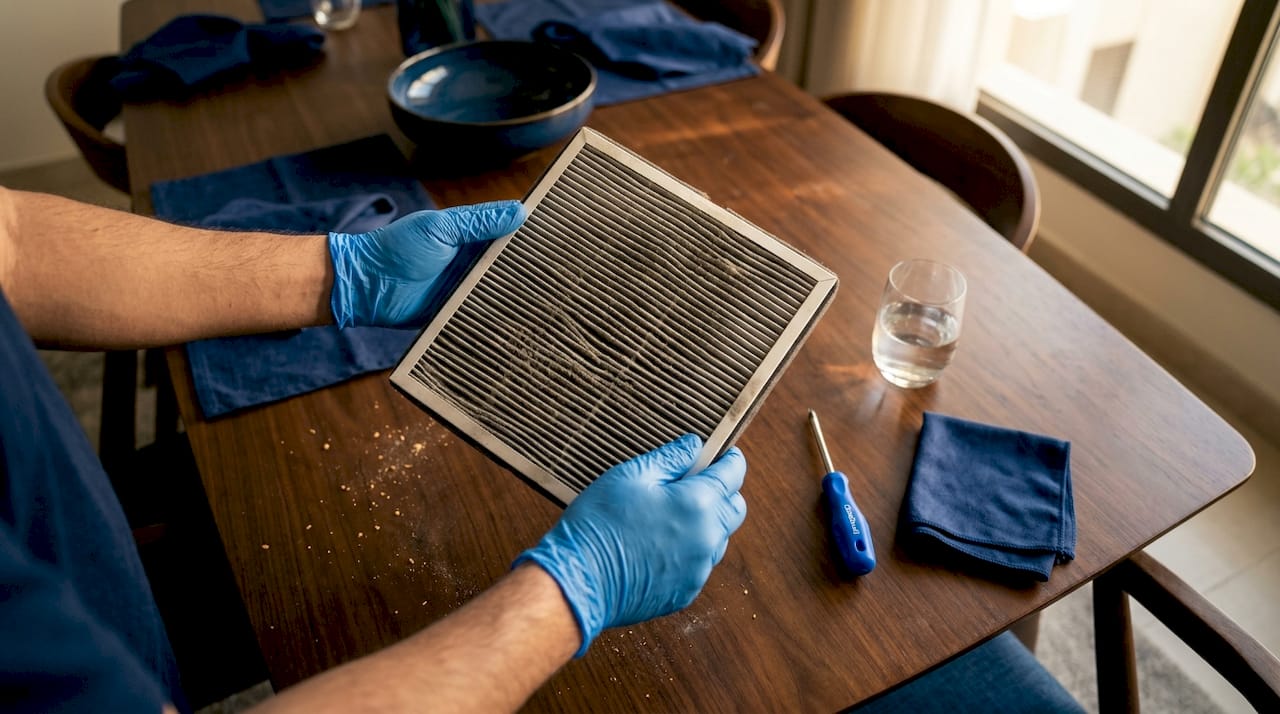
Beyond colour, pay attention to smell. A musty or stale odour coming from your purifier strongly suggests the activated carbon layer is saturated and the HEPA is under stress. Reduced airflow from the unit is another warning sign. Airflow restriction and a fan that sounds like it is working harder than usual both indicate an overloaded filter.
One thing to clarify about indicator lights: filter replacement lights are time-based, not sensor-based. They count hours of operation, not actual filter loading. In Saudi Arabia’s dusty conditions, your filter may be exhausted well before the light triggers. Always combine the light alert with a visual and smell check.
Pro Tip: Remove the filter carefully and inspect the back face under good lighting. If you see grey or brown colouration spreading across most of the back surface, replace it immediately regardless of what the indicator light says.
3. Step-by-step HEPA filter installation guide for a safe, correct change
Now you have assessed your filter condition. Here is the full replacement sequence.
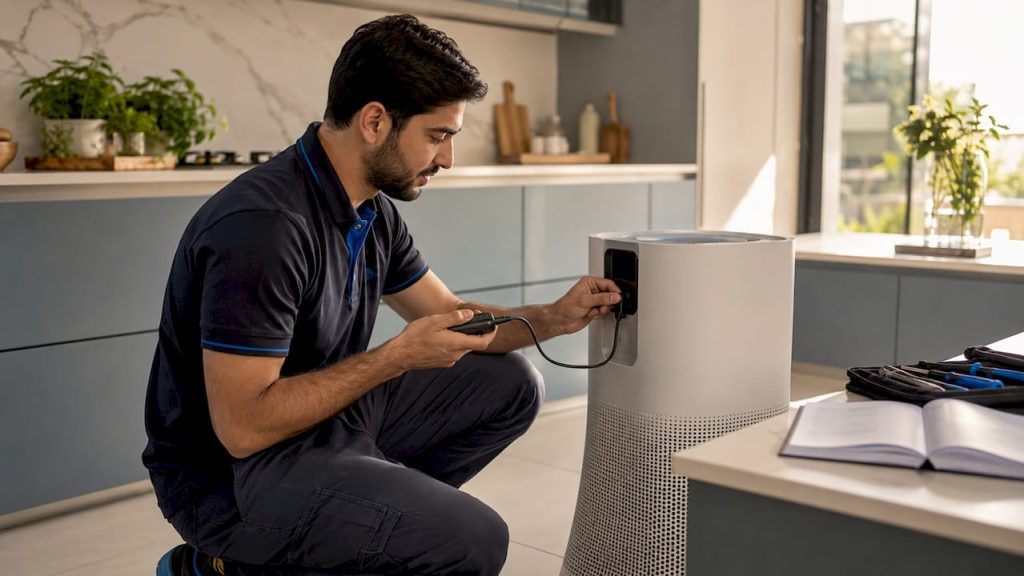
- Power off the device completely. Do not just reduce the fan speed. Switch it off at the mains and unplug it. This prevents dust from being drawn in during the change.
- Gather your replacement filter and a waste bag before you start. Having everything ready means you can move quickly and avoid leaving the unit open longer than needed.
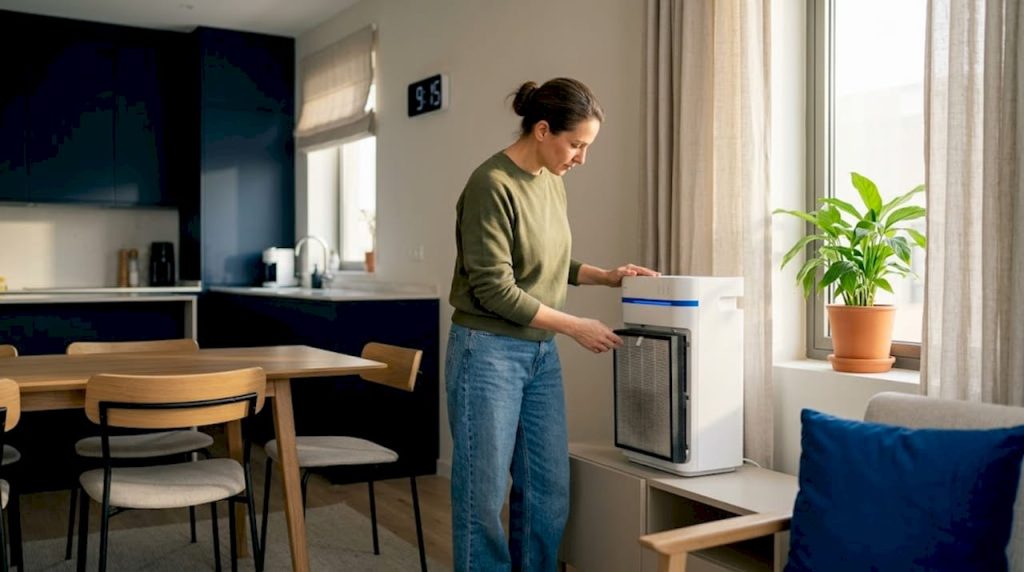
- Remove the old filter slowly and carefully. Avoid shaking it or turning it upside down. Place it directly into the waste bag and seal it before setting it aside.
- Inspect the filter housing and slot. Wipe away any dust settled in the compartment using a dry cloth. Do not use water inside the unit.
- Check the directional arrows on the new filter. Most HEPA filters have printed arrows showing correct airflow direction. Fitting a filter backwards reduces performance significantly.
- Remove packaging from the new filter only when you are ready to install it. Avoid touching the filter media itself. Handle it by the frame only.
- Slide the new filter into the slot firmly. There should be no gaps around the edges. A poor seal allows unfiltered air to bypass the filter entirely, which defeats its purpose.
- Close the housing securely. Confirm all clips or panels are locked before switching the device back on.
- Record the replacement date. Write it on the filter frame in marker or note it in a phone reminder. This is the single most useful habit for maintaining your HEPA filter replacement frequency.
- Run the purifier on high for five minutes after installation. Listen for unusual sounds and check that airflow feels strong. This confirms the seal is correct and the unit is operating normally.
- Dispose of the used filter as sealed waste. Check your local municipality guidelines in Riyadh, Jeddah, or Dammam for proper disposal. Do not attempt to recycle HEPA filters through standard channels.
Pro Tip: Consider adding a HEPA filter change to your home’s deep clean schedule. Pairing it with a full room clean removes the dust stirred up during the change and gives you a genuinely fresh start.
4. Comparing HEPA filter types and replacement schedules for Saudi homes
Not all HEPA filters are built or priced the same way, and the Saudi market has specific options worth understanding before you buy.
| Filter type | Typical lifespan in Saudi conditions | Replacement cost range | Key consideration |
|---|---|---|---|
| True HEPA (standalone) | 8 to 12 months | SAR 80 to 200 | Most cost-effective over time |
| Bonded 3-in-1 (HEPA + carbon combined) | 6 to 10 months | SAR 150 to 350 | Replace whole unit even if only one layer is spent |
| HEPA H13 certified | 8 to 14 months | SAR 120 to 280 | Higher particle capture rate, worth the premium |
| HEPA-type (non-certified) | 4 to 6 months | SAR 40 to 100 | Avoid where possible; underperforms in dust-heavy rooms |
The bonded 3-in-1 design is common across many mid-range purifiers. It combines a pre-filter, HEPA layer, and activated carbon into a single unit. Independently replaceable filters are more economical because you only replace the component that is spent. If your carbon layer saturates after four months but your HEPA still has capacity, a bonded unit forces you to replace both. That adds up quickly.
For Saudi homes specifically, here are the most relevant guidance points:
- Homes with pets or smokers should replace HEPA every 6 to 8 months and carbon layers every 2 to 4 months.
- During sandstorm season, check your filter monthly rather than relying on a fixed schedule.
- Longer-lasting filters with higher upfront costs are often more economical than cheap replacements bought frequently.
- Purchasing genuine replacement filters from a local Saudi supplier means faster delivery and assured compatibility.
Blueair models available in the Saudi market, including the Blue 3610 and ComfortPure T20i, use distinct filter cartridges that are widely stocked. Compatibility matters. Fitting a generic replacement into a precision-engineered unit risks air leakage around the frame and a drop in filtration performance.
5. Maintaining HEPA filters and maximising air quality in your Saudi home
Replacing the filter correctly is only part of the picture. What you do between replacements has a direct effect on how long each filter lasts and how clean your air actually is.
A multi-stage filtration setup with a pre-filter, HEPA layer, and activated carbon is the standard approach for managing dust and odours in Saudi homes. The pre-filter does the heavy lifting for larger particles, which protects the HEPA from saturating too quickly.
Here are the practical habits that make a measurable difference:
- Clean pre-filters every 2 to 4 weeks. Regular pre-filter cleaning is one of the most effective ways to extend HEPA lifespan. Most pre-filters are washable. Rinse under cool water, allow to dry fully before reinserting, and never reinstall a damp pre-filter.
- Position your purifier strategically. Place it near the primary dust source, typically near windows or doors, while keeping at least 30 centimetres of clearance on all sides for airflow.
- Monitor sound and airflow regularly. A fan that sounds strained or airflow that feels weaker than normal signals clogging, even if the indicator light has not triggered yet. For a wider look at air quality solutions suited to Saudi conditions, it helps to understand how purifiers and standalone filters compare.
- Budget for replacement filters as a recurring home cost. If you own a purifier, plan for one to two filter replacements per year as a standard line item, the same way you budget for HVAC servicing.
- Adjust your schedule around environmental events. Saudi Arabia’s shamal winds bring significant dust loads from the north. After a notable dust storm, inspect your filter rather than waiting for the next scheduled check.
- Never use non-certified filters to save money short-term. An undersized or poorly constructed filter lets particles through that a genuine HEPA would capture. The health cost outweighs any price saving.
Understanding how different city-specific conditions in Saudi Arabia affect your purifier choices can help you refine this routine further.
My honest take on HEPA filter maintenance in Saudi homes
I have seen too many people treat filter replacement as a once-a-year task they do only when the indicator light flashes. In the Gulf climate, that approach consistently leads to months of degraded air quality without the occupant realising it.
What I have found actually works is building a two-step routine: a quick visual check every month and a full replacement assessment every three months. Pull the filter out, look at the back face, and smell the housing. Those two checks take under two minutes and tell you more than any timer-based light ever will.
I am also a firm believer in choosing purifiers that allow independent filter replacement. The upfront cost is slightly higher, but units with separate filter stages save a considerable amount over the life of the device. Replacing a carbon layer that is spent without discarding a perfectly functional HEPA filter is simply sensible management.
For renters, the argument is even clearer. You cannot control what dust comes through the building’s common areas or what your neighbours burn on their balconies. What you can control is how often you service your purifier and whether you use a genuine certified filter. It is the one variable entirely in your hands. The benefits of running a well-maintained air purifier in an apartment are substantial, particularly in shared buildings with high foot traffic.
— Pauline
Find genuine HEPA filters and purifiers for Saudi homes at Climasaudi
If you have worked through this checklist and realised your current filter is overdue for a change, Climasaudi makes the next step straightforward. The platform stocks genuine HEPA H13 replacement filters alongside a curated range of air purifiers designed specifically for Saudi residential conditions, whether you live in a compact flat in Jeddah or a large villa in Riyadh.
The Blueair ComfortPure 3-in-1 T20i and the Blueair Blue 3610 are among the most popular models stocked locally, with filters available for next-day delivery across major Saudi cities. Prices are listed in SAR with no hidden conversion fees, and the local customer support team can help you identify the correct replacement filter for your specific unit. Browse the full range of air purifiers and HEPA filters at Climasaudi to find what fits your home and budget.
FAQ
How often should I replace my HEPA filter in Saudi Arabia?
Most Saudi homes should replace True HEPA filters every 6 to 12 months. Homes near construction, with pets, or affected by frequent sandstorms may need replacement every 6 to 8 months.
Can I wash or vacuum a HEPA filter to extend its life?
No. Washing or vacuuming a HEPA filter permanently damages the fibre matrix and reduces its efficiency. Clean only the pre-filter and replace the HEPA when it is spent.
What are the main signs that my HEPA filter needs replacing?
A grey or brown back face, reduced airflow from the unit, a strained fan sound, and musty odours are the clearest signs. Do not wait for the indicator light alone.
What does True HEPA mean and why does it matter?
True HEPA filters meet the standard of capturing 99.97% of particles at 0.3 microns. Filters labelled “HEPA-type” do not meet this benchmark and offer significantly weaker filtration in dusty Saudi conditions.
How do I know if my new HEPA filter is installed correctly?
After installation, run the purifier on high for five minutes. Strong, even airflow and no unusual sounds confirm a correct seal. Any gap around the filter frame allows unfiltered air to bypass the HEPA entirely.
Recommended
- HEPA filter ratings: choosing clean air for your Saudi home — Blog | ClimaSaudi
- How HEPA filters trap allergens for cleaner air at home — Blog | ClimaSaudi
- What is true HEPA certification? A guide for Saudi homeowners — Blog | ClimaSaudi
- Air Purifiers, Humidifiers & HEPA Filters in Saudi Arabia | ClimaSaudi