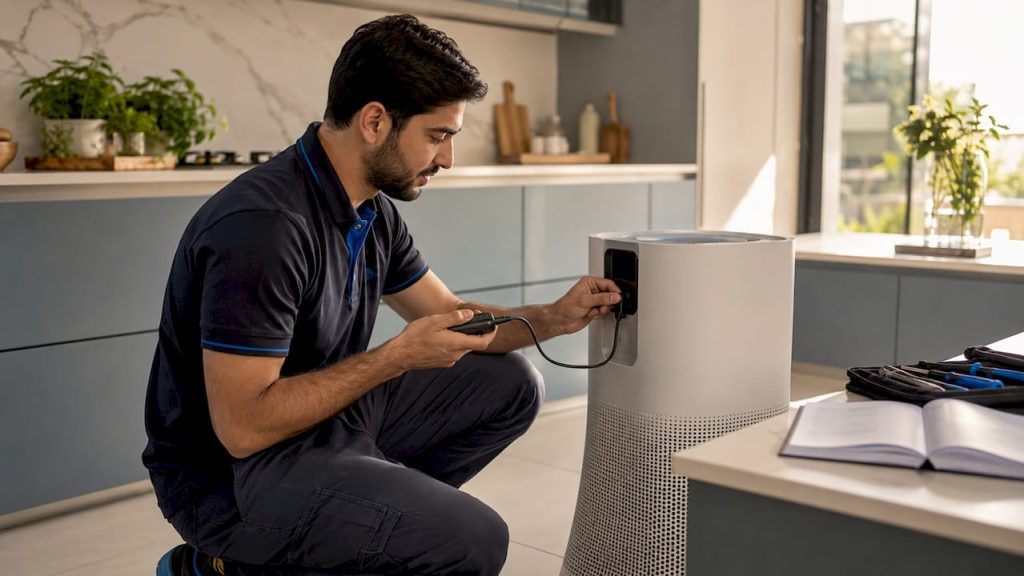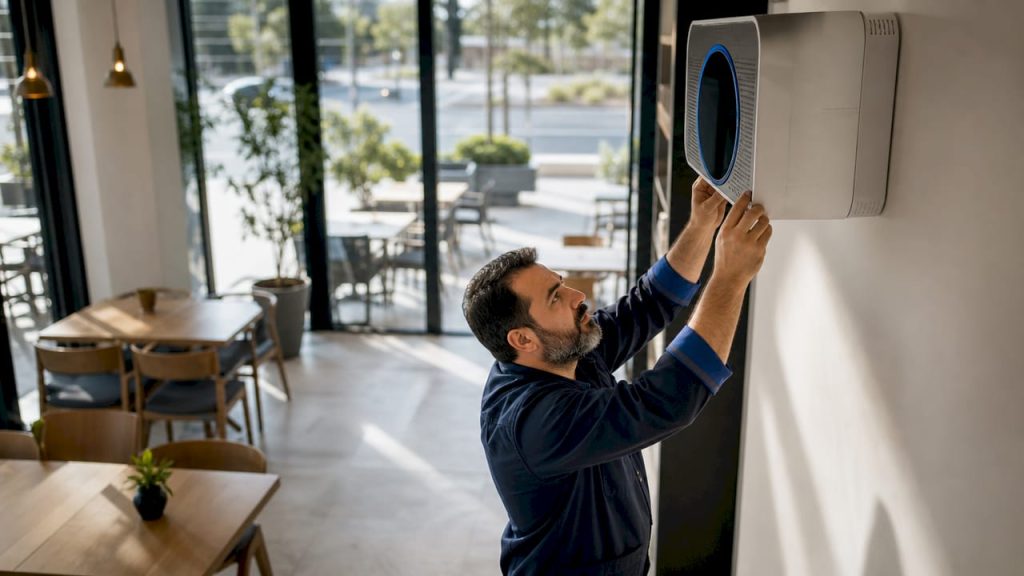
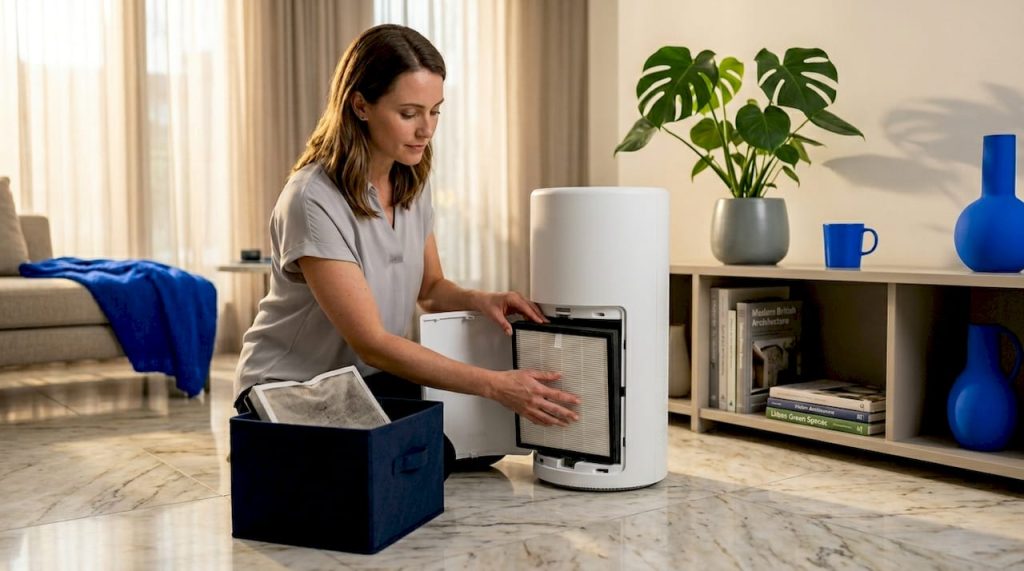
Your air purifier is running. The indicator light is off. You assume the filter is fine. This is the mistake most homeowners make, and it costs them in health, energy bills, and device longevity. Understanding why replace HEPA filters regularly matters starts with a fact that surprises many people: a dirty filter does not simply clean less. It actively works against you. This guide covers exactly how HEPA filtration degrades, when to act, what signs to look for, and how your household conditions change everything.
Table of Contents
- Key takeaways
- Why replace HEPA filters regularly: the science behind it
- How often to change HEPA filters
- The real cost of skipping filter replacement
- Signs your HEPA filter needs replacing
- Replacement timing by household type
- My honest take on HEPA filter maintenance
- Keep your air clean with Climasaudi
- FAQ
Key takeaways
| Point | Details |
|---|---|
| Filters clog gradually | Performance loss is invisible at first, often showing up as worsening allergy symptoms before anything else. |
| Replace every 6 to 12 months | Homes with pets, smokers, or heavy dust need replacements more frequently than the standard guideline suggests. |
| Pre-filter cleaning matters | Cleaning your pre-filter regularly can significantly extend the life of your HEPA filter. |
| Neglect costs more long term | Clogged filters strain the motor, increase electricity use, and can shorten your air purifier’s lifespan. |
| Use indicators alongside visual checks | Filter-life monitors combined with regular inspections give you the most reliable replacement timing. |
Why replace HEPA filters regularly: the science behind it
HEPA stands for High Efficiency Particulate Air. A certified HEPA H13 filter captures at least 99.95% of particles as small as 0.3 microns. That includes pollen, dust mites, pet dander, mould spores, and fine smoke particles (PM2.5). It does this mechanically, not chemically. Particles physically get trapped in a dense mat of fibres through three mechanisms: interception, impaction, and diffusion.
Here is where the common misconception begins. Some filters become more efficient as particles accumulate because the build-up increases fibre density and surface area. This is technically true for certain high-performance filters in controlled conditions. But for residential HEPA filters used in everyday homes in Riyadh, Jeddah, or Dammam, that initial efficiency gain quickly tips into a problem.
As more particles collect, the resistance to airflow increases. This is called pressure drop. Your purifier’s fan must work harder to push the same volume of air through a denser, more clogged filter. The result is that clogged filters burden the motor, consuming more electricity and producing less clean air output per hour. Your device’s Clean Air Delivery Rate (CADR) and Air Changes per Hour (ACH) both fall. For a room that previously received four full air changes per hour, a heavily loaded filter might deliver only two or three. That gap matters when you are managing allergies or asthma.
Pro Tip: Check your air purifier’s CADR rating against your room size. If your purifier sounds like it is working harder than usual but the air still feels stale or dusty, a clogged filter is the most likely cause.
Understanding how HEPA filters trap allergens at a mechanical level makes it clear why replacement is about maintaining designed performance, not just cleanliness.
How often to change HEPA filters
The standard guidance for residential HEPA replacement is every 6 to 12 months. That range exists because households vary enormously. A studio flat with one person, no pets, and good ventilation will sit comfortably at the 12-month mark. A busy family villa in Riyadh with two dogs and regular sand-laden winds may need a change every four to six months.
Several factors shorten filter life considerably:
- Pets. Animal dander and hair load filters faster than almost any other indoor source. Two or more pets in a medium-sized room can halve your filter’s expected life.
- Smokers in the home. Cigarette smoke particles are extremely fine and saturate HEPA fibres quickly. Filters in smoking households may need replacement every two to three months.
- Wildfire smoke or sandstorms. Saudi Arabia’s dust season puts an extraordinary load on filters. Running your purifier continuously during a Shamal wind event can age a filter by weeks in a single day.
- Cooking fumes. Frequent cooking, especially frying, introduces greasy aerosols that coat filter fibres and reduce airflow faster than dry particulates.
- High runtime hours. Running your purifier 24 hours a day at high fan speed is very different from running it eight hours a day at a medium setting.
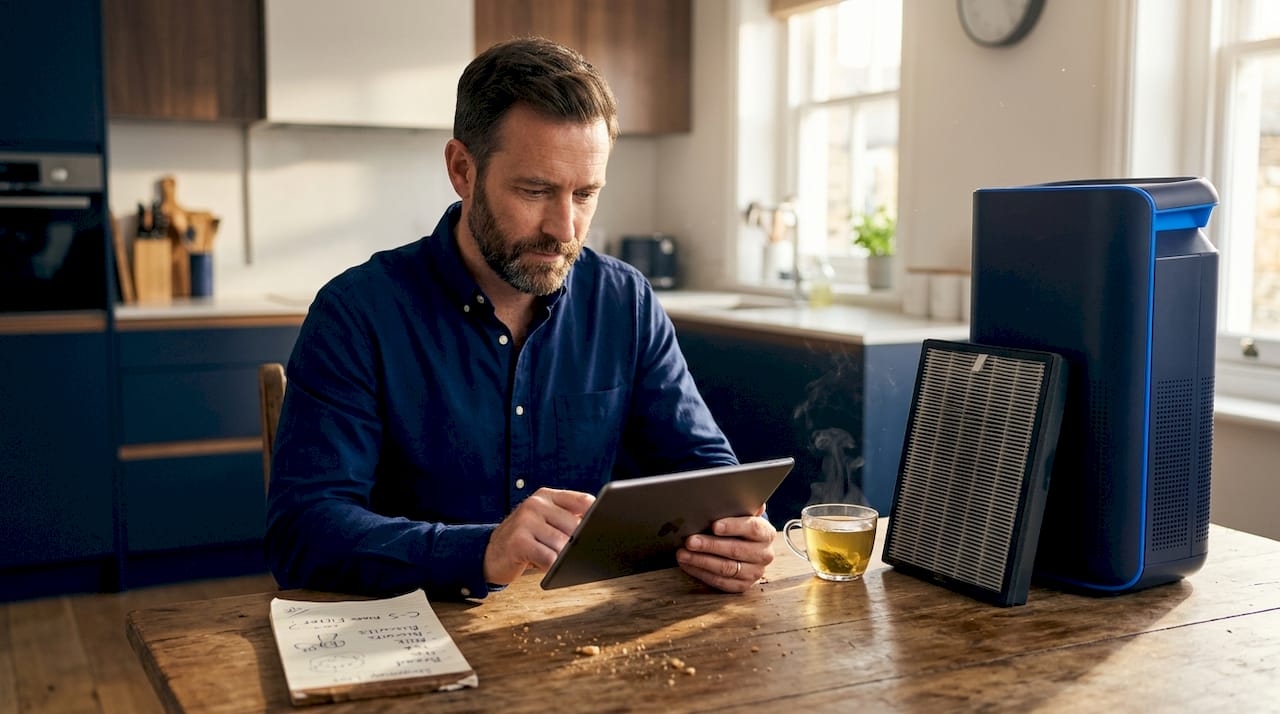
Pre-filters play an important role in protecting your HEPA layer. They capture larger particles, including dust, hair, and visible debris, before those particles ever reach the main filter. Cleaning your pre-filter can meaningfully extend HEPA filter life, and in homes with pets, regular pre-filter maintenance can effectively double how long the primary filter lasts. Check it every two to four weeks and rinse or vacuum it according to the manufacturer’s instructions.
Reviewing HEPA filter ratings for your specific device will also tell you whether your filter is rated for your room’s air quality demands.
The real cost of skipping filter replacement
Postponing filter replacement feels like a saving. It is not. The costs show up in three places: your health, your electricity bill, and your device.
-
Declining air quality. A saturated HEPA filter cannot maintain its rated capture efficiency. The purifier continues running, giving you the illusion of clean air, while actually delivering significantly less protection. For allergy and asthma sufferers, this is not a minor inconvenience. Worsening symptoms with no obvious cause are often traced back to a filter that has passed its useful life.
-
Higher electricity bills. Increased airflow resistance forces the motor to draw more current to maintain the same fan speed. Over weeks and months, this adds measurable cost to your electricity consumption. A device that runs continuously with a clogged filter may consume 20 to 30% more power than the same device with a fresh filter.
-
Shortened device lifespan. The motor strain caused by blocked filters is cumulative. Ignoring pressure drop metrics and long-term motor stress can reduce your air purifier’s lifespan significantly and potentially lead to costly repairs. An air purifier that should last seven to ten years may fail in four or five if filters are consistently replaced late.
The straightforward calculation: a replacement filter costs a fraction of a new device. Replacing filters on schedule is one of the lowest-cost maintenance decisions you can make for a high-use home appliance.
Signs your HEPA filter needs replacing
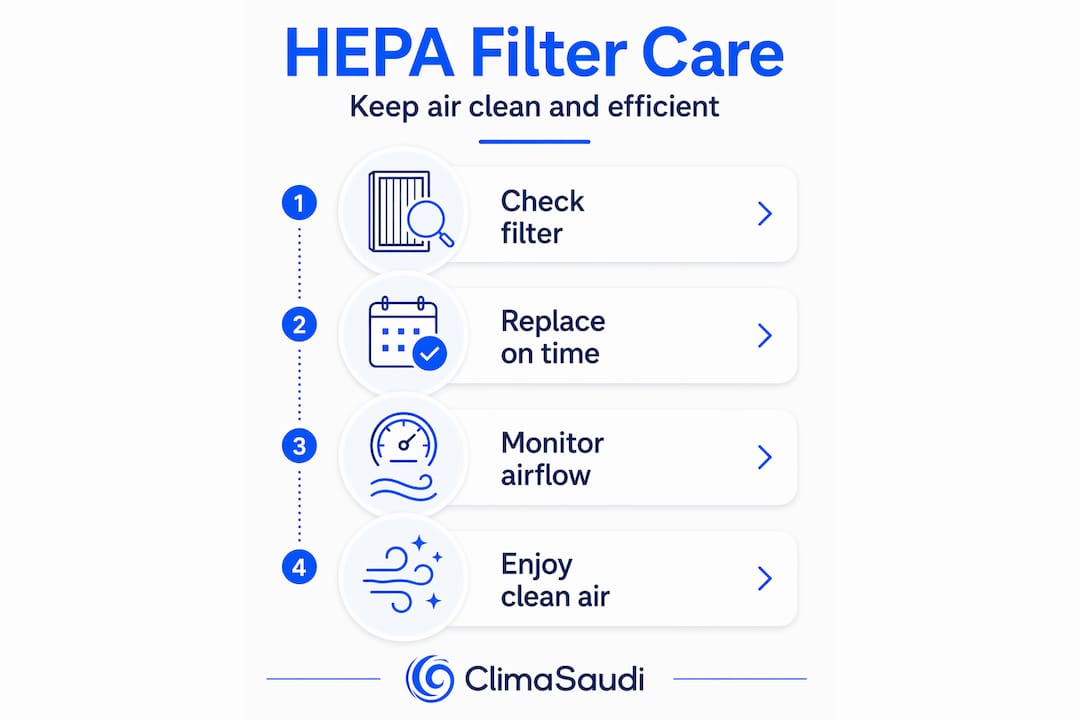
HEPA filter degradation is gradual and invisible, unlike a carbon filter, whose exhaustion announces itself through returning odours. This makes active monitoring more important, not less. Here are the practical cues to watch for:
- Visible discolouration. A new HEPA filter is white or off-white. A grey or dark filter has accumulated significant particulate load. If it looks visibly dirty, it almost certainly is.
- Reduced airflow. Hold your hand near the air outlet. If airflow feels weaker than it did when the purifier was new, the filter is likely restricting output.
- Increased operating noise. The motor compensating for a clogged filter often runs louder. If your device sounds strained or higher-pitched than usual, check the filter.
- Rising allergy or asthma symptoms. If your symptoms worsen despite the purifier running normally, the filter may no longer be capturing particles effectively.
- Filter indicator lights. Many modern purifiers include filter-life monitors. Systems that alert users with indicator lights when a filter needs replacing are more reliable than purely calendar-based reminders, because they measure actual usage and airflow conditions.
Pro Tip: Do not rely solely on a manufacturer’s timer or the indicator light in isolation. Combine the device’s alert with a quick visual inspection. In dusty environments like those common across Saudi Arabia, filters can reach end-of-life well before any automated alert triggers.
For a thorough walkthrough of ongoing care, the guidance on maintaining HEPA filters at home is worth bookmarking.
Replacement timing by household type
Your home environment shapes your replacement schedule more than any single factor. Intervals can range from two to sixteen months depending on the combination of occupants, habits, and outdoor air quality.
| Household type | Typical replacement interval | Key contributing factors |
|---|---|---|
| Single occupant, no pets, low pollution | 10 to 12 months | Minimal particulate load, lower runtime |
| Family home, no pets, urban setting | 8 to 10 months | Higher dust accumulation, longer daily runtime |
| Family home with one or more pets | 5 to 7 months | Dander and hair accelerate filter loading |
| Home with a smoker | 2 to 4 months | Fine smoke particles saturate fibres rapidly |
| High pollution or frequent sandstorms | 3 to 6 months | External PM2.5 and dust significantly increase load |
| 24/7 operation at high fan speed | Reduce interval by 30 to 40% | Continuous airflow accelerates filter saturation |
Washable pre-filters are worth investing in if you fall into the high-load categories. Unlike disposable HEPA filters, pre-filters can be cleaned repeatedly. This does add a small maintenance task every few weeks, but the saving on HEPA replacement frequency is real. The HEPA layer itself should never be washed. Washing a HEPA filter damages the fibres and destroys its filtration rating. Always replace rather than wash the main HEPA element.
My honest take on HEPA filter maintenance
I have seen a consistent pattern when homeowners talk about their air purifiers. They buy a good device, set it up, and then essentially forget about it. The purifier keeps running and they assume everything is fine. The manufacturer’s timer goes off eventually, but many people dismiss it, thinking “it still looks okay.”
In my experience, the timer is a starting point, not the final word. What I have found actually works is treating the timer as a prompt to inspect the filter rather than as a definitive instruction. Context matters. If you have been running your purifier through two months of Riyadh dust season with the windows cracked, a six-month timer reading is already unreliable.
The piece of advice I think is genuinely underappreciated is the pre-filter. Most people barely think about it. But combining pre-filter cleaning with filter-life monitors is the most practical approach to stretching your HEPA investment without compromising air quality. A clean pre-filter once a month costs you nothing except a few minutes.
The cost-versus-health trade-off also deserves a more honest conversation. A replacement filter might cost 100 to 250 SAR. A worsened allergy season, missed work days, or a broken air purifier motor will cost considerably more. Skipping replacement to save money rarely saves money over any meaningful timeframe.
— Pauline
Keep your air clean with Climasaudi
If you are ready to take your indoor air quality seriously, Climasaudi makes it straightforward. Whether you live in a compact Jeddah apartment or a spacious villa in Riyadh, Climasaudi’s range of certified HEPA H13 air purifiers and genuine replacement filters is stocked locally and available with next-day delivery.
You do not need to guess which filter fits your device. Climasaudi’s team offers direct support to help you match the right replacement filter to your existing purifier, so you are never left wondering whether you have ordered the correct part. From popular models like the Blueair ComfortPure T20i to affordable replacement filter options, everything is priced transparently in SAR with local customer support behind it. Browse the full range at Climasaudi and get your replacement filter before you need it, not after.
FAQ
How often should you replace a HEPA filter at home?
Most residential HEPA filters need replacing every 6 to 12 months. Homes with pets, smokers, or high dust levels may need replacement every 3 to 6 months to maintain effective air purification.
What happens if you do not replace your HEPA filter?
A clogged HEPA filter delivers less clean air, increases your electricity consumption, and puts strain on the purifier’s motor. Over time, this can lead to device failure and worsening indoor air quality.
What are the signs a HEPA filter needs replacing?
Look for visible grey or dark discolouration on the filter, reduced airflow from the device’s outlet, increased operating noise, and worsening allergy or respiratory symptoms despite the purifier running.
Can you wash a HEPA filter to extend its life?
No. Washing a HEPA filter damages its fibres and destroys its filtration rating. Only pre-filters are designed to be cleaned and reused. The HEPA element itself should always be replaced, not washed.
Does running an air purifier 24 hours a day affect how often you replace the filter?
Yes. Continuous high-speed operation loads the filter faster than intermittent use. If you run your purifier around the clock, reduce your replacement interval by approximately 30 to 40% compared to standard guidelines.