Damp walls, condensation on windows, that persistent musty smell in the bathroom — excess indoor humidity causes real problems. If you have been wondering how dehumidifier works home, you are in the right place. A dehumidifier, more formally described as a humidity control appliance, does not cool your room the way an air conditioner does. It removes water vapour from the air. Understanding this distinction changes how you choose, position, and use one. This article walks you through the science, the types available, the health benefits, and how to decide which system suits your home.
Table of Contents
- Key takeaways
- How dehumidifiers remove moisture from home air
- Types of home dehumidifiers
- Humidity targets and health benefits
- Whole-home vs portable units
- My honest take on dehumidifier use
- Ready to manage your home’s humidity?
- FAQ
Key takeaways
| Point | Details |
|---|---|
| Core process | A dehumidifier pulls in humid air, condenses moisture over cold coils, and returns drier air to the room. |
| Two main types | Refrigerant units suit warm, humid conditions; desiccant units perform better in cooler environments. |
| Healthy humidity range | The EPA recommends keeping indoor relative humidity between 30% and 50% to prevent mould and allergens. |
| Whole-home vs portable | Whole-home units connect to your HVAC for continuous control; portable units treat individual rooms on demand. |
| Maintenance matters | Regular cleaning of filters and the collection tank keeps your unit working at full efficiency. |
How dehumidifiers remove moisture from home air
The technical term for what most household dehumidifiers do is refrigerant dehumidification, which is part of the broader home dehumidification process. It works by exploiting a simple principle: cool air cannot hold as much water vapour as warm air. When you force warm, humid air past a cold surface, moisture drops out.
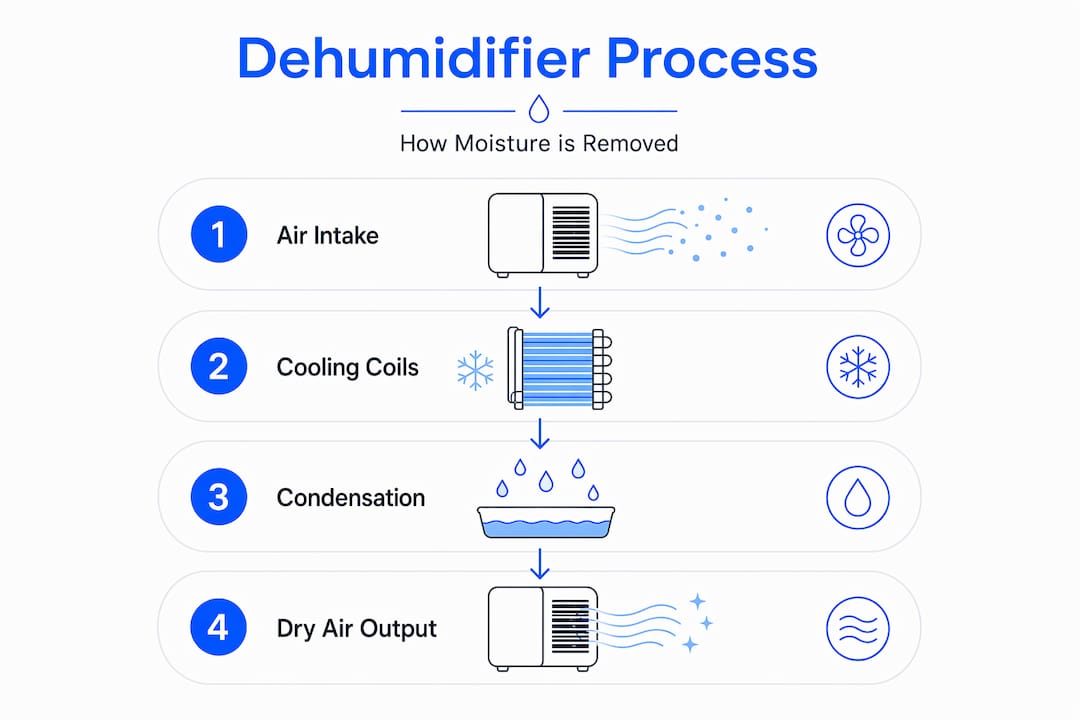
Here is the process, step by step:
- The fan draws humid air in. A built-in fan pulls room air through the front or side of the unit and directs it towards the internal coils.
- Air passes over cold evaporator coils. These coils are chilled by a refrigerant, much like the back of your fridge. The air temperature drops sharply as it moves across them.
- Water vapour condenses into liquid. Once the air cools below its dew point, moisture condenses into liquid droplets collected in a tank or sent down a drain hose.
- Air is reheated before it returns to the room. A second set of coils warms the now-dry air back up to near room temperature, so the space does not feel cold.
- The humidistat reads the air. A built-in sensor measures relative humidity continuously. The unit cycles on and off automatically once your target humidity level is reached.
One detail many homeowners miss is the dew point. Professional HVAC engineers focus on dew point rather than just relative humidity when assessing where condensation will form. When a dehumidifier lowers the moisture content of your air, it lowers the dew point too. That means cold surfaces like windows and pipes are less likely to attract condensation, even if the room temperature has not changed at all.
Temperature affects efficiency significantly. Refrigerant dehumidifiers work best when the room is above roughly 15°C. Below that, the evaporator coils can ice over, reducing water extraction. If your home runs cool, especially in winter or in an air-conditioned room, keep this in mind.
Pro Tip: Set your humidistat to a fixed target, around 50% relative humidity, rather than running the unit on a timer. The unit stops automatically when the target is met, which saves energy and avoids over-drying the air.
Types of home dehumidifiers
Understanding dehumidifiers in homes means knowing that not all units work the same way. The two main categories operate on entirely different principles, and the distinction matters for Saudi homes in particular, where coastal cities like Jeddah experience persistent humidity and air-conditioned interiors can run surprisingly cool.
Refrigerant and desiccant units represent the two main types. Here is how they compare:
| Feature | Refrigerant unit | Desiccant unit |
|---|---|---|
| Technology | Cooling coils and refrigerant | Moisture-absorbing rotating material |
| Best climate | Warm and humid (above 15°C) | Cool or cold environments |
| Energy use | Lower in warm conditions | Higher energy draw, warms the room slightly |
| Water extraction rate | High in warm, humid air | More consistent across temperatures |
| Noise level | Moderate (compressor runs) | Generally quieter |
| Typical use | Living rooms, kitchens, basements | Garages, loft spaces, cooler climates |
Refrigerant units are the most common choice for home use in warm climates. They extract large volumes of water quickly and run efficiently when the air is warm and genuinely humid. The coils can freeze in cold conditions, which reduces performance and can damage the unit over time.
Desiccant units use a hygroscopic material, typically a silica-based rotating wheel, that absorbs water vapour directly from the air. A heating element then dries the wheel, releasing the moisture as condensate into a collection tank. Because no refrigerant cooling is involved, performance does not drop in lower temperatures.
One practical note: desiccant units emit slightly warm, dry air back into the room. In a cold space this is a genuine bonus. In an already warm room it can feel uncomfortable.
Pro Tip: For homes in Riyadh or Dammam, where indoor temperatures stay high year-round, a refrigerant dehumidifier will deliver better extraction rates and lower running costs than a desiccant model.
Humidity targets and health benefits
One of the most important benefits of using a dehumidifier is not just comfort. It is health protection. Mould, dust mites, and airborne allergens all thrive in humid conditions. Controlling moisture levels addresses these problems at the source.
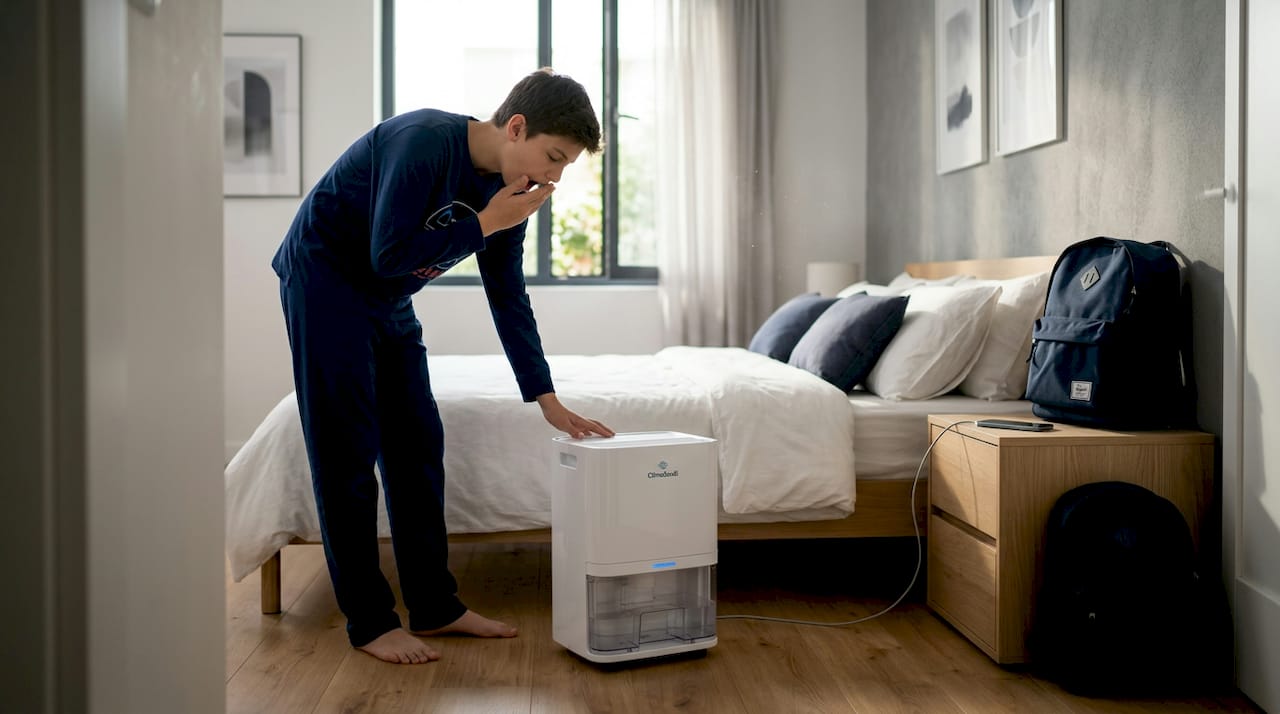
The EPA recommends keeping humidity below 60% and ideally between 30% and 50% relative humidity to reduce mould risk and allergen load. Most home dehumidifiers allow you to set a precise target through the built-in humidistat.
Here is what consistent humidity control does for your home:
- Reduces mould growth. Mould spores need moisture to develop. Keeping humidity below 50% removes that condition reliably.
- Lowers dust mite populations. Dust mites cannot survive well when relative humidity stays below 50%. For asthma and allergy sufferers, this is significant.
- Protects your home structure. Persistent excess moisture warps wooden floors, damages plaster, and causes corrosion in metal fixtures over time.
- Improves how air feels. Humid air feels warmer and heavier than dry air at the same temperature. Lower humidity makes rooms feel cooler and more comfortable without adjusting the thermostat.
- Supports better sleep. Drier air reduces the likelihood of waking with a stuffy nose or throat irritation, common side effects of sleeping in a humid room.
A dehumidifier improves indoor air quality by reducing the moisture load in the air, rather than filtering particles directly. For particle removal you still need a dedicated air purifier. The two devices complement each other rather than compete.
“A dehumidifier does more than reduce stickiness. It prevents mould by consistently removing the excess moisture that allows it to grow.”
For homes in Jeddah and along the Saudi coast, where outdoor humidity regularly exceeds 80% during summer months, a dehumidifier is not a luxury. It is practical protection for your family and your property. You can find more targeted advice for bedrooms and sleeping spaces in this bedroom air quality guide from Climasaudi.
Whole-home vs portable units
How a dehumidifier works can differ significantly depending on whether you choose a portable unit for a single room or a whole-home system connected to your central HVAC.
Portable dehumidifiers are standalone units that treat one room at a time. They are straightforward to set up and move around as needed. Key features include:
- Easy to position in any room without installation
- Water collects in a removable tank that needs regular emptying, or can connect to a continuous drain hose
- Best suited for apartments, single-problem areas like bathrooms or laundry rooms, or renters who cannot modify the building
- Lower upfront cost, though running multiple units across several rooms adds up
Whole-home dehumidifiers connect directly to your home’s ductwork and work in parallel with your air conditioning system. Whole-home units use the same refrigeration cycle for moisture removal but operate continuously across all rooms, with condensate drained away automatically. There is no tank to empty.
The trade-off is installation complexity and cost. Undersized or oversized whole-home units cause operational problems, so correct sizing and professional HVAC installation are genuinely necessary, not optional extras. If you are unsure about HVAC integration, the guides at LC Heating & Air cover the process in useful detail.
For homeowners in a large villa in Riyadh with persistent humidity across multiple rooms, a whole-home system offers the most consistent control. For renters or those with a single damp room, a quality portable unit is the practical choice.
My honest take on dehumidifier use
I have spent years reading about and working with indoor air quality products, and the most common mistake I see is running a dehumidifier on a fixed timer rather than a humidity target. People run the unit for two hours in the morning and assume the job is done. It is not. Humidity fluctuates with cooking, showering, and even breathing. A set target of 50% and a working humidistat does the job properly.
The second thing I would challenge is the belief that a dehumidifier makes a room cold. It does not lower temperature. What it does is lower the dew point, which means cold surfaces like windows stop collecting condensation. That is not cooling. That is moisture being removed from the air before it can settle somewhere it causes damage.
My practical advice: check and clean the collection tank weekly, wipe down the air intake grille monthly, and replace or rinse filters as the manufacturer recommends. A dirty filter reduces airflow and forces the unit to work harder for less result. The HEPA filter maintenance guide from Climasaudi is a good reference point for building that habit, even if your dehumidifier uses a simpler filter type.
Finally, do not ignore climate when choosing your unit. In Saudi Arabia, the combination of high temperatures and high coastal humidity strongly favours refrigerant models. In a heavily air-conditioned villa where indoor temperatures drop low, a desiccant unit might actually serve you better. The choice is not about brand or price alone. It is about matching the technology to the conditions you actually live in.
— Pauline
Ready to manage your home’s humidity?
If this article has clarified how the home dehumidification process works and why the right unit matters, the next step is straightforward. Climasaudi carries a curated range of home dehumidifiers suited to the Saudi climate, with transparent SAR pricing and next-day delivery across Riyadh, Jeddah, and Dammam.
Whether you are dealing with a damp bathroom, a humid bedroom, or a coastal home that struggles year-round, Climasaudi has a unit matched to your room size and humidity challenge. You can also explore air purifiers and humidifiers to build a complete indoor air quality setup. For any questions about which unit suits your home, the local customer support team is available and ready to help.
FAQ
How does a dehumidifier remove moisture from the air?
A dehumidifier pulls humid air over cold evaporator coils, causing water vapour to condense into liquid. The dry air is then reheated and returned to the room, while the collected water drains into a tank or hose.
Do dehumidifiers really work for mould prevention?
Yes. By keeping relative humidity consistently below 50%, dehumidifiers remove the moisture mould needs to grow. The EPA recommends maintaining indoor humidity between 30% and 50% specifically to reduce mould and allergen risk.
What is the difference between a refrigerant and a desiccant dehumidifier?
Refrigerant units cool air over coils to condense moisture and work best in warm conditions. Desiccant units absorb moisture using a hygroscopic material and perform more consistently in cooler environments.
How do I choose the right dehumidifier for my home?
Consider your room temperature, the severity of humidity, and whether you need a portable or whole-home solution. In warm climates like most of Saudi Arabia, a refrigerant model with a built-in humidistat is the most practical and energy-efficient choice.
Can I run a dehumidifier alongside an air purifier?
Yes, and it is recommended. A dehumidifier lowers moisture load while an air purifier removes airborne particles like dust and allergens. The two devices address different aspects of indoor air quality and work well together.
Recommended
- Buy Dehumidifiers in Riyadh Saudi Arabia | Best Price SAR – ClimaSaudi
- Buy Blueair 2-in-1 Purify + Humidify DH3i in Saudi Arabia | Best Price SAR 1,190 | ClimaSaudi
- Buy Dyson Purifier Humidify+Cool PH2 De-NOx in Saudi Arabia | Best Price SAR 2,214 | ClimaSaudi
- Buy Blueair InvisibleMist Humidifier H35i in Saudi Arabia | Best Price SAR 446 | ClimaSaudi