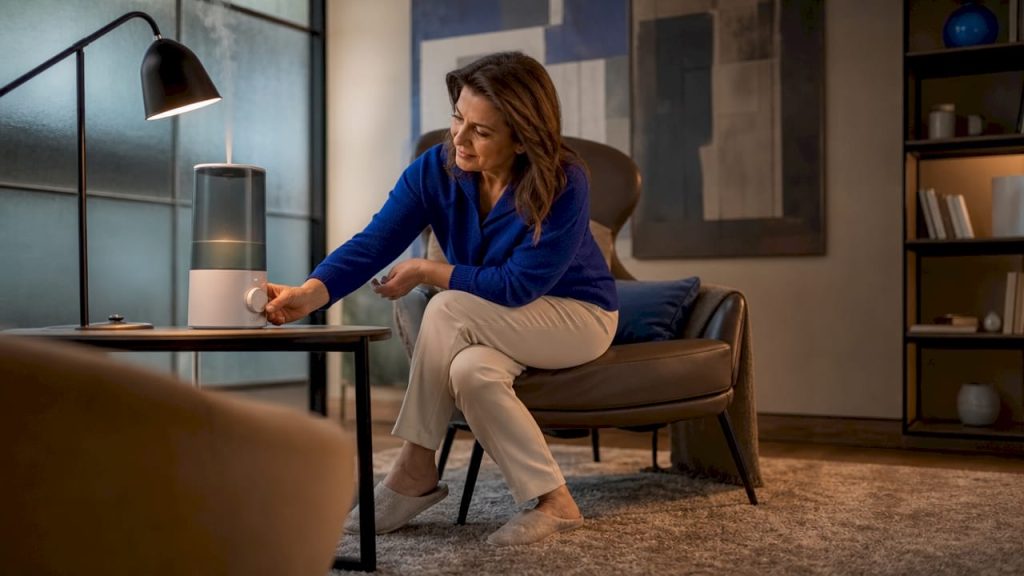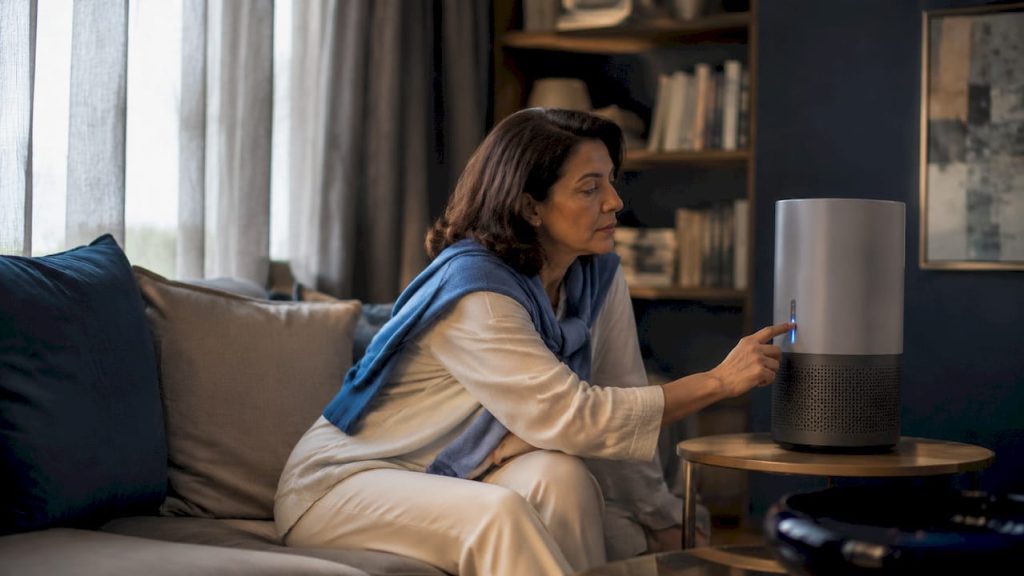
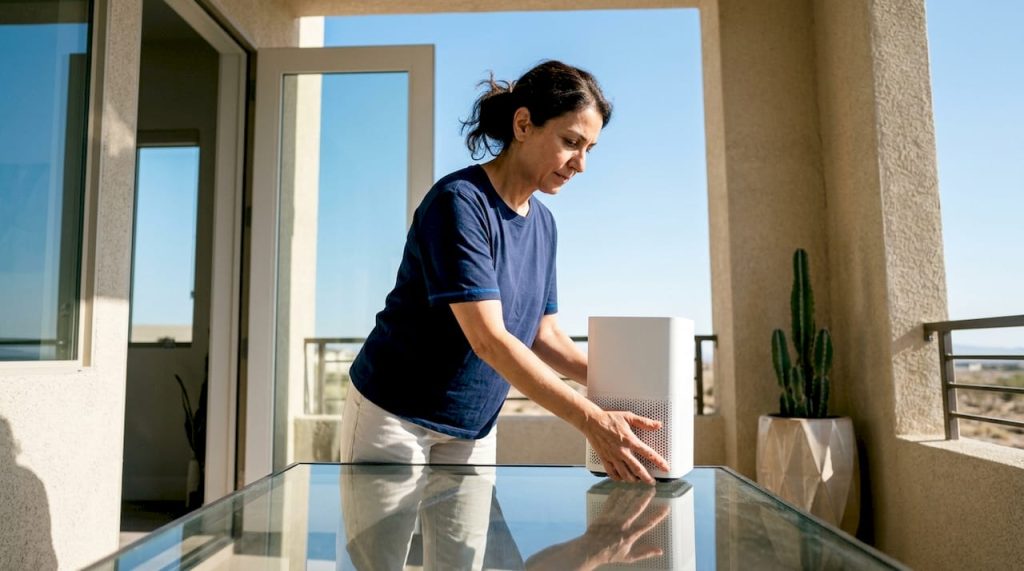
Desert cities face an indoor air quality crisis that most residents never see coming. Fine mineral dust, silica particles, and volatile organic compounds (VOCs) infiltrate homes daily, creating conditions that standard ventilation simply cannot address. This is why desert cities need air purifiers: not as a luxury, but as a practical health tool. HEPA H13 filtration captures 99.97% of particles at 0.3 microns, the size range where desert dust does the most damage. Residents of Riyadh, Jeddah, and Dammam face some of the highest particulate loads of any urban environment in the world.
Why desert cities need air purifiers more than most
Desert air is not simply dry and dusty. It carries a specific mix of fine mineral particles, including caliche and silica dust, that fall into the PM2.5 and PM10 size categories. PM2.5 particles are small enough to bypass the nose and throat entirely, reaching deep into the lungs. Standard HVAC filters are not built to trap particles this fine, which means your air conditioning system circulates the problem rather than solving it.
The physics of desert homes make this worse. High-velocity desert winds create a Venturi effect, pulling fine dust through window frames, door seals, and wall gaps under pressure. Once inside, low humidity keeps those particles suspended in the breathing zone for hours rather than letting them settle. That means every breath you take in a closed room carries a measurable particulate load, even with windows shut.
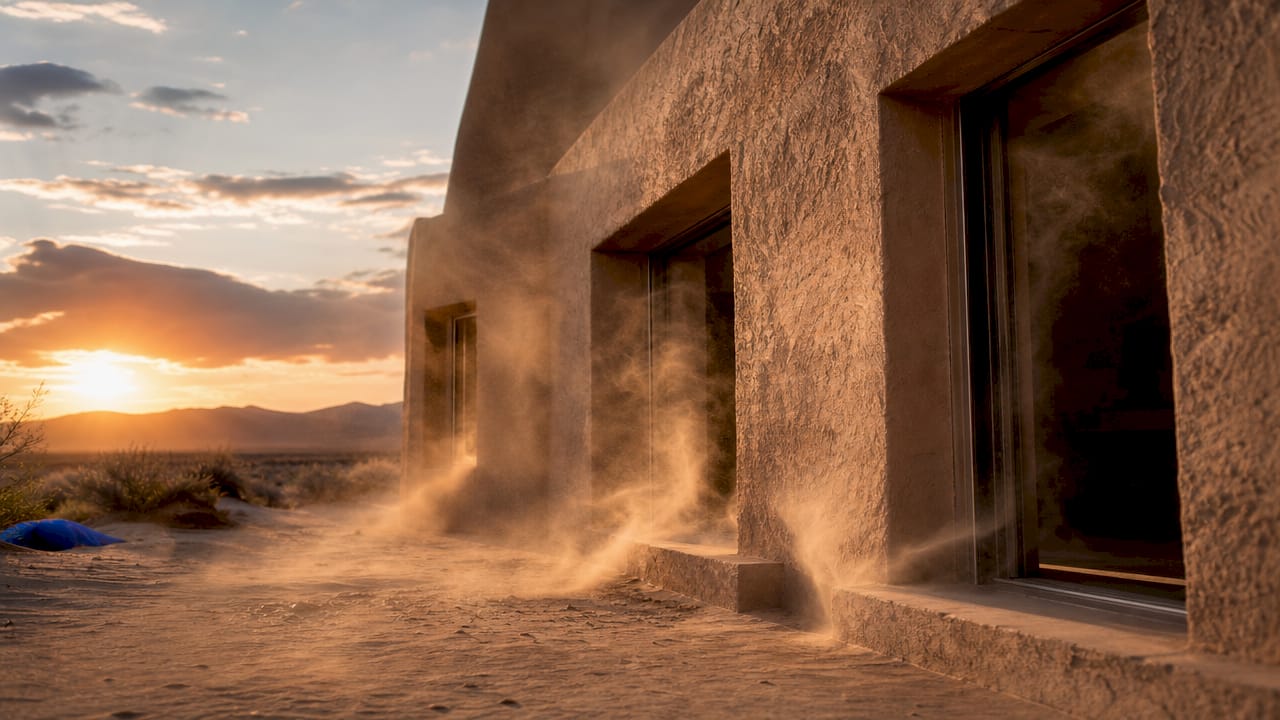
The composition of desert dust adds another layer of concern. Beyond mineral particles, desert air carries biological allergens such as pollen, fungal spores, and dust mite debris. Construction activity in fast-growing cities like Riyadh generates additional silica and concrete dust. VOCs, mould, and desert allergens compound the problem, making carbon filtration and microbial controls just as important as particle removal.
Pro Tip: Seal window and door frames with weatherstripping before relying on an air purifier. Reducing dust infiltration at the source means your purifier works less hard and lasts longer.
- PM2.5 and PM10 particles from mineral dust penetrate deep into lung tissue and are not stopped by standard HVAC filters.
- The Venturi effect forces pressurised air through tiny gaps, raising indoor particle concentrations even in sealed homes.
- Low humidity keeps particles airborne for hours, extending your exposure window significantly.
- VOCs and xerophilic mould add chemical and biological threats beyond visible dust.
- Construction dust in growing Saudi cities adds silica and concrete particulates to the baseline desert load.
How do air purifiers improve health in desert environments?
The health case for air purifiers in desert cities is well supported. HEPA air purifiers reduce indoor PM2.5 levels by 25% to 56% in residential settings, with documented improvements in allergy and asthma symptoms. That reduction is not trivial. For residents with chronic respiratory conditions, it represents a meaningful change in daily quality of life.
The benefits extend beyond the lungs. Research shows that consistent HEPA filtration improves cognitive performance in adults over 40 by 12% on mental flexibility tests. Cleaner air reduces the neurological burden of chronic low-level particulate exposure, which accumulates over years of desert living. This is particularly relevant for residents who work from home in cities like Riyadh, where outdoor air quality regularly exceeds WHO guidelines.
“HEPA air purifiers measurably reduce airborne allergens, pollutants, and dust particles. Research shows symptom reductions of 25–60%, with major EPA and allergy associations recommending their use for residents in high-pollution environments.”
VOCs present a separate but equally serious risk. Desert homes trap VOCs from cleaning products, furniture off-gassing, and vehicle exhaust that seeps indoors. Activated carbon filtration, used alongside HEPA, adsorbs these chemical compounds before they accumulate to harmful concentrations. Without a carbon stage, a HEPA-only purifier leaves VOCs entirely unaddressed.
| Health concern | Relevant pollutant | Filtration solution |
|---|---|---|
| Respiratory irritation | PM2.5, PM10 mineral dust | HEPA H13 filter |
| Allergy and asthma symptoms | Pollen, dust mite debris, fungal spores | HEPA H13 filter |
| Chemical sensitivity and headaches | VOCs from furniture and cleaning products | Activated carbon stage |
| Microbial exposure | Xerophilic mould spores | HEPA H13 plus humidity control |
| Cognitive fatigue | Chronic low-level particulate exposure | Consistent HEPA filtration |
How to choose the right air purifier for a desert home
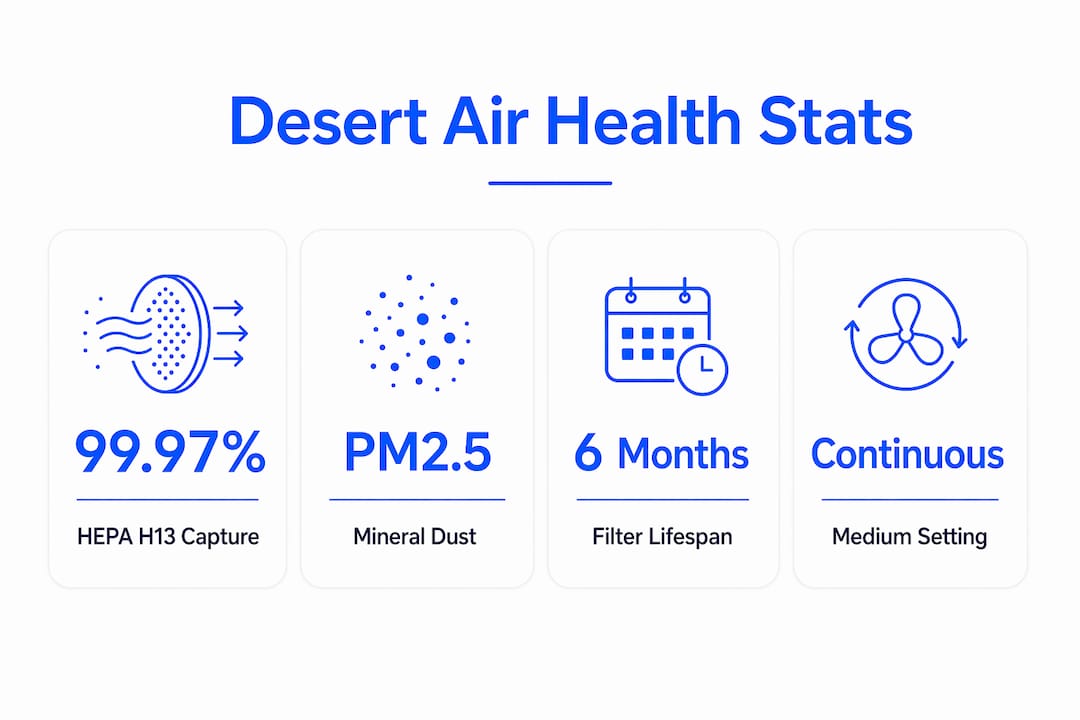
Choosing the right purifier starts with understanding HEPA H13 certification. A HEPA H13 filter captures 99.97% of particles at 0.3 microns, the most penetrating particle size. This is the minimum standard for desert environments. Filters rated below H13 allow a significant fraction of the most harmful particles to pass through.
Clean Air Delivery Rate (CADR) determines whether a purifier is actually sized for your room. A unit with a low CADR placed in a large living room will cycle air too slowly to keep pace with desert dust infiltration. Match the CADR rating to your room’s square footage, then add a margin for high-dust periods such as sandstorms. For large villas or open-plan spaces, air purifiers for large rooms with higher CADR ratings are the correct starting point.
Portable HEPA units alone are not sufficient for whole-house dust management. A layered filtration system integrating a whole-home MERV 16 media air cleaner with portable HEPA units for individual rooms is the recommended approach. The whole-home unit handles the bulk dust load; the portable units provide fine-particle polishing in the spaces where you spend the most time.
- Confirm HEPA H13 certification. Check the filter grade before purchasing. H13 is the minimum for desert dust.
- Calculate CADR for your room size. Undersized units fail to reduce particulate loads during high-dust periods.
- Add an activated carbon stage. Carbon adsorbs VOCs and odours that HEPA alone cannot capture.
- Consider a layered approach. Pair a whole-home MERV 16 cleaner with portable HEPA units for complete coverage.
- Place units correctly. Position purifiers away from walls and in the centre of the room for maximum air circulation.
Pro Tip: Run your air purifier on a medium setting continuously rather than on high for short bursts. Continuous lower-speed operation removes more particles over time and extends filter life.
What else can you do to improve indoor air quality?
Air purifiers deliver the most benefit when they are part of a broader indoor air quality strategy. Source control is the first step. Sealing gaps around windows, doors, and cable entry points reduces the volume of dust entering the home, which directly reduces the workload on your purifier and extends filter life.
Ventilation is the second pillar. Energy recovery ventilators (ERVs) bring filtered fresh air into the home while recovering thermal energy, avoiding the need to open windows during dusty or hot periods. ERVs are particularly effective in Saudi climates where outdoor temperatures make natural ventilation impractical for much of the year.
Cleaning practices matter more than most residents realise. Settled dust on surfaces becomes airborne again with foot traffic and air movement. Regular damp wiping of surfaces, vacuuming with a HEPA-filtered vacuum, and washing soft furnishings reduces the reservoir of particles available to re-enter the air. Xerophilic mould grows in HVAC systems and dust accumulation spots where hidden condensation occurs, so cleaning must include air handling units and filter housings.
- Seal the building envelope using weatherstripping and foam sealant around frames and penetrations.
- Install a MERV 16 whole-home filter in your HVAC system to capture bulk particulates before they circulate.
- Use an ERV to supply filtered fresh air without opening windows to desert dust.
- Monitor PM2.5 and CO2 levels with a low-cost indoor air quality sensor to identify problem periods.
- Control humidity between 40% and 60% to prevent xerophilic mould growth in dry desert conditions.
- Clean HVAC components including coils, drain pans, and filter housings at least twice a year.
Key takeaways
Desert city residents need HEPA H13 air purifiers because standard HVAC filters cannot trap PM2.5 mineral dust, and low humidity keeps particles airborne for hours, creating chronic respiratory and cognitive health risks.
| Point | Details |
|---|---|
| Desert dust is uniquely harmful | PM2.5 and PM10 mineral particles bypass standard filters and reach deep into the lungs. |
| HEPA H13 is the minimum standard | Only H13-rated filters capture 99.97% of 0.3-micron particles, the most penetrating size. |
| Layered filtration outperforms single units | Pairing a whole-home MERV 16 cleaner with portable HEPA units handles both bulk dust and fine particles. |
| Carbon filtration addresses VOCs | An activated carbon stage is required to remove chemical pollutants that HEPA alone cannot capture. |
| Source control multiplies purifier effectiveness | Sealing gaps and using ERVs reduces dust infiltration, extending filter life and improving outcomes. |
What I have learned from years of watching desert homes get this wrong
Most residents buy an air purifier and place it in a corner, run it on the highest setting for a week, and then wonder why their dust problem persists. The unit is doing its job. The problem is everything else in the room is undoing it.
The single biggest mistake I see is treating an air purifier as a standalone solution. A well-specified HEPA H13 unit in a room with unsealed window frames and no HVAC filter upgrade is fighting a losing battle. The layered filtration approach is not a premium option for large villas. It is the baseline for any desert home that takes indoor air seriously.
The second mistake is ignoring VOCs entirely. Residents focus on visible dust and overlook the chemical load building up from furniture, paint, and cleaning products. A purifier without an activated carbon stage leaves that problem completely untouched. In a sealed, air-conditioned home in Riyadh or Dammam, VOC concentrations can reach levels that cause headaches and fatigue long before anyone connects them to air quality.
The third point is one the industry rarely emphasises: filter maintenance is not optional. A clogged HEPA filter does not just lose efficiency. It can begin to release trapped particles back into the air under high-pressure conditions. Check your filter every three months in a desert environment. Replace it on schedule, not when it looks dirty.
— Pauline
Climasaudi’s range for desert city residents
Desert air quality demands products built for the conditions you actually live in, not generic units designed for temperate climates.
Climasaudi stocks a full range of HEPA H13 certified air purifiers sized for Saudi homes, from compact bedroom units to high-CADR models for large living spaces. Every product listed includes clear room-size guidance and filter specifications, so you can match the right unit to your space without guesswork. Climasaudi also carries humidifiers and dehumidifiers to support the humidity control that desert mould prevention requires. Products are held in local inventory with next-day delivery across Riyadh, Jeddah, and Dammam, and SAR pricing is listed transparently on every product page.
FAQ
What makes desert dust more dangerous than regular household dust?
Desert dust contains fine mineral particles such as silica and caliche in the PM2.5 size range, which penetrate deep into lung tissue. Standard household dust is typically coarser and less likely to reach the lower respiratory tract.
Do standard HVAC filters remove desert dust effectively?
Standard HVAC filters are not rated to capture PM2.5 particles. A MERV 16 whole-home media cleaner or a HEPA H13 portable unit is required to address fine desert particulates adequately.
How often should I replace my HEPA filter in a desert home?
In a desert environment, check your HEPA filter every three months and replace it at least twice a year. High dust loads clog filters faster than in temperate climates, reducing filtration efficiency significantly.
Can an air purifier help with allergies in Saudi cities?
Yes. HEPA air purifiers reduce airborne allergens including pollen, dust mite debris, and fungal spores, with documented symptom reductions of 25–60% among allergy and asthma sufferers.
Is one air purifier enough for a whole house?
A single portable unit is not sufficient for whole-house dust management in a desert home. A layered system combining a whole-home MERV 16 air cleaner with portable HEPA units in key rooms delivers the most effective coverage.