Choosing an air purifier in Saudi Arabia is not as simple as picking the most popular model online. In Riyadh, a sandstorm can push PM2.5 levels (fine airborne particles measuring 2.5 micrometres or smaller) to dangerous heights within hours. In Jeddah, coastal humidity encourages mould spores and dust mites year-round. In Dammam, sand intrusion combines with moderate humidity to create a mixed challenge that most generic purifiers are simply not built for. Airborne particles and humidity vary greatly across Saudi cities, and the purifier that works brilliantly in one home may underperform in another just 400 kilometres away. This guide helps you match the right features to your city’s specific air quality problems.
Table of Contents
- How city air challenges shape your purifier needs
- Essential features for desert dust, humidity, and allergens
- Top air purifiers for Saudi city challenges: Key options
- Feature comparison: Which purifier fits your city’s air?
- Getting the most from your purifier in Saudi homes
- Why city-specific thinking leads to better air, and what others miss
- Find the ideal air solution for your Saudi city and home
- Frequently asked questions
Key Takeaways
| Point | Details |
|---|---|
| Match purifier to city | Choose features that target your city’s main indoor air quality challenge, be it dust or humidity. |
| HEPA and humidity essential | Combine HEPA filtration with humidity control for the best results in Saudi homes. |
| Mind infiltration limits | Portable purifiers alone cannot overcome air leaks or insufficient whole-home filtration. |
| Choose proven models | Consider devices with local track records for dealing with Saudi city conditions. |
| Regular upkeep matters | Maintain filters and check seals for year-round clean and healthy air indoors. |
How city air challenges shape your purifier needs
Saudi Arabia’s three major residential cities each present a distinct indoor air quality profile. Understanding these differences is the first step towards making a genuinely useful purchase.
Riyadh sits in the heart of the Najd plateau, surrounded by open desert. Sandstorms, locally called haboobs, arrive with little warning and can reduce visibility to near zero. Indoors, fine dust infiltrates through door gaps, window seals, and ventilation systems. The city also experiences low relative humidity for most of the year, which dries out airways and makes fine particles easier to inhale deeply. The primary concern here is particulate matter, specifically PM2.5 and PM10 (coarser particles up to 10 micrometres).
Jeddah faces a very different set of problems. Positioned on the Red Sea coast, it carries high humidity throughout the year, often exceeding 70 to 80 percent indoors during summer months. This creates ideal conditions for mould growth, dust mite proliferation, and the spread of biological allergens. Dust still enters from the surrounding desert, but humidity management becomes equally important alongside filtration.
Dammam on the Eastern Province coast combines both worlds. Sand intrusion from the Arabian Gulf region is frequent, and moderate humidity adds biological allergen risk on top of the particulate load. Residents here often need a purifier that handles both dust and moisture without compromise.
- Riyadh: prioritise fine particle filtration and strong sealing
- Jeddah: balance filtration with humidity control or dehumidification
- Dammam: address both sand intrusion and moderate biological allergen risk
- All cities: consider seasonal shifts and adjust settings accordingly
Key insight: A purifier rated for large rooms in a clean European climate may struggle to maintain the same performance during a Saudi sandstorm, where particle concentrations can spike to ten times normal levels within minutes.
Now that you understand why city conditions matter, let us look at the specific features needed.
Essential features for desert dust, humidity, and allergens
Not every purifier is built for the Saudi environment. Here are the features that genuinely make a difference in local conditions.
HEPA H13 filtration is non-negotiable for dust-heavy cities. HEPA H13 (High Efficiency Particulate Air, grade 13) captures at least 99.95% of particles at 0.3 micrometres, which covers the most dangerous fine dust and allergen range. Standard HEPA filters rated H11 or H12 let more particles through, and that gap matters during a sandstorm.
Activated carbon filters sit alongside the HEPA layer in quality purifiers. They absorb volatile organic compounds (VOCs), cooking odours, and traffic-related pollutants that are common in dense urban areas like central Riyadh and Jeddah. Without a carbon layer, you remove particles but leave gaseous pollutants untouched.
Humidity management is critical for coastal cities. A purifier paired with a dehumidifier function, such as the Blueair DH3i, actively removes excess moisture while filtering air. In Riyadh’s dry months, a separate humidifier like the InvisibleMist H35i can restore healthy humidity levels and reduce the irritation caused by extremely dry air.
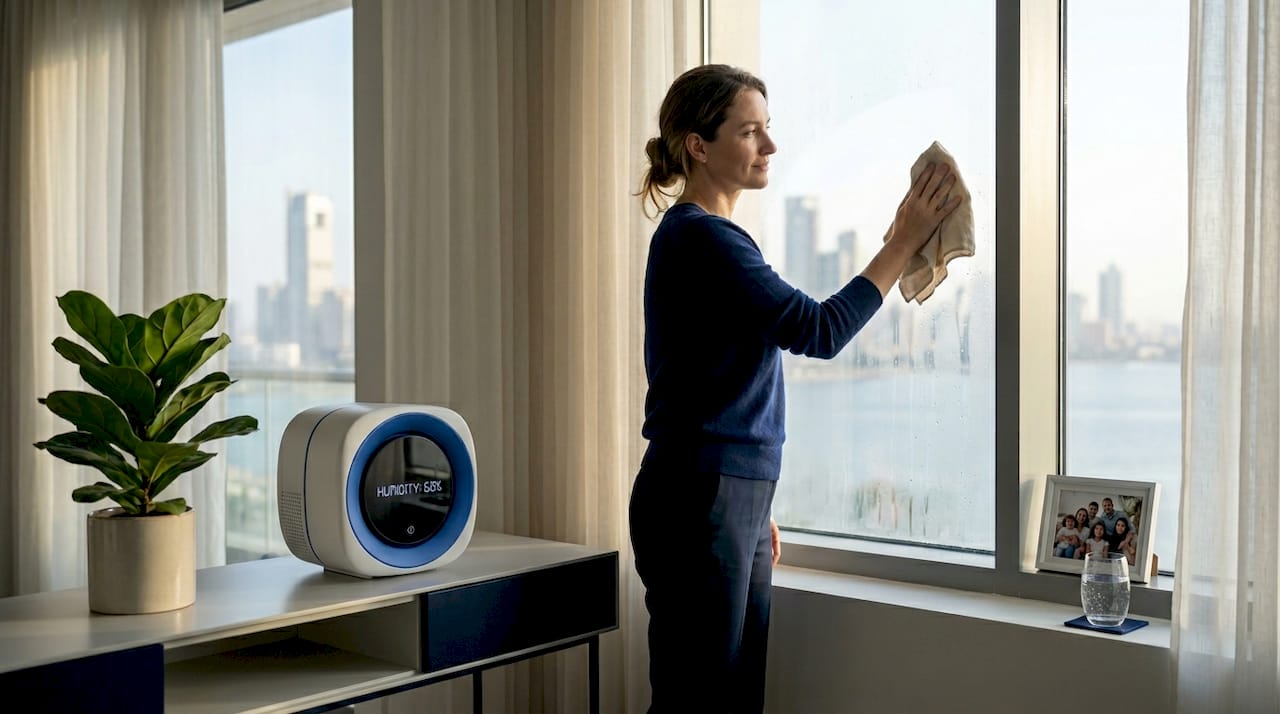
Smart sensors and auto mode allow the purifier to respond to real-time air quality changes. During a sandstorm, particle levels can jump sharply. A purifier with a built-in PM2.5 sensor will automatically increase fan speed to compensate, rather than running at a fixed level that was set on a calm day.
Seal quality and airflow design matter more than most people realise. A poorly sealed unit allows unfiltered air to bypass the filter entirely. Look for purifiers with a 360-degree intake or a well-sealed single-direction flow system that draws all room air through the filter media.
“Purifiers help reduce indoor particles, but infiltration from intake, open doors, and untreated ventilation means whole-home systems may be required for best results.”
Pro Tip: Run your purifier on its highest setting for 30 minutes after a sandstorm, then let it settle to auto mode. This clears the initial particle surge quickly and lets the sensor maintain air quality from there.
Top air purifiers for Saudi city challenges: Key options
Not all products suit every Saudi city, so matching a device to your main local challenge is essential. Here are standout options available for Saudi homes.
For Riyadh (dust-dominated):
The Blue Max 3450i is built for large rooms and delivers strong particle capture with HEPA filtration and a carbon layer. Its auto mode responds quickly to dust spikes, making it well-suited to Riyadh’s unpredictable sandstorm season. The unit covers up to 34 square metres effectively, which suits most villa living rooms and open-plan apartments.
The Blue 211i Max offers similar performance in a slightly more compact form. It handles rooms up to 21 square metres and is a practical choice for bedrooms or home offices where quiet operation matters as much as filtration power.
For Jeddah (humidity and allergens):
The ComfortPure T20i combines air purification with temperature and humidity sensing, making it a strong fit for Jeddah’s coastal conditions. Its 3-in-1 design reduces the need for separate devices and keeps your setup simple.
For Dammam (mixed dust and humidity):
The Blueair DH3i purify and humidify combination unit addresses both particulate filtration and moisture balance in a single device. For Dammam homes that face both sand and humidity, this type of integrated solution avoids the need to manage two separate appliances.
- Blue Max 3450i: best for large, dust-heavy rooms in Riyadh
- Blue 211i Max: ideal for bedrooms and smaller spaces
- ComfortPure T20i: strong choice for Jeddah’s mixed allergen and humidity load
- Blueair DH3i: practical for Dammam’s dual challenge
- InvisibleMist H35i: dedicated humidifier option for Riyadh’s dry season
With these devices in mind, compare their features directly to pinpoint the best match for your home.
Feature comparison: Which purifier fits your city’s air?
The table below summarises key specifications across five models, focused on the factors that matter most in Saudi homes.
| Model | Filter type | Dust rating | Humidity control | Room size | Smart sensor | Best for |
|---|---|---|---|---|---|---|
| Blue Max 3450i | HEPA + Carbon | Excellent | None | 34 m² | Yes | Riyadh, large rooms |
| Blue 211i Max | HEPA + Carbon | Excellent | None | 21 m² | Yes | Riyadh, bedrooms |
| ComfortPure T20i | HEPA + Carbon | Very good | Monitoring | 20 m² | Yes | Jeddah, mixed use |
| Blueair DH3i | HEPA + Humidify | Very good | Active humidify | 20 m² | Yes | Riyadh dry season, Dammam |
| InvisibleMist H35i | Ultrasonic | N/A | Active humidify | 20 m² | Basic | Riyadh winter dryness |
A few points worth noting from this comparison. First, none of these portable units include active dehumidification. If you live in Jeddah and indoor humidity regularly exceeds 65 percent, you will need a dedicated dehumidifier alongside your purifier. Second, room size ratings are based on standard air exchange calculations. During a sandstorm, effective coverage may be reduced by 20 to 30 percent as the filter works harder. Consider sizing up if you live in a particularly exposed location.
“Portable units filter room air, but don’t substitute whole-home solutions if infiltration is significant.”
Pro Tip: Before buying based on room size ratings alone, check the noise level comparison guide for each model. A purifier that runs loudly at high speed may force you to lower the fan setting at night, reducing its effectiveness precisely when bedroom air quality matters most.
Selecting based on this comparison, consider practical tips for getting the most from your purifier in your city’s unique conditions.
Getting the most from your purifier in Saudi homes
Buying the right purifier is only half the equation. How you use it determines whether you actually breathe cleaner air every day.
-
Seal your space before running the unit. Close windows and doors when the purifier is operating. Every gap is a route for unfiltered outdoor air to enter. In older Saudi villas with less airtight construction, use draught excluders on door gaps and check window seals annually.
-
Change filters on schedule, not just when the indicator lights up. In dusty Saudi conditions, filters load up faster than the manufacturer’s standard timeline assumes. Check your filter every three months during sandstorm season and replace it when you see visible grey or brown discolouration, even if the indicator has not triggered yet.
-
Pair with whole-home solutions for heavy dust or humidity. Clean air depends not only on the purifier but on managing infiltration via building envelope and HVAC strategies. If your building has a central air handling unit, ensure its filters are also maintained. A room purifier working against a dirty HVAC system is fighting an uphill battle.
-
Adjust settings seasonally. Riyadh’s sandstorm season runs roughly from March to May. During this period, increase your purifier’s scheduled run time and check filters more frequently. In Jeddah, summer humidity peaks between June and September, so this is when dehumidification support becomes most critical.
-
Position the unit correctly. Place your purifier in the room where you spend the most time, ideally in the centre of the space or near the main air circulation path. Avoid placing it in a corner where airflow is restricted, as this significantly reduces effective coverage.
For the Blueair DH3i, make sure the water tank is kept filled during dry months so the humidification function can operate continuously overnight, which is when Riyadh’s air is at its driest.
Even with best efforts, there are limitations. Here is our perspective on what really matters when choosing for your city.
Why city-specific thinking leads to better air, and what others miss
Most people approach air purifier shopping the same way they buy a kitchen appliance. They look at price, brand, and maybe room size. What they rarely consider is whether the device was designed with their city’s specific air profile in mind. This is where the majority of purchasing mistakes happen in Saudi Arabia.
A purifier that performs brilliantly in a temperate European flat is not automatically the right choice for a Jeddah apartment with 80 percent indoor humidity and a sea breeze carrying biological allergens through every window gap. Similarly, a humidity-focused device designed for coastal climates may not prioritise the particle filtration speed that Riyadh residents need during a sudden haboob.
The uncomfortable truth is that portable room purifiers, however good, are one layer of a larger system. Ultimate air quality control requires both targeted purifiers and effective building or HVAC-based filtration and humidity management. If your building’s ventilation system is pushing unfiltered desert air into your rooms, a single purifier will struggle to keep pace.
The best approach combines three things: a room purifier matched to your city’s primary challenge, a building envelope that minimises infiltration, and seasonal awareness that prompts you to adjust your strategy as conditions change. Homeowners who think in these three layers consistently report better results than those who rely on a purifier alone. City-specific thinking is not a marketing concept. It is the practical difference between clean air and a device that runs constantly without fully solving your problem.
Find the ideal air solution for your Saudi city and home
At ClimaSaudi, every product in our range is selected with Saudi city conditions in mind, from Riyadh’s dust-heavy winters to Jeddah’s humid summers. We stock air solutions for Saudi homes that cover the full spectrum of local air quality challenges, with transparent SAR pricing, local inventory, and next-day delivery across major cities.
Whether you need a powerful dust-fighting purifier like the Blue Max 3450i for a large Riyadh living room, or a complete humidity and filtration solution for a Jeddah villa, our team can help you match the right device to your space. Browse our full humidifier range and purifier catalogue, or use our Air Match tool to get a personalised recommendation based on your city, room size, and main air quality concern. Clean, comfortable air at home is achievable. The right product for your city makes all the difference.
Frequently asked questions
Which air purifier features are essential for Riyadh homes?
A HEPA filter for dust and a built-in PM2.5 sensor with auto mode are the top priorities for Riyadh, where sandstorm particle levels can spike rapidly and without warning.
Do I need a humidifier or dehumidifier in Jeddah?
Most Jeddah homes benefit from dehumidification support due to high year-round humidity, which encourages mould and dust mite growth that a standard purifier alone cannot address.
Can a portable air purifier replace whole-home systems?
Portable purifiers are effective for single rooms but cannot replace whole-home air handling solutions, particularly in homes with significant dust infiltration through ventilation or building gaps.
How often should I change air purifier filters in Saudi cities?
In dusty Saudi conditions, check your filter every three months and replace it as soon as visible discolouration appears, as frequent dust requires more regular changes than standard manufacturer timelines suggest.
What should I do if the air still feels dusty after using a purifier?
Inspect doors, windows, and ventilation points for infiltration gaps, and consider whether effective clean air requires additional building sealing or a whole-home filtration upgrade alongside your room purifier.
Recommended
- Air Purifiers, Humidifiers & HEPA Filters in Saudi Arabia | ClimaSaudi
- Buy Blueair ComfortPure 3-in-1 T20i Air Purifier in Saudi Arabia | Best Price SAR 1,503 | ClimaSaudi
- Buy Air Purifiers in Riyadh Saudi Arabia | Best Price SAR – ClimaSaudi
- Buy Blueair ComfortPure 3-in-1 T10i Air Purifier in Saudi Arabia | Best Price SAR 952 | ClimaSaudi