If you live in Riyadh, Jeddah, or Dammam, you already know that keeping indoor air clean is a daily challenge. Desert dust settles on every surface, humidity rises along the coast, and allergen particles circulate through your home long after windows are shut. Many homeowners assume that smaller particles simply slip through any filter, but that assumption is wrong. HEPA filters capture allergen particles through three primary mechanical mechanisms that target particles of all sizes, including the finest dust and pollen that trigger allergy symptoms.
Table of Contents
- Understanding allergen particles in Saudi homes
- How HEPA filters capture allergen particles: The science explained
- HEPA filter performance in Saudi Arabian climates: Dust and humidity factors
- Choosing and maintaining the right HEPA filter at home
- A fresh perspective: Why ‘just buy a HEPA’ isn’t enough in Saudi homes
- Find the ideal HEPA and air quality tools for your Saudi home
- Frequently asked questions
Key Takeaways
| Point | Details |
|---|---|
| HEPA’s triple mechanism | HEPA filters use impaction, interception, and diffusion to capture small and large allergen particles. |
| Saudi climate challenges | Desert dust and humidity stress HEPA filters, so maintenance and climate control are crucial for long-term use. |
| Certified HEPA matters | Only tested and sealed HEPA filters provide reliable protection in real-world Saudi homes. |
| Pair with dehumidifiers | Combining HEPA filtration with proper humidity control ensures maximum filtration efficiency and filter lifespan. |
Understanding allergen particles in Saudi homes
Before you can protect your family, you need to know what you are actually filtering. Saudi homes face a wider range of airborne allergens than most people realise, and the combination of desert conditions and coastal humidity makes the problem more complex than simply opening a window.
What is floating in your indoor air?
The most common allergen particles found in Saudi households include:
- Desert dust (PM2.5 and PM10): Fine particulate matter (PM2.5 refers to particles smaller than 2.5 micrometres) generated by sandstorms and everyday outdoor dust. These particles penetrate deep into the lungs and are a leading trigger for respiratory symptoms.
- Pollen: Seasonal pollen from local plants travels indoors through open doors, windows, and clothing. In spring months across the Kingdom, pollen counts can rise sharply.
- Mould spores: In coastal cities like Jeddah, humidity encourages mould growth on walls, furniture, and air conditioning units. Mould spores become airborne and worsen asthma and allergy symptoms.
- Pet dander: Cats and dogs shed microscopic skin flakes that remain suspended in air for hours and accumulate in carpets and soft furnishings.
- Dust mites: These microscopic creatures thrive in bedding and upholstery, particularly in humid conditions. Their waste particles are a potent allergen.
| Allergen type | Typical size (micrometres) | Primary Saudi source |
|---|---|---|
| Desert dust (PM2.5) | Less than 2.5 | Sandstorms, outdoor air |
| Pollen | 10 to 100 | Seasonal plants |
| Mould spores | 2 to 20 | Damp walls, AC units |
| Pet dander | 0.5 to 10 | Pets indoors |
| Dust mite waste | 0.5 to 50 | Bedding, carpets |
Fine dust in Saudi Arabia is particularly concerning because PM2.5 allergens penetrate deep into lung tissue, causing inflammation that standard household filters simply cannot prevent. This is why investing in HEPA filters in Saudi Arabia is not a luxury. It is a practical health decision.
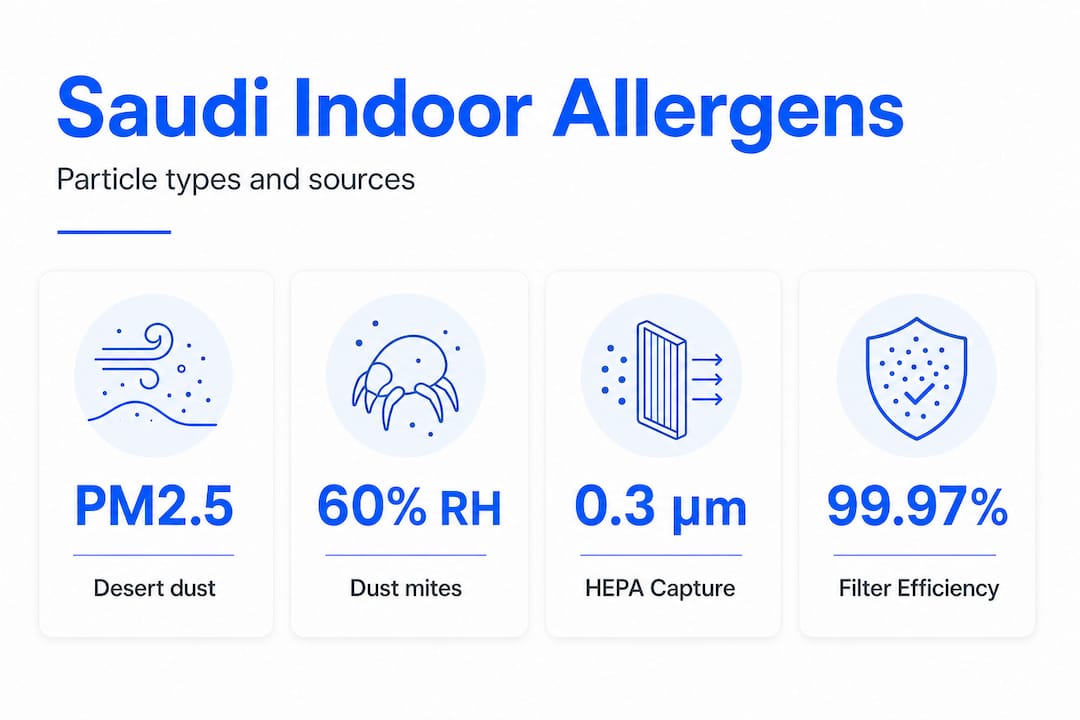
Humidity compounds the problem further. When indoor relative humidity (RH) rises above 60%, dust mite populations grow rapidly, mould spores multiply, and existing allergen particles become stickier and harder to remove from surfaces. Effective filtration is not optional in these conditions. It is essential. Exploring the right air purifier options for your room size is the logical first step.
How HEPA filters capture allergen particles: The science explained
Most people assume that a filter works like a simple sieve, catching large particles and letting small ones through. HEPA technology works completely differently. It uses three distinct physical mechanisms, each targeting a different particle size range.
The three capture mechanisms
-
Impaction: Large particles (generally above 1 micrometre) travel with the airflow but cannot follow the sharp curves around filter fibres. Their momentum carries them straight into the fibre, where they stick. Think of it like a vehicle that cannot turn a sharp corner at speed.
-
Interception: Medium-sized particles do follow the airflow around fibres, but they pass close enough to a fibre surface to make contact and adhere. This mechanism handles the mid-range particle sizes that impaction misses.
-
Diffusion: The smallest particles, those below about 0.1 micrometres, behave unpredictably. They do not travel in straight lines. Instead, they zigzag randomly due to Brownian motion (the constant collision with air molecules). This erratic movement actually increases the chance of hitting a fibre. Counterintuitively, the very smallest particles are captured more efficiently than medium-sized ones.
“HEPA filters capture allergen particles through three primary mechanical mechanisms: impaction, interception, and diffusion.”
This is why the 0.3-micrometre particle size is so significant. It sits in the zone where impaction is losing effectiveness and diffusion has not yet fully taken over. This is the hardest particle size to capture, which is precisely why the HEPA standard requires capturing at least 99.97% of particles at 0.3 microns, the most penetrating particle size (MPPS). Particles larger or smaller than 0.3 micrometres are actually captured with even greater efficiency.
| Particle size | Primary capture mechanism | Capture efficiency |
|---|---|---|
| Above 1 micrometre | Impaction | Very high |
| 0.1 to 1 micrometre | Interception | High |
| 0.3 micrometres (MPPS) | Combined | 99.97% minimum |
| Below 0.1 micrometre | Diffusion | Very high |
Pro Tip: When shopping for an air purifier, always look for the words “true HEPA” or “HEPA H13” on the packaging. These designations confirm the filter meets the 99.97% capture standard at 0.3 microns. Generic “HEPA-type” or “HEPA-style” filters do not meet this standard and will underperform in Saudi dust conditions.
For households dealing with allergies, the right air purifiers for allergy relief will always specify certified HEPA filtration, not approximations.
HEPA filter performance in Saudi Arabian climates: Dust and humidity factors
Understanding how HEPA works in theory is one thing. Understanding how it performs in a Saudi home during a shamal (a seasonal dust storm common across the Gulf) or in a humid Jeddah apartment is another matter entirely.
How desert dust affects your filter
During a dust storm, fine PM2.5 and PM10 particles flood into your home even through closed windows and door gaps. This sudden surge of particulate matter loads your HEPA filter far faster than normal daily use. A filter that might last 12 months under standard conditions can become significantly clogged within weeks if your home is exposed to repeated dust events.
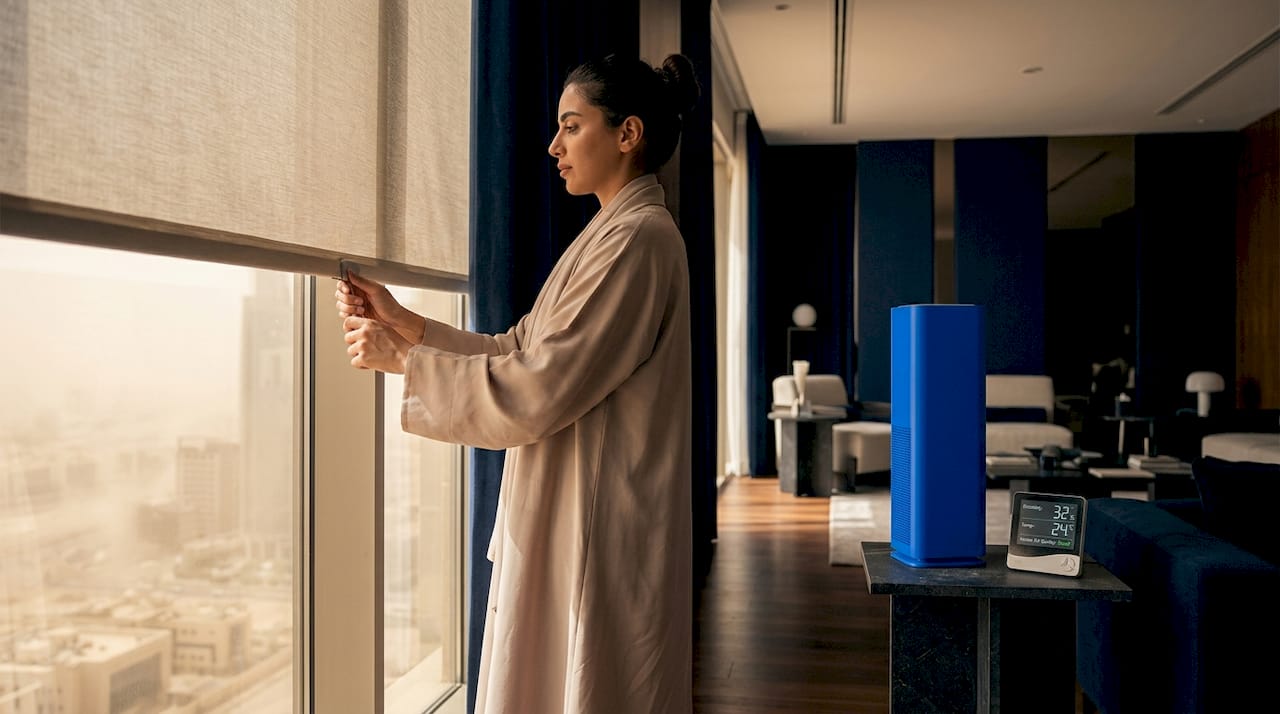
A loaded filter does not just stop working. It forces your air purifier to work harder, reducing airflow and increasing energy consumption. In severe cases, a blocked filter can allow particles to bypass the filtration media entirely through gaps in the seal.
Key impacts of desert dust on HEPA performance:
- Rapid filter loading, reducing airflow and efficiency
- Shortened filter lifespan, sometimes by 50% or more
- Increased pressure drop across the filter, reducing the purifier’s fan performance
- Risk of bypass if the filter frame seal is not tight
How humidity degrades HEPA filters
Coastal humidity is a serious threat to HEPA performance. In high humidity above 60 to 85% RH, HEPA filters face fibre swelling, increased pressure drop, faster clogging from sticky dust, potential microbial growth on the filter surface, and reduced overall efficiency.
This is a critical point for homeowners in Jeddah and the Eastern Province. When humidity is high, dust particles become sticky. They clump together and clog filter fibres faster than dry dust would. At the same time, the moisture can encourage mould and bacteria to grow directly on the filter, turning your air purifier into a source of biological contamination rather than a solution.
Maintaining indoor humidity below 60% RH is not just good practice for comfort. It is essential for protecting your HEPA investment and ensuring it continues to perform as certified.
Pro Tip: Place a small digital hygrometer (a device that measures relative humidity) near your air purifier. If the reading consistently exceeds 60%, add a dehumidifier to your setup before investing in a new HEPA filter. Explore HEPA solutions for Saudi homes that are designed with these local conditions in mind.
Statistic to note: Studies on HEPA performance in humid environments consistently show that filters exposed to humidity above 85% RH can lose a measurable percentage of their rated efficiency, with microbial growth on filter media observed within days under sustained high humidity conditions.
Choosing and maintaining the right HEPA filter at home
Selecting the right system is only the beginning. Proper setup and ongoing maintenance determine whether your HEPA filter actually delivers the clean air it promises.
How to choose the right HEPA system
Experts stress certification, sealing, and real-world factors like humidity over raw specifications. A filter rated at 99.99% efficiency on paper will underperform if it is not properly sealed inside the purifier housing, allowing unfiltered air to bypass the media entirely.
Follow these steps when selecting your system:
- Confirm HEPA H13 certification. Look for documented third-party testing, not just marketing claims. HEPA H13 is the standard most relevant for allergy and respiratory protection.
- Match the purifier to your room size. Check the CADR (Clean Air Delivery Rate) rating for the product. A unit designed for 20 square metres will not adequately protect a 50-square-metre living room.
- Check the filter seal design. The filter should lock firmly into the housing with no visible gaps. Even a small gap allows unfiltered air to pass through.
- Pair with a pre-filter. Pre-filters capture large particles like hair, large dust clumps, and fibres before they reach the HEPA layer. This significantly extends HEPA filter life in dusty Saudi conditions.
- Consider a dehumidifier for humid rooms. For Saudi homeowners with allergies, HEPA excels against desert dust via multi-mechanism capture, but pairing with dehumidifiers to maintain humidity below 60% RH and using pre-filters extends filter life considerably.
Maintenance tips for Saudi conditions
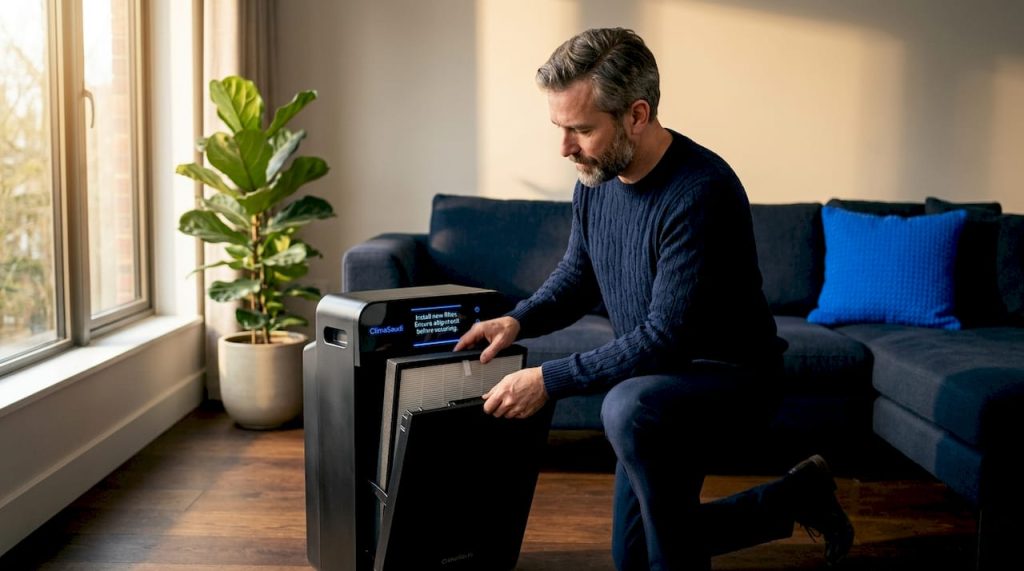
- Replace filters on schedule. Follow the manufacturer’s recommended replacement interval, but inspect filters monthly in dusty seasons. If the filter looks visibly grey or brown, replace it early.
- Clean pre-filters regularly. Most pre-filters are washable. Rinse and dry them fully before reinstalling to prevent moisture transfer to the HEPA layer.
- Keep the purifier running consistently. Turning the unit off during the day and on at night means allergens accumulate for hours unchecked. Continuous low-speed operation is more effective than periodic high-speed bursts.
- Seal your home during dust storms. Use door seals and window draught excluders to reduce the volume of dust entering your home. This reduces the load on your filter.
- Use genuine replacement filters. Off-brand replacements may not meet HEPA H13 standards and can degrade faster.
For specific product guidance, the Blueair purifier guide and the Levoit purifier guide offer detailed comparisons relevant to Saudi home sizes and conditions.
Pro Tip: Set a calendar reminder for filter inspection every 60 days during summer months, when dust storms and air conditioning use are at their peak. Early replacement is far cheaper than dealing with allergy flare-ups caused by a degraded filter.
A fresh perspective: Why ‘just buy a HEPA’ isn’t enough in Saudi homes
Here is something that most product guides will not tell you plainly: buying a HEPA air purifier and placing it in a corner is not a complete solution. Not in Saudi Arabia.
The advice to “just get a HEPA filter” is well-intentioned but dangerously incomplete when applied to local conditions. A certified HEPA H13 unit placed in a room with 75% relative humidity, no pre-filter, and a poorly sealed housing will not deliver the protection you are paying for. Experts consistently emphasise certification, sealing, and real-world factors over raw efficiency numbers on a specification sheet.
We see this pattern repeatedly. A homeowner invests in a quality air purifier, notices some improvement, but still experiences allergy symptoms. The cause is almost always one of three things: humidity above 60% degrading filter performance, a filter that has loaded quickly due to dust storms and was not replaced on time, or a unit that is too small for the room it is placed in.
True allergy relief in a Saudi home requires a system approach. That means a certified HEPA purifier sized correctly for your room, a dehumidifier if you live in a coastal city or experience seasonal humidity, a pre-filter to protect the HEPA layer, and a consistent maintenance schedule. None of these elements is optional. Each one supports the others.
The label on the box matters, but the setup in your home matters more. A HEPA filter working inside a well-managed indoor environment, with controlled humidity and regular maintenance, will outperform a higher-rated filter installed carelessly in a humid, dusty room every single time.
If you are serious about protecting your family’s health, treat your HEPA filters in Saudi Arabia as part of a broader indoor air quality system, not as a standalone purchase.
Find the ideal HEPA and air quality tools for your Saudi home
Cleaner indoor air is a realistic goal for every Saudi household. The right combination of certified filtration and humidity control makes a measurable difference for allergy and respiratory sufferers.
At ClimaSaudi, we stock HEPA H13 certified air purifiers, dehumidifiers, and accessories selected specifically for the Saudi climate. Whether you live in a compact Riyadh apartment or a large Jeddah villa, there is a solution matched to your room size and air quality concern. You can explore air purifiers by room size and filtration standard, or browse dehumidifiers to pair with your existing purifier for full humidity control. For a complete view of everything available, visit our complete air quality solutions page. Next-day delivery, local SAR pricing, and Saudi-based customer support are included as standard.
Frequently asked questions
How often should I replace a HEPA filter in Saudi Arabia?
Replace HEPA filters every 6 to 12 months, but inspect them monthly during dusty seasons. High humidity above 60% RH and heavy dust loading from sandstorms can clog filters far faster than the standard replacement schedule suggests.
Does humidity affect all types of HEPA filters?
Yes. Humidity above 60 to 85% RH can cause fibre swelling, encourage microbial growth on the filter surface, and reduce overall filtration efficiency, regardless of the filter’s original certification level.
Are HEPA filters effective against fine desert dust and allergens?
Yes. True HEPA filters meet the standard that requires capturing 99.97% of particles at 0.3 microns, which covers fine desert dust, pollen, mould spores, and most other allergens common in Saudi homes.
Do I need a dehumidifier alongside my HEPA air purifier?
In humid areas like Jeddah or during seasonal humidity spikes, yes. A dehumidifier helps maintain indoor humidity below 60% RH, which extends HEPA filter life and prevents the microbial growth and fibre damage that high moisture causes.