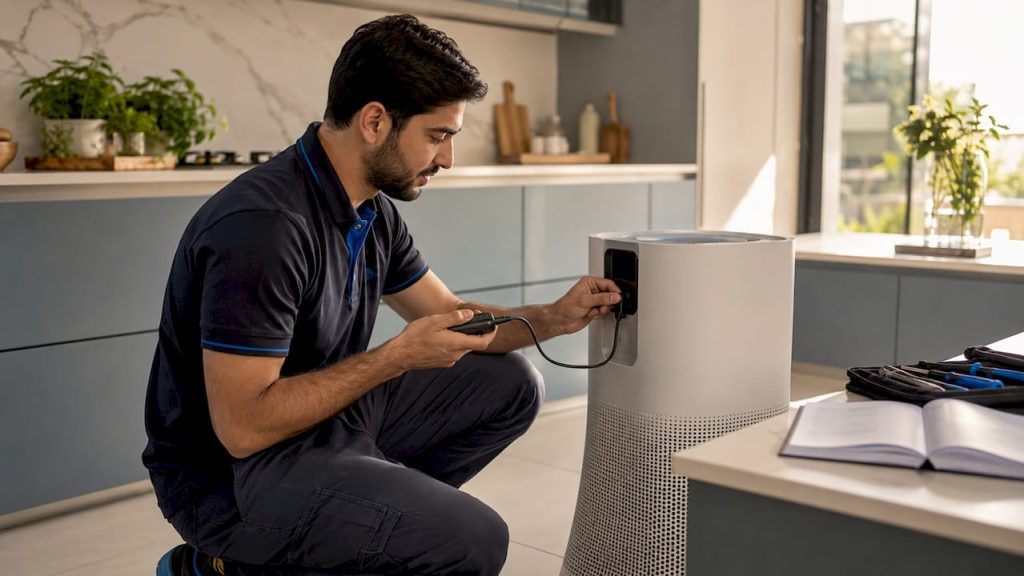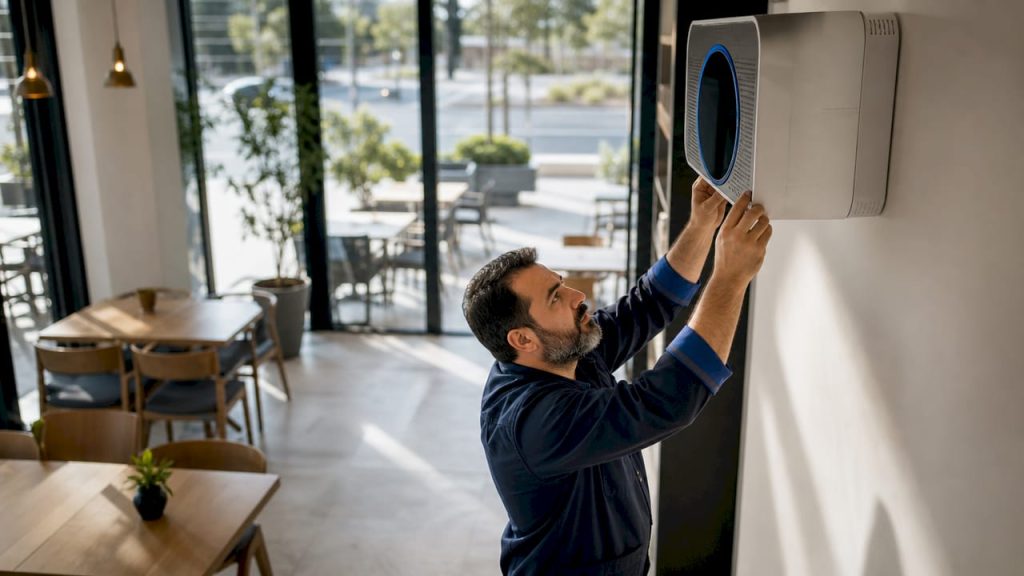
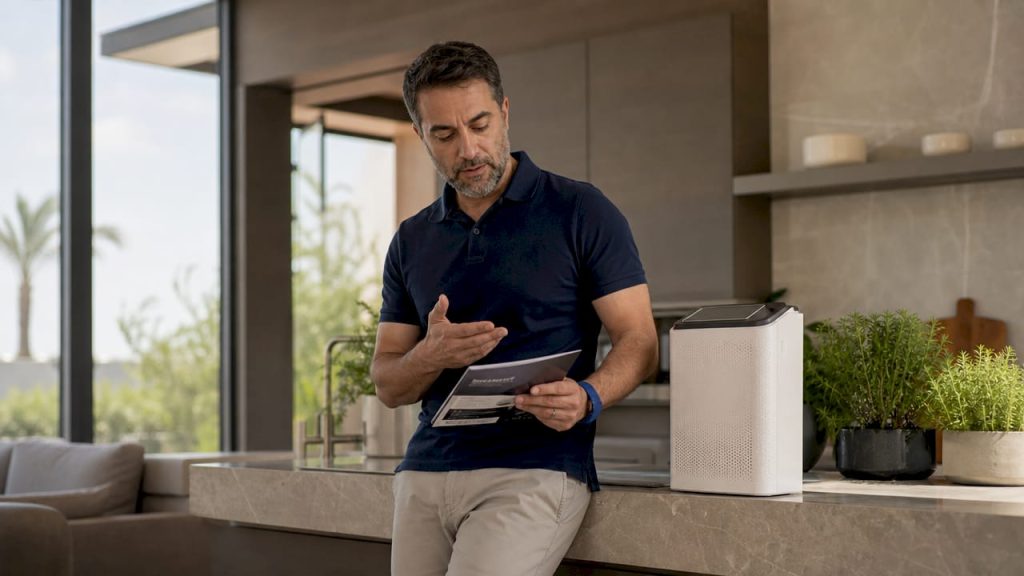
Choosing the right air purifier for your villa starts with one metric: Clean Air Delivery Rate, or CADR. This figure tells you exactly how much filtered air a purifier delivers per minute, tested independently by AHAM, and it is the only reliable way to match a unit to your rooms. Saudi villas face a specific combination of threats: fine desert dust carrying PM2.5 particles, cooking odours and VOCs from enclosed kitchens, and coastal humidity in cities like Jeddah that encourages mould growth. Getting the filter stack and sizing right from the start saves you money, protects your family’s health, and means you are not running an undersized unit on full speed all day.
How to size an air purifier properly for villa rooms
CADR is the volume of filtered air delivered per minute, tested by AHAM to provide a standard comparison across models. This matters because manufacturer room size claims are marketing figures, not tested performance data. Without verifying CADR through independent testing, you risk buying a purifier that cannot clean your room effectively, regardless of what the box says.
The standard sizing rule is straightforward. Target a CADR of at least 67% of your room’s square footage in square metres converted to cubic feet per minute. This corresponds to roughly 4.8 air changes per hour (ACH), which is the accepted residential standard for clean air. A majlis of 50 square metres needs a purifier with a CADR of at least 225 cfm to meet that threshold.
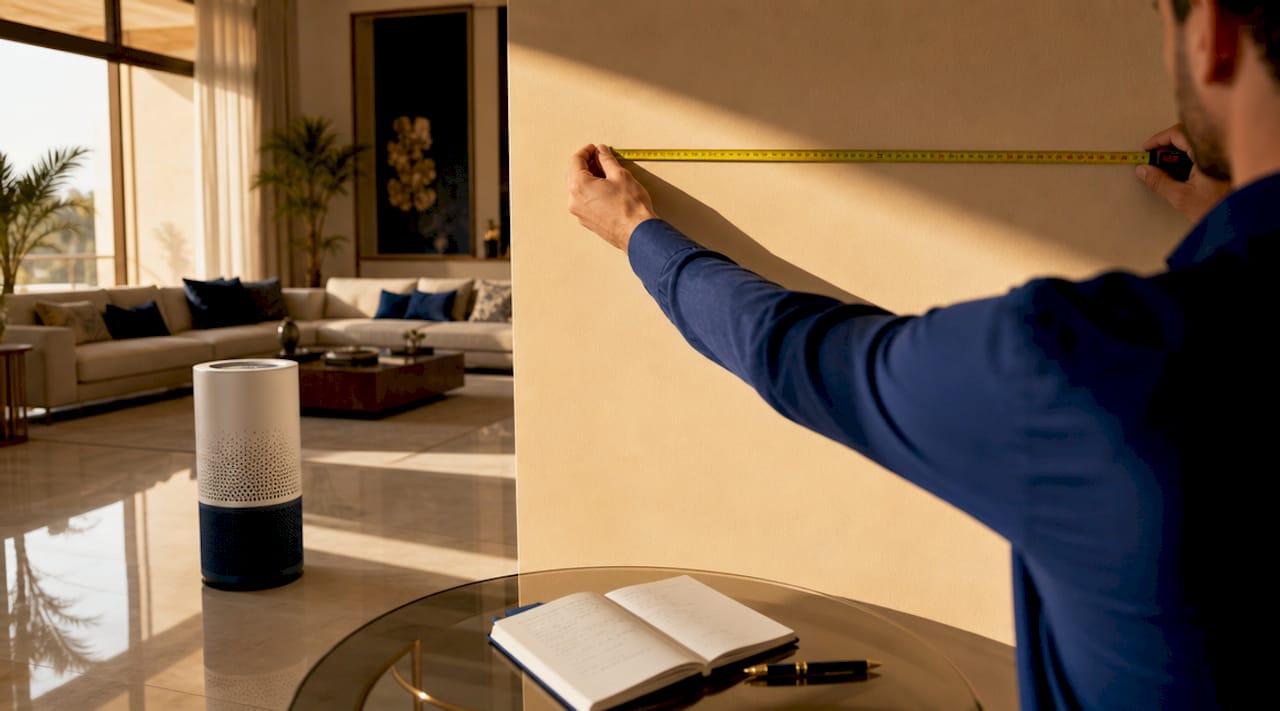
Villa ceilings complicate this calculation. A room with a 4-metre ceiling needs roughly 50% more CADR than the same floor area with a standard 2.5-metre ceiling, because ACH is calculated on air volume, not floor area. Always multiply floor area by ceiling height to get cubic volume, then apply the ACH formula.
| Room type | Approx. floor area | Recommended minimum CADR |
|---|---|---|
| Bedroom | 20–30 m² | 130–200 cfm |
| Living room / majlis | 40–60 m² | 270–400 cfm |
| Open-plan kitchen and dining | 50–70 m² | 335–470 cfm |
| Large villa hall or reception | 70–100 m² | 470–670 cfm |
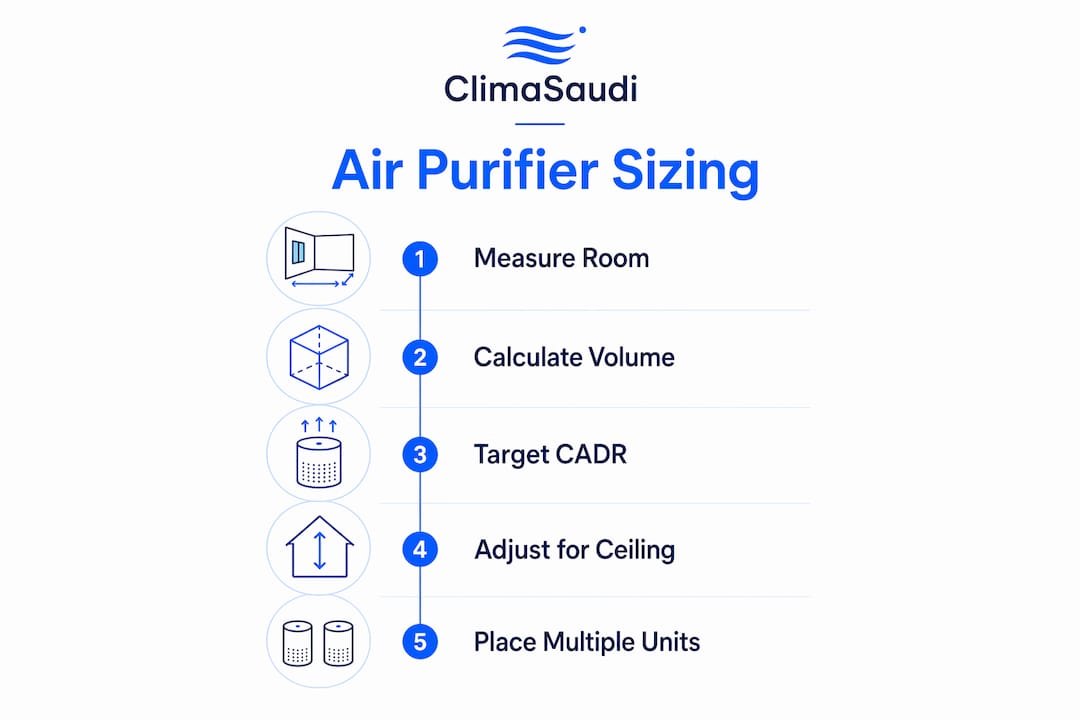
For multi-floor villas, one large central unit is rarely the answer. Multiple purifiers sized to each occupied zone outperform a single oversized device because air does not travel freely between floors or around corners. Treat each distinct zone as its own room and size accordingly.
Pro Tip: If your villa has an open-plan ground floor connecting the kitchen, dining, and living areas, calculate the combined volume of all connected spaces as one room. Then split coverage between two units placed at opposite ends rather than one central device.
Which filter types address Saudi villa air quality issues?
True HEPA filtration is non-negotiable for desert environments. HEPA filters capture 99.97% of particles as small as 0.3 microns, which covers desert dust, pollen, mould spores, and PM2.5 particles that penetrate deep into the lungs. The standard you need is H13 or better. Anything labelled “HEPA-type” or “HEPA-like” is not tested to this standard and will not deliver the same protection.
Activated carbon filtration handles what HEPA cannot. Carbon beds adsorb gases, cooking odours, and VOCs that pass straight through particulate filters. This matters in Saudi villas where kitchens are often large and heavily used, and where new construction materials and furnishings off-gas formaldehyde and other compounds. The key detail: the carbon bed must be thick and substantial. A thin carbon sheet, common in lower-cost purifiers, does not hold enough carbon to make a meaningful difference.
Here is what to look for in a filter stack for a Saudi villa:
- True HEPA H13 or H14 certification. Verify the certification label, not just the marketing copy.
- Substantial activated carbon layer. Look for granular carbon beds, not carbon-coated foam sheets.
- Pre-filter for coarse dust. Saudi dust storms deposit large particles quickly. A washable pre-filter extends the life of your HEPA filter significantly.
- No ozone-generating technology. Ionisers and UV-C lamps that produce ozone worsen indoor air quality rather than improve it.
Pro Tip: In Riyadh and Dammam, where dust storms (haboob) are frequent, check and clean your pre-filter every two weeks during peak season. This single habit can double the lifespan of your HEPA filter and keep your purifier running at full CADR.
You can read more about maintaining HEPA filters correctly to protect your investment over time.
How to position purifiers in a large villa for best results
Placement determines whether your purifier performs at its rated CADR or falls well short. Poor placement reduces effective CADR by up to 25%, which is the difference between clean air and marginal improvement. Follow these steps to position units correctly across your villa:
- Place units at breathing height. For standing rooms like living areas and kitchens, position purifiers at 0.5 to 1.5 metres off the floor. Floor-level placement in large rooms reduces the volume of air the unit processes at the height where you actually breathe.
- Keep units away from walls and furniture. A purifier pushed into a corner or behind a sofa cannot draw air from all directions. Leave at least 50 centimetres of clearance on all sides.
- Avoid placing units near open windows during dust storms. This forces the purifier to process a constant stream of incoming particulates, clogging filters faster and reducing effectiveness for the rest of the room.
- Use separate units per floor. Air does not circulate between floors efficiently. A purifier on the ground floor provides no meaningful benefit to bedrooms upstairs. Each floor needs its own coverage.
- Choose quieter operation for bedrooms. Selecting a slightly larger unit for a bedroom allows it to run on a lower speed setting, reaching the required CADR without disruptive noise. A purifier rated for 40 m² running quietly in a 25 m² bedroom is more practical than a perfectly sized unit running at full speed all night.
For guidance on air purifiers for large rooms, including multi-zone placement strategies, Climasaudi’s blog covers the specific layouts common in Saudi villas.
HEPA filter replacement intervals typically run between 6 and 12 months, but in dusty Saudi environments this shortens considerably. Check your filter indicator monthly and do not wait for the alarm. A clogged filter reduces airflow and CADR before any warning light activates.
How to integrate air purifiers with humidity control in Saudi villas
Air purifiers alone cannot control moisture. This is the most common gap in villa air quality planning. In coastal cities like Jeddah, indoor relative humidity regularly exceeds 60%, which is the threshold above which mould spores germinate and dust mite populations expand. Visible mould colonies can form within weeks if humidity is not actively managed.
The target range for indoor humidity in a Saudi villa is 30 to 50% relative humidity. Below 30%, the air becomes dry enough to irritate airways and damage wooden furniture. Above 60%, you face biological growth risks regardless of how good your air purifier is.
Here is how to build a complete air quality system for your villa:
- Pair a dehumidifier with your air purifier in coastal rooms. In Jeddah or Dammam, a dehumidifier in the bedroom and living areas keeps humidity in the safe range and reduces the particulate load on your HEPA filter.
- Use a humidifier in Riyadh during winter. Dry desert winters push indoor humidity below 30%, which worsens respiratory comfort. An ultrasonic humidifier in bedrooms restores healthy humidity without adding particulates.
- Control ventilation carefully. Opening windows during a sandstorm to “freshen” the air is counterproductive. Use mechanical ventilation with filtration, or keep windows closed and rely on your purifier during high-dust periods.
- Monitor with a hygrometer. A basic digital hygrometer costs under SAR 50 and tells you exactly when to run your dehumidifier or humidifier. Do not guess.
| Condition | Recommended device | Target outcome |
|---|---|---|
| Coastal humidity above 60% RH | Dehumidifier plus air purifier | Reduce RH to 30–50%, suppress mould |
| Desert dry air below 30% RH | Humidifier plus air purifier | Restore healthy humidity, reduce dust suspension |
| Dust storm or high PM2.5 event | Air purifier on high, windows closed | Remove particulates, protect HEPA filter |
| Normal conditions, all regions | Air purifier on auto mode | Maintain clean air with minimal energy use |
You can find more detail on bedroom humidity control and how it interacts with air purification in Saudi homes on the Climasaudi blog.
Key takeaways
Choosing the right air purifier for a Saudi villa requires matching CADR to room volume, selecting True HEPA H13 filtration with substantial activated carbon, and pairing purification with humidity control for complete indoor air quality.
| Point | Details |
|---|---|
| Size by CADR, not marketing claims | Target a CADR of at least 67% of room area and scale up for high ceilings. |
| Insist on True HEPA H13 or better | Reject “HEPA-type” labels; only certified H13 captures 99.97% of particles at 0.3 microns. |
| Use multiple units in multi-zone villas | One central purifier cannot cover multiple floors; zone each area separately. |
| Add humidity control for coastal regions | Keep indoor RH between 30 and 50% to prevent mould growth above 60% RH. |
| Maintain filters more frequently in desert climates | High particulate loads in Saudi Arabia shorten HEPA filter life; check monthly, not annually. |
What living with air purifiers in Saudi villas has taught me
The most consistent mistake I see villa owners make is trusting the room size printed on the box. A purifier labelled “covers up to 60 m²” is almost always tested in a sealed, standard-height room with no furniture, no cooking, and no open doors. Your villa is none of those things. I would always recommend buying one size up from what the label suggests, particularly for open-plan spaces.
The second issue is treating air purification as a set-and-forget solution. In Riyadh, a single haboob can load a HEPA filter with weeks’ worth of particulates in a matter of hours. Homeowners who check their filters monthly are consistently getting better air quality and lower long-term costs than those who wait for the indicator light.
My honest view on noise: most people underestimate how much a purifier running at full speed disrupts sleep. Buying a unit rated for a larger space and running it at 60% speed in the bedroom is not a compromise. It is the smarter choice. You get the same air changes per hour with far less noise, and the filter lasts longer because the airflow is gentler.
Finally, do not skip the humidity side of the equation. A True HEPA purifier in a room at 70% relative humidity is fighting a losing battle against mould spores. The purifier captures what is airborne, but the mould keeps producing more. A dehumidifier resolves the source. Both devices together give you genuinely clean, healthy air.
— Pauline
Find the right air quality solution for your villa with Climasaudi
Climasaudi stocks a curated range of True HEPA and activated carbon air purifiers sized for Saudi villas, from single bedrooms to large open-plan reception rooms. Every product is selected for its verified CADR performance and suitability for desert dust and coastal humidity conditions. You will also find humidifiers and dehumidifiers to complete your indoor air quality setup, with transparent SAR pricing, local inventory, and next-day delivery across Riyadh, Jeddah, and Dammam. Explore the full range of air quality solutions on the Climasaudi website and use the Air Match tool to find the right unit for your specific rooms and climate conditions.
FAQ
What CADR rating do I need for a villa living room?
For a typical villa living room of 40 to 60 square metres with standard ceiling height, target a CADR of at least 270 to 400 cfm. Scale this up by roughly 50% if your ceiling height exceeds 3.5 metres.
Is True HEPA H13 necessary, or will a standard HEPA filter work?
True HEPA H13 captures 99.97% of particles at 0.3 microns, including fine desert dust and PM2.5. Standard or “HEPA-type” filters are not tested to this standard and offer meaningfully lower protection in Saudi Arabia’s high-dust environment.
How often should I replace filters in a Saudi villa?
In a typical home, HEPA filters last 6 to 12 months. In Saudi Arabia, where dust loads are significantly higher, check your filter every month and expect to replace it every 4 to 6 months during peak dust season.
Can one air purifier cover my entire villa?
No. Air does not circulate freely between floors or across large open zones. Place separate units sized to each occupied area, and treat each floor as its own zone for effective coverage.
Do I need a dehumidifier as well as an air purifier?
In coastal cities like Jeddah, yes. Indoor humidity above 60% RH promotes mould growth that an air purifier alone cannot prevent. A dehumidifier keeps humidity in the safe 30 to 50% range and reduces the biological load on your HEPA filter.