Many households in Saudi Arabia assume that any HEPA filter will do the job. After all, they all say “HEPA” on the box. But the grade printed beneath that label makes an enormous difference, especially in a country where desert dust, sandstorms, and intense pollen seasons put indoor air quality under serious pressure. This guide breaks down exactly what separates HEPA H13 from H11, why the efficiency gap matters for your home in Riyadh, Jeddah, or Dammam, and how to choose a solution that genuinely delivers cleaner, healthier air.
Table of Contents
- What makes a HEPA filter: grades and standards explained
- H13 vs H11: How much difference does the higher grade make?
- Advanced filtration: How H13 tackles Saudi Arabia’s toughest air problems
- What HEPA grades don’t tell you: The importance of purifier design
- Why we think H13 is worth it — if you look beyond the label
- Ready to upgrade your air? Explore top H13 solutions in Saudi Arabia
- Frequently asked questions
Key Takeaways
| Point | Details |
|---|---|
| H13 offers superior filtration | H13 HEPA filters capture 99.95% of tiny particles, compared to 95% for H11. |
| Better for Saudi dust and allergens | H13 filters are especially effective against fine desert dust, pollen, and smoke common in Saudi Arabia. |
| System design also matters | A strong filter is only as good as the purifier around it—look for well-designed, high-quality units. |
| Worth the extra investment | The extra cost of H13 is justified by significantly better air quality and health benefits. |
What makes a HEPA filter: grades and standards explained
With the stage set on why filter grades matter, let’s clarify what these grades and standards mean and why they are important for your indoor air.
HEPA stands for High Efficiency Particulate Air. It describes a class of mechanical air filters capable of trapping very fine particles that ordinary filters miss entirely. However, “HEPA” on its own is not a single performance standard. It is a family of grades, each with a different level of particle capture efficiency.
In Europe, and increasingly across global manufacturers, HEPA filters are classified according to the EN 1822 standard. This standard defines grades from E10 through H14, with each step up representing a meaningful improvement in filtration performance. The two grades most commonly found in home air purifiers are H11 and H13.
The key measurement in EN 1822 is the most penetrating particle size, or MPPS. This refers to the particle size that is hardest for any filter to trap, typically around 0.3 microns. At this size, particles are too small to be caught by simple impaction and too large to be effectively captured by diffusion alone. It is essentially the “weak point” of any HEPA filter, and it is exactly where grades diverge most sharply.
Here is how H11 and H13 compare at a glance:
| Filter grade | Minimum efficiency at MPPS | Particles blocked per 10,000 |
|---|---|---|
| H11 | 95.00% | 9,500 |
| H12 | 99.50% | 9,950 |
| H13 | 99.95% | 9,995 |
| H14 | 99.995% | 9,999 |
The numbers make it clear: HEPA H13 filters capture at least 99.95% of particles at the most penetrating particle size, compared to just 95% for H11 filters under the EN 1822 standard. That means H13 allows five times fewer particles to pass through compared to H11.
Key facts about HEPA filter standards that every buyer should know:
- EN 1822 is the most widely cited international standard for HEPA classification.
- H11 passes roughly 1 in 20 particles at the MPPS, while H13 passes just 1 in 2,000.
- The grade applies to the filter as a whole unit, not just the filter media itself.
- A higher grade does not automatically mean a better air purifier; system design also plays a significant role (more on this shortly).
- Filters labelled simply “True HEPA” without a grade number may or may not meet H13 performance levels. Always check for the specific EN 1822 grade.
Understanding these fundamentals puts you in a much stronger position when comparing products, especially in a market where marketing language can obscure real-world performance differences.
H13 vs H11: How much difference does the higher grade make?
Now that you know what distinguishes the grades, let’s see the concrete difference that H13 brings to Saudi homes.
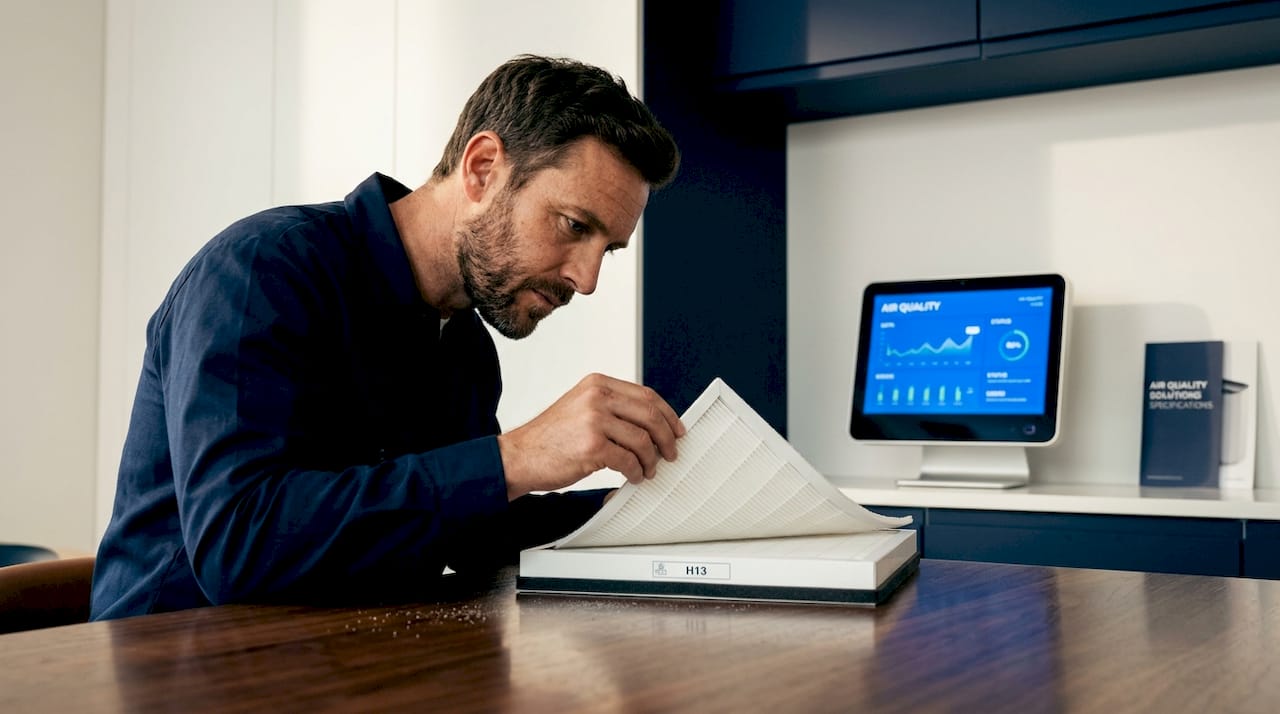
On paper, 95% versus 99.95% may seem like a minor step. In practice, that gap is significant. For every 10,000 particles passing through an H11 filter, approximately 500 escape into your room air. For H13, that number drops to just 5. Over hours and days of continuous operation in a sandy environment, those escaped particles accumulate on surfaces, in your lungs, and throughout your living space.
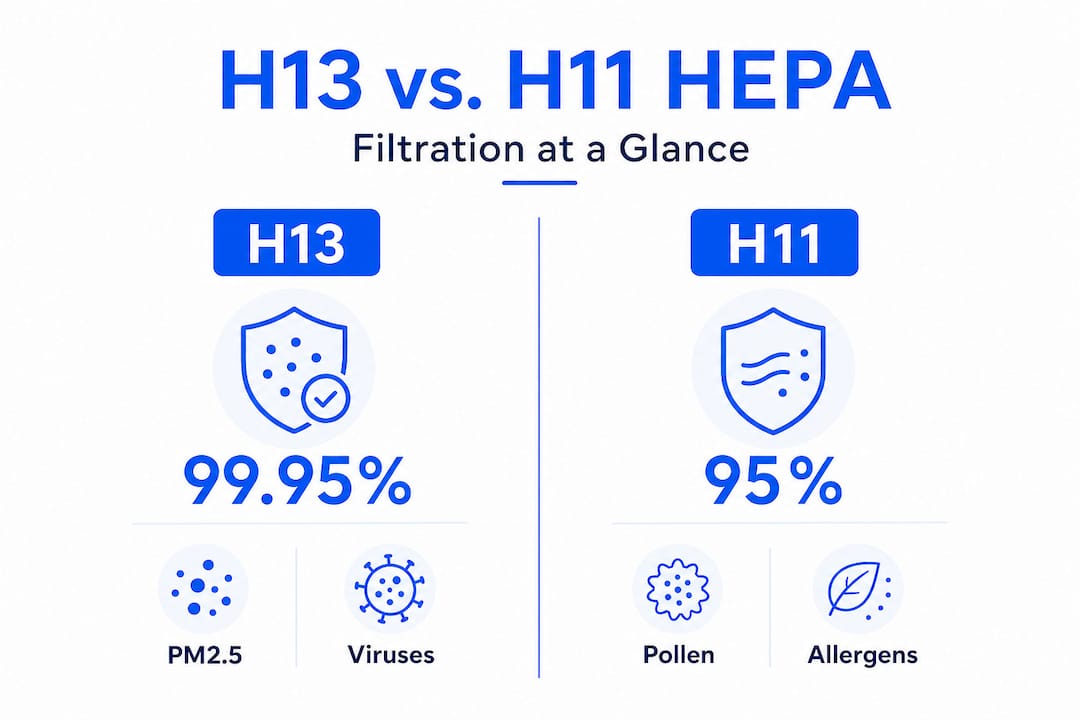
Higher H13 efficiency comes from denser filter media that uses enhanced diffusion, interception, and impaction mechanisms simultaneously, allowing it to trap finer particles like allergens, fine desert dust (PM2.5), and smoke far more effectively than H11 media.
Here is a direct comparison across common pollutants found in Saudi homes:
| Pollutant type | Typical size (microns) | H11 capture rate | H13 capture rate |
|---|---|---|---|
| Desert dust (coarse) | 2.5 to 10 | ~99% | ~99.9% |
| PM2.5 fine particles | 0.1 to 2.5 | 90 to 95% | 99.5 to 99.95% |
| Pollen | 10 to 100 | ~99.9% | ~99.99% |
| Airborne bacteria | 0.5 to 5 | 92 to 97% | 99.5 to 99.97% |
| Smoke particles | 0.1 to 1 | 88 to 94% | 99 to 99.95% |
The pollutants where H13 makes the biggest measurable difference are the smallest ones. These include:
- Fine desert dust and PM2.5 — the particles responsible for respiratory irritation during and after sandstorms.
- Seasonal pollen — a significant allergen in Saudi Arabia, particularly during spring months in areas like Riyadh and the Eastern Province.
- Smoke particles — from cooking, outdoor fires, or nearby industrial activity.
- Airborne bacteria — which travel on dust and moisture droplets, particularly relevant in humid coastal cities like Jeddah.
- VOCs attached to fine particles — chemical compounds from cleaning products, furniture, and building materials.
For Saudi residents, these are not abstract concerns. During a haboob or seasonal dust event, PM2.5 levels indoors can rise sharply even with windows closed, because fine dust finds its way through gaps and ventilation systems. An H11 filter working at 95% efficiency still allows a meaningful quantity of these particles to recirculate. An H13 filter, by contrast, provides measurably tighter protection.
Products like the Blueair Blue 211i Max Air Purifier and the ComfortPure 3-in-1 T10i are built specifically around H13-grade filtration and designed to handle the particle loads common in Saudi living environments.
Advanced filtration: How H13 tackles Saudi Arabia’s toughest air problems
Let’s look at why this matters so much for homes and flats in Saudi Arabia, where ordinary filters often are not enough.
Saudi Arabia’s air quality challenges are unique in their intensity and variety. Residents in Riyadh face frequent dust storms that can reduce visibility to metres. Families in Jeddah deal with coastal humidity that carries mould spores alongside salt particles. Those in Dammam contend with industrial emissions combined with desert conditions. No other climate combination tests indoor air quality quite like this.
Denser H13 filter media enhances diffusion, interception, and impaction simultaneously, giving it a decisive advantage when handling the mix of fine desert dust, pollen, and smoke that Saudi air frequently contains.
The pollutants H13 handles well inside Saudi homes include:
- Fine sand and silt particles carried indoors during and after dust storms.
- Date palm and grass pollen, which peaks in spring and can trigger intense seasonal allergies.
- Pet dander from cats and dogs kept indoors.
- Cooking smoke and aerosols, particularly relevant where traditional grilling occurs near living spaces.
- Mould spores, especially in coastal and basement environments with higher humidity.
- Dust mite debris, a year-round concern in carpeted homes.
One additional factor worth noting is that many Saudi homes rely on central air conditioning systems that recirculate indoor air rather than bringing in fresh outdoor air. This recirculation can concentrate fine particles over time if the system’s built-in filters are not supplemented by a standalone HEPA unit.
The Blue Pure 511 Air Purifier is a compact example of an H13-grade unit well suited to smaller rooms and bedrooms, providing targeted filtration where you spend the most time.
Pro Tip: For best results in a sandstorm-prone area, run your H13 air purifier on a higher setting during and immediately after a dust event, then reduce to a quieter setting once particle levels normalise. This approach maximises filtration efficiency when it matters most without constant high-noise operation.
The slightly higher cost of H13 filters compared to H11 alternatives is real but manageable. When you consider the reduction in dust on surfaces, fewer allergy symptoms, and less frequent deep cleaning, the investment is justified across most Saudi households.
What HEPA grades don’t tell you: The importance of purifier design
At this point you know H13’s strengths, but before you buy, it is critical to understand what really makes the investment pay off.
Here is something most filter guides overlook: a top-grade H13 filter inside a poorly designed air purifier will not deliver H13 performance. The filter grade describes the filter media itself. But air does not pass only through the filter. It also passes around seals, past joints, and through the fan housing. If any of these elements are substandard, unfiltered air bypasses the filter entirely.
“Empirical tests confirm H13’s edge for severe cases, but system design matters more than grade alone. Seals, fan power, and overall construction are decisive factors in real-world filtration performance.”
This is a critical point for Saudi buyers. When evaluating an air purifier, the H13 label should be your starting point, not your finishing criterion. Here is a quick checklist of what to look for beyond the filter grade:
- Airtight seals around the filter housing to prevent air bypass.
- Sufficient CADR (Clean Air Delivery Rate) for the room size you intend to cover.
- Fan power capable of circulating room air at least 4 to 5 times per hour under normal conditions.
- Build quality that keeps the unit free of gaps or loose panels.
- Genuine certified replacement filters available locally, so you can maintain performance over time.
A common mistake is purchasing an inexpensive purifier, then upgrading only the filter to an H13-rated version. If the unit was not engineered to work with denser H13 media (which has higher airflow resistance), you may find that the fan struggles, airflow drops, and actual filtration performance suffers.
Pro Tip: When choosing an air purifier, always check the manufacturer’s stated CADR rating for your room size, and confirm it was tested with the H13 filter installed. Some brands publish two CADR figures, one with and one without the HEPA filter, and these can differ substantially.
The best-performing units for Saudi homes combine a certified H13 filter with a robust, well-sealed housing, adequate fan speed options, and quiet operation for nighttime use. These are the products worth investing in.
Why we think H13 is worth it — if you look beyond the label
We have helped many Saudi families choose their first serious air purifier, and a pattern stands out clearly. Most people start by searching for the highest filter grade they can find, then pick the cheapest unit that claims to use it. They are disappointed when the results fall short of expectations.
The truth we have learnt through real conversations with customers in Riyadh, Jeddah, and Dammam is this: the filter grade sets the ceiling; the purifier design determines the floor. You need both to be good before H13 pays off.
We have seen homes where a well-matched combination of an H13 filter and a properly sealed, adequately powered unit transformed daily comfort. Less dust settling on furniture within 24 hours of a sandstorm. Children with dust allergies sleeping more easily. Residents noticing fewer sneezing episodes during pollen season. These are not marketing claims. These are the outcomes that follow from choosing the whole system thoughtfully, not just the filter rating.
The Blueair Blue Max 3450i is one example of a unit where H13 filtration and solid engineering work together in a way that genuine results follow. It is the combination approach that delivers lasting comfort, not a specification number alone.
Our honest view: do not let anyone sell you an H13 filter as a magic solution. And do not let cost pressure push you toward an H11 unit and hope for the best. For Saudi homes dealing with real dust, real allergens, and real sandstorms, H13 paired with a quality purifier is the only combination that consistently delivers on its promise.
Ready to upgrade your air? Explore top H13 solutions in Saudi Arabia
If you are ready to experience allergen-free, dust-free indoor air in Saudi Arabia, here is where to start.
At ClimaSaudi, we stock certified H13 air purifiers with local inventory, next-day delivery, and transparent SAR pricing. Every product we carry is selected for its real-world performance in Saudi conditions, not just its specification sheet.
Start with the Blueair Blue 211i Max with H13, one of the highest-rated options for medium to large rooms. Or browse all purifiers to find the right match for your room size and specific air quality concerns. Our Air Match tool helps you narrow down quickly without guesswork. For a full overview of all air quality solutions including humidifiers, dehumidifiers, and replacement filters, visit ClimaSaudi today. Our local customer support team is ready to help you choose wisely.
Frequently asked questions
Is a HEPA H13 filter worth the extra cost over H11 in Saudi Arabia?
For households dealing with severe dust, asthma, or seasonal allergies, H13 is worth the marginally higher cost because it captures 99.95% of particles at the MPPS compared to just 95% for H11, offering significantly better protection.
Are all H13 purifiers actually effective for fine Saudi dust?
Not necessarily. System design and seals matter as much as filter grade, so a poorly built unit can underperform even with an H13 filter fitted.
Do H13 HEPA filters remove viruses and bacteria?
H13 filters trap a large proportion of airborne bacteria and larger viral particles, given that H13 captures at 99.95% at 0.3 microns, but they do not eliminate all pathogens and should not replace other hygiene measures.
What is the lifespan of H13 vs H11 filters?
H13 filters typically last a similar duration to H11 filters, though in very dusty Saudi environments the denser media may load slightly faster, so checking your unit’s filter indicator every three to six months is advisable.
Recommended
- Buy Blueair Blue 211i Max Air Purifier in Saudi Arabia | Best Price SAR 877 | ClimaSaudi
- Buy Blueair Blue Pure 511 Air Purifier in Saudi Arabia | Best Price SAR 272 | ClimaSaudi
- Buy Blueair ComfortPure 3-in-1 T10i Air Purifier in Saudi Arabia | Best Price SAR 952 | ClimaSaudi
- Buy Blueair Blue 511i Max Air Purifier in Saudi Arabia | Best Price SAR 325 | ClimaSaudi