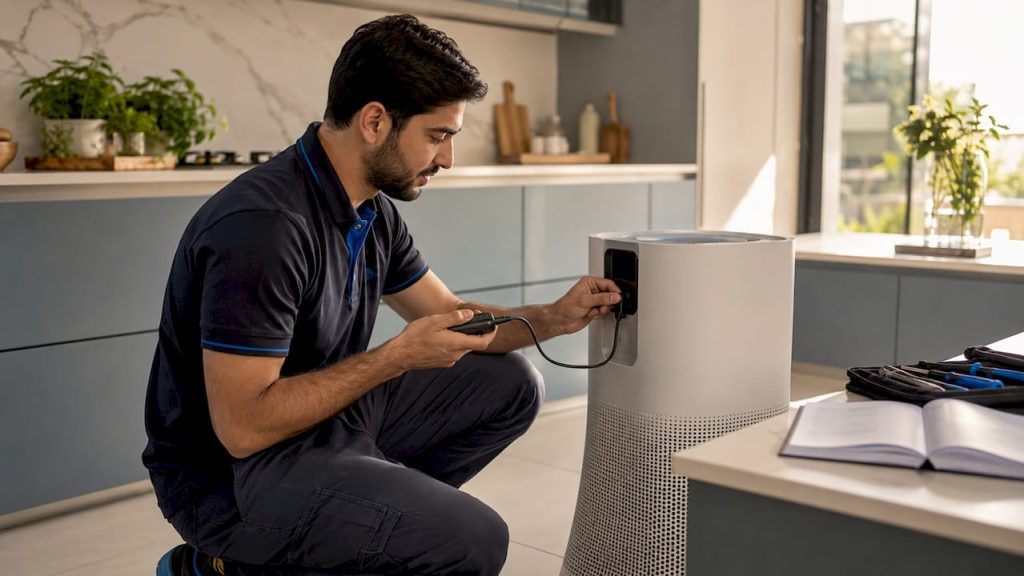
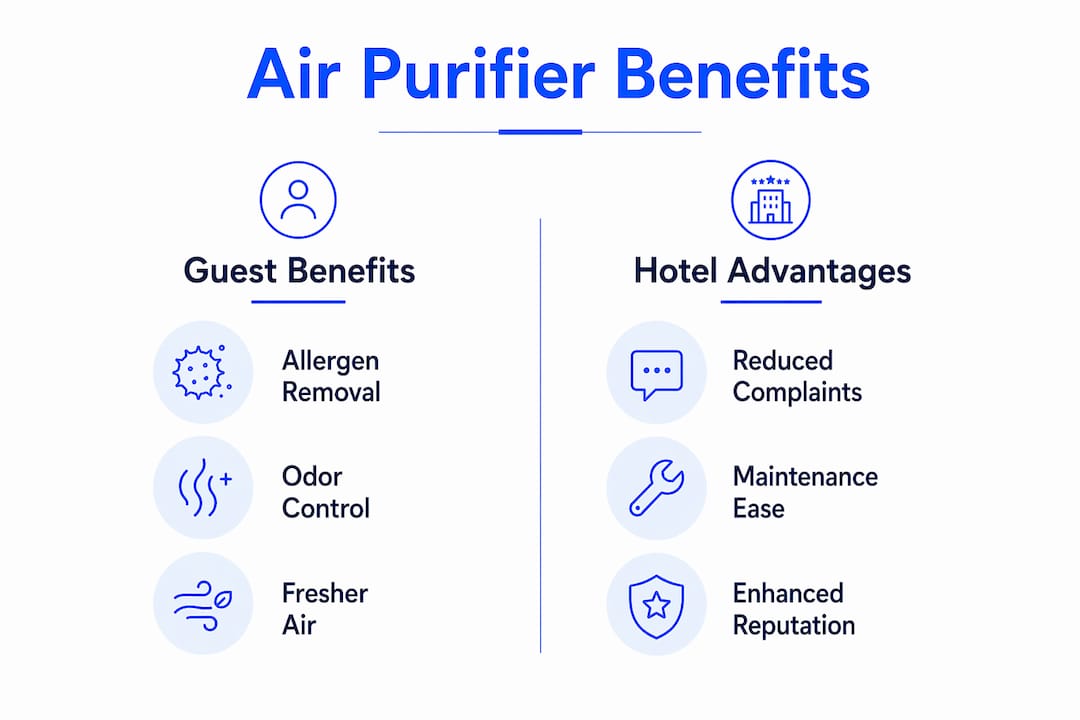
Hotel rooms need air purifiers because they remove airborne allergens, pathogens, and odours that standard HVAC systems cannot fully address, directly protecting guest health and your property’s reputation. Indoor air quality (IAQ) is the recognised industry term for the standard of air within enclosed spaces, and it has become a measurable factor in guest satisfaction scores. Advanced filtration technologies, including HEPA+ filters and UV-C light systems, now give hotel managers practical tools to maintain clean, fresh air in every room. This guide explains how these technologies work, why consistent IAQ management matters operationally, and how to implement air purification as permanent room infrastructure rather than an afterthought.
How do air purifiers improve air quality in hotel rooms?
Air purifiers improve hotel room air quality by drawing room air through a series of filtration stages that capture or destroy contaminants before recirculating clean air back into the space. The core technology in most commercial-grade units is the HEPA+ filter, which captures viral particles with 99.99% efficacy. That figure matters because standard HVAC filters are not rated to capture particles at that size range, meaning guests can still inhale fine particulates and biological matter even in a well-ventilated room.
UV-C light is the second critical layer. When integrated into an air purifier or HVAC system, UV-C technology eliminates 93.3% of airborne pathogens within 180 minutes. For a hotel room turning over between guests, that performance window is highly practical. A room treated with UV-C before the next guest checks in presents a measurably lower pathogen load than one relying on ventilation alone.
Beyond pathogens, air purifiers address the full spectrum of IAQ concerns that affect guest perception:
- Allergens: Dust mites, pet dander carried in on luggage, and pollen tracked in from outdoors are captured by HEPA+ filtration, reducing allergic reactions in sensitive guests.
- Odours: Activated carbon stages in multi-layer purifiers absorb volatile organic compounds (VOCs), tobacco residue, and cleaning product fumes that linger after housekeeping.
- PM2.5 particulates: Fine particles from outdoor pollution, particularly relevant in cities like Riyadh and Jeddah where desert dust is a persistent factor, are captured before they settle on surfaces or enter guests’ airways.
- Humidity-related contaminants: When paired with proper humidity control, air purifiers reduce the airborne spread of mould spores that thrive in poorly managed room environments.
The combined effect is a room that guests perceive as fresher and cleaner, even if they cannot articulate why. That perception translates directly into review scores.
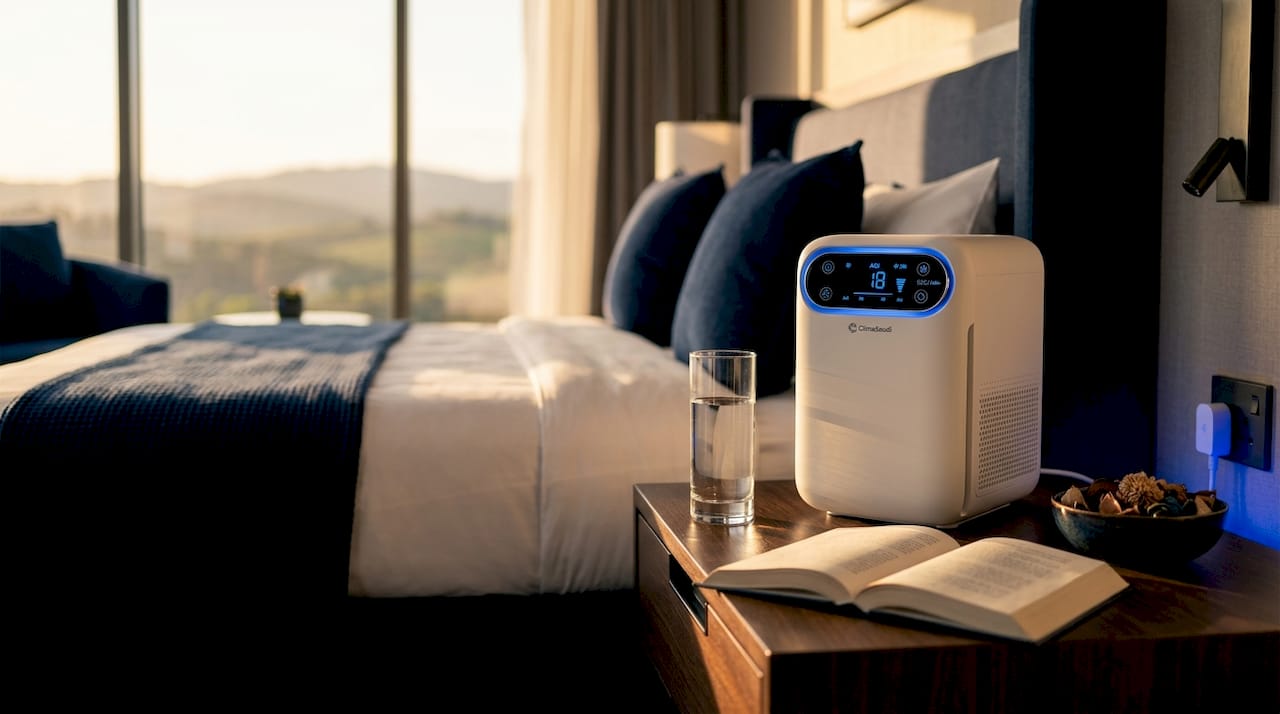
Pro Tip: Pair your air purifier with a unit that displays a real-time PM2.5 reading. Guests who can see a low particulate count on a small display feel an immediate, measurable sense of reassurance about the room.
What challenges do hotels face with IAQ, and how do purifiers help?
Hotel rooms present a uniquely difficult IAQ environment. Unlike offices or residential spaces, they are occupied by a constantly rotating population of guests who bring different allergens, habits, and sensitivities. Ventilation systems designed to code minimums are rarely sufficient to handle this variability.
The most common IAQ failures in hotels follow a predictable pattern:
- Filter degradation: HVAC filters clog progressively, and pressure-monitored filters that are not replaced on time cause supply air volume to drop by 25 to 40%. That drop produces the stale, stuffy air guests describe in negative reviews.
- Humidity extremes: Humidity above 60% creates conditions for mould growth on cooling coils and room surfaces. Humidity-driven mould and biofilm growth is responsible for nearly all musty odour complaints in guest rooms.
- Cross-contamination between rooms: Shared HVAC ductwork can carry odours and particulates from one room into adjacent spaces, particularly in older properties.
- Inadequate fresh air exchange: Energy-saving HVAC settings that reduce outdoor air intake to cut costs create CO2 build-up and a sense of stuffiness that no amount of fragrance can mask.
Air purifiers address points one, two, and four directly. They provide a dedicated filtration layer within the room itself, independent of the central HVAC system. When a guest opens a window in a dusty environment or the HVAC filter is approaching end of life, the in-room purifier continues to clean the air. This redundancy is what makes air purification a genuine operational safeguard rather than a luxury add-on.
Pro Tip: Do not wait for guest complaints to identify IAQ problems. Install a simple CO2 and humidity sensor in a sample of rooms and review the data weekly. Patterns across room types will tell you where your HVAC system has structural weaknesses.
Wall-mounted vs portable air purifiers: which is right for hotels?
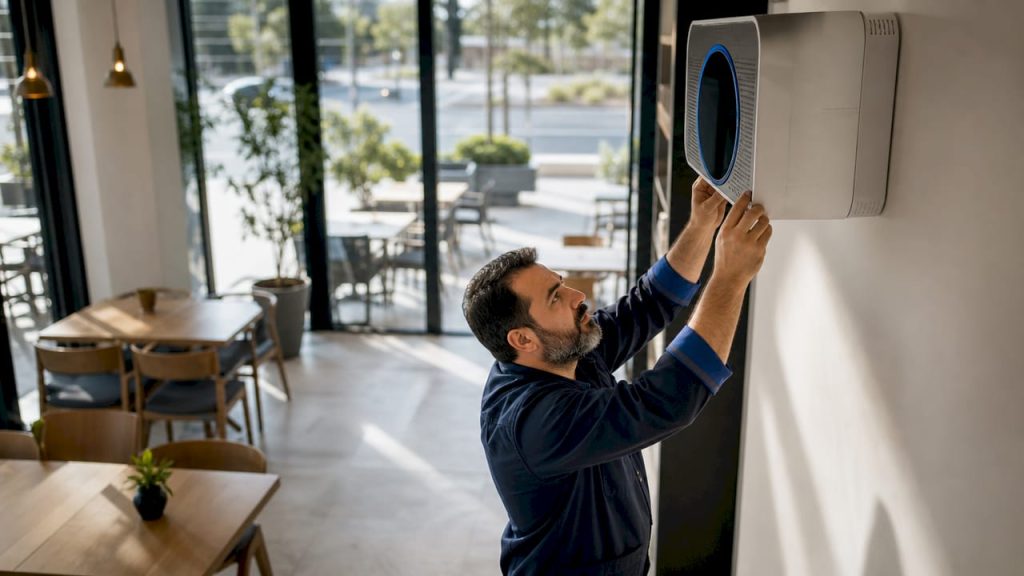
The choice of installation type determines whether air purification becomes a reliable room standard or an inconsistent variable. Portable and floor-standing units are frequently moved, damaged, or unplugged by guests, creating gaps in air quality that undermine the entire investment. Wall-mounted units, by contrast, become part of the room’s fixed infrastructure in the same way that smoke detectors and thermostats do.
| Feature | Wall-mounted units | Portable or floor-standing units |
|---|---|---|
| Guest interference | Minimal. Fixed position, out of reach | High. Frequently moved or unplugged |
| Maintenance access | Standardised. Housekeeping follows a fixed protocol | Variable. Units may be in different positions each visit |
| Floor space | None used | Occupies usable floor area |
| Airflow coverage | Optimised for room layout at installation | Dependent on where guest places the unit |
| Brand consistency | Uniform across all rooms | Varies if units are different models or conditions |
| Damage risk | Very low | Higher, particularly in rooms with children |
Wall-mounted units also simplify the maintenance workflow considerably. Because the unit is always in the same position, housekeeping staff can check filter status and clean pre-filters in a consistent, repeatable sequence. Wall-mounted units save floor space and improve reliability, which translates to lower labour costs per room over time. For a property managing 100 or more rooms, that operational consistency has a measurable impact on maintenance budgets.
From a guest experience perspective, a wall-mounted unit signals permanence and intentionality. It communicates that air quality is a designed feature of the room, not a temporary measure. That distinction matters to guests who are increasingly aware of IAQ as a health consideration when choosing accommodation.
How to implement and maintain air purifiers for consistent guest satisfaction
Effective implementation of air purification in hotels requires more than purchasing units and installing them. The benefits of air purifiers in hotels are only fully realised when installation, maintenance, and guest communication are treated as a single integrated programme.
Start with these priorities:
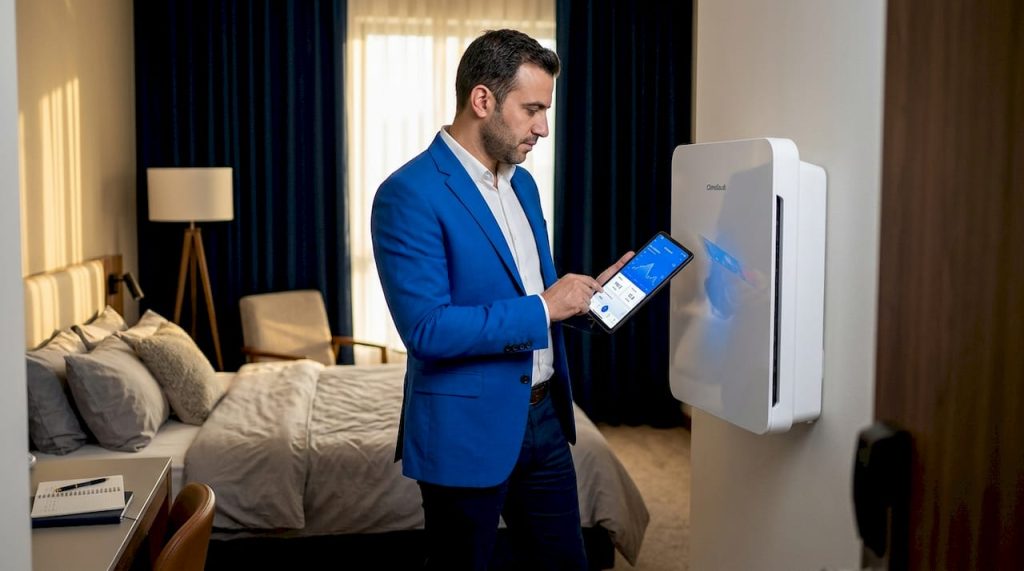
- Integrate with your HVAC monitoring system. Real-time IAQ data, including PM2.5, CO2, and humidity readings, should feed into your building management system so facilities teams can identify problems before guests notice them. Hotels that display IAQ data to guests report higher perceived safety and room value.
- Replace filters based on pressure differential, not calendar schedule. A filter in a high-occupancy room during peak season degrades faster than one in a low-traffic room. Pressure differential monitoring tells you exactly when a filter needs changing, preventing the 25 to 40% airflow drop that causes stale air complaints.
- Train housekeeping staff on filter inspection. Pre-filter cleaning should be part of the standard room servicing checklist. Staff who understand why they are doing it maintain the routine more reliably than those following instructions without context.
- Combine air purification with frequent cleaning and proper ventilation. HEPA purifiers reduce allergens most effectively when used alongside regular surface cleaning and adequate fresh air exchange. The purifier handles airborne particles; cleaning removes settled contaminants before they re-enter the air.
- Use visible IAQ displays strategically. A small display showing a green “Good” air quality reading in the room is a low-cost, high-impact trust signal. Guests who see it feel the benefit of your investment without needing to read a brochure.
For properties considering a phased rollout, prioritise rooms with the highest occupancy rates, rooms on lower floors where outdoor particulates are more likely to infiltrate, and any rooms that have historically generated odour or air quality complaints. You can find practical guidance on filter maintenance best practices that apply equally well to hotel room units as to residential settings.
Key takeaways
Air purifiers deliver consistent IAQ improvements in hotel rooms only when combined with pressure-monitored filter maintenance, wall-mounted installation, and real-time monitoring integrated into HVAC management.
| Point | Details |
|---|---|
| HEPA+ and UV-C technology | HEPA+ filters capture 99.99% of viral particles; UV-C eliminates 93.3% of airborne pathogens within 180 minutes. |
| Wall-mounted over portable | Fixed units prevent guest interference, standardise maintenance, and signal intentional air quality design. |
| Pressure differential monitoring | Replace filters based on pressure readings, not dates, to prevent 25 to 40% airflow drops and stale air complaints. |
| Combined IAQ strategy | Air purifiers work best alongside frequent cleaning, humidity control, and adequate ventilation. |
| Guest trust through visibility | Displaying real-time IAQ data increases perceived room value and guest confidence without additional cost. |
Air quality as a reputational asset, not just an engineering metric
I have reviewed enough hotel operations to say with confidence that IAQ is one of the most undervalued levers in hospitality management. Properties invest heavily in bedding, lighting, and bathroom fixtures, yet the air guests breathe for eight hours every night receives almost no deliberate attention until a complaint appears on a review platform.
The pattern I see repeatedly is this: a property installs portable air purifiers in response to a cluster of negative reviews, places them in rooms without a maintenance protocol, and considers the problem solved. Six months later, the filters are clogged, the units have been moved to corners, and the reviews continue. The investment produced no lasting benefit because the implementation was reactive rather than structural.
IAQ investments that correlate with higher occupancy and improved revenue per available room share a common characteristic: they are built into the room infrastructure, not added on top of it. Wall-mounted units with pressure-monitored filters and real-time IAQ displays are not a premium feature. They are the baseline standard that guests in 2026 are beginning to expect, particularly in markets where outdoor air quality is a known concern.
The properties that will benefit most are those that act before IAQ becomes a visible complaint category in their reviews. At that point, the reputational damage is already done and the cost of recovery is far higher than the cost of prevention. Strategic IAQ management is not a cost centre. It is a guest retention tool with a measurable return.
— Pauline
Upgrade your hotel rooms with Climasaudi’s air purification range
Climasaudi offers a curated selection of advanced air purifiers designed for demanding indoor environments, including hotel guest rooms. The Blueair ComfortPure 3-in-1 T20i combines HEPA+ filtration with UV-C technology in a single unit, making it well suited to rooms where both particulate removal and pathogen control are priorities. For smaller guest rooms, the Blueair Blue 3610 delivers reliable HEPA filtration at a price point that works for multi-room rollouts. All products are available with next-day delivery across Saudi Arabia, transparent SAR pricing, and local customer support. Visit Climasaudi to browse the full range and find the right unit for your property.
FAQ
What do air purifiers actually remove from hotel room air?
Air purifiers with HEPA+ filtration remove allergens, dust, PM2.5 particulates, mould spores, and viral particles. Units with activated carbon stages also absorb odours and VOCs from cleaning products or previous guests.
How often should hotel air purifier filters be replaced?
Filter replacement should be based on pressure differential readings, not a fixed calendar schedule. Rooms with high occupancy degrade filters faster, and waiting for a set date risks a 25 to 40% drop in airflow that causes stale air complaints.
Are wall-mounted air purifiers better than portable units for hotels?
Wall-mounted units are the preferred choice for hotels because they cannot be moved or unplugged by guests, maintain consistent airflow coverage, and simplify housekeeping maintenance routines across all rooms.
Do air purifiers help guests with allergies in hotel rooms?
HEPA+ filtration captures the allergens most commonly responsible for reactions in hotel rooms, including dust mites, pollen, and pet dander. Combined with regular surface cleaning, air purifiers significantly reduce allergen load for sensitive guests.
Can air purifiers replace a hotel’s HVAC system?
Air purifiers complement HVAC systems but do not replace them. They provide an additional filtration layer within the room itself, which is particularly valuable when HVAC filters are approaching end of life or outdoor air quality is poor.