If you live in Riyadh, Jeddah, or Dammam, you already know that fine dust is part of daily life. But the particles you can see settling on surfaces are not the ones posing the greatest risk to your lungs. PM2.5, particles smaller than 2.5 microns, penetrate deep into your respiratory system and linger indoors long after outdoor conditions improve. Understanding the role of HEPA filters for PM2.5 is not abstract science. It directly affects how well you breathe at home, and whether the air purifier you own is actually doing its job.
Table of Contents
- Key takeaways
- How HEPA filters capture PM2.5 particles
- Real-world effectiveness: what the research shows
- Misconceptions about HEPA and PM2.5
- Choosing and using a HEPA system effectively
- My view on HEPA filtration and realistic expectations
- Find the right HEPA purifier at Climasaudi
- FAQ
Key takeaways
| Point | Details |
|---|---|
| True HEPA traps PM2.5 effectively | Certified HEPA filters remove at least 99.97% of airborne particles at 0.3 microns, capturing PM2.5 reliably. |
| Real-world reductions are measurable | Studies show portable HEPA purifiers cut indoor PM2.5 by around 15% during high-pollution events such as wildfire smoke. |
| CADR matching matters | Choose a purifier with a CADR rating equal to at least two-thirds of your room’s square footage for effective air cleaning. |
| HEPA does not remove gases | Activated carbon filters are needed alongside HEPA to address odours, VOCs, and gas-phase pollutants. |
| Certification labels count | Products labelled “HEPA-like” or “HEPA-style” do not meet true HEPA standards and may fail against PM2.5. |
How HEPA filters capture PM2.5 particles
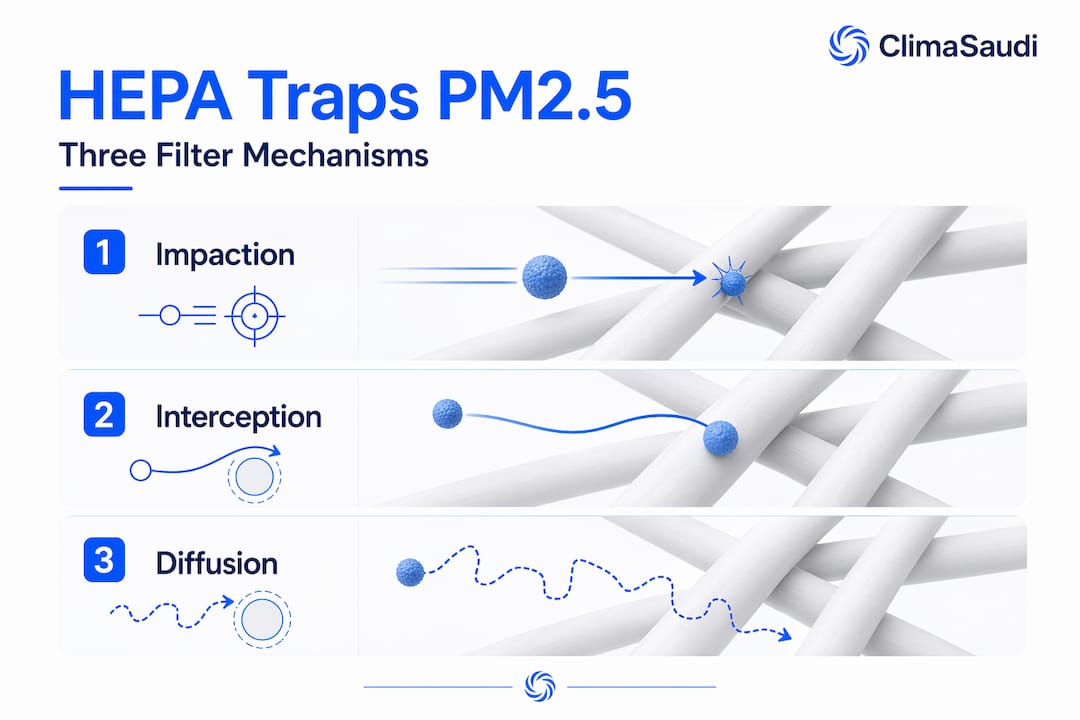
Most people assume air filters work like a net: particles smaller than the gaps simply pass through. True HEPA filtration does not work that way. It uses three distinct physical mechanisms that make it surprisingly effective at capturing even the finest PM2.5 particles.
Impaction targets larger particles within the PM2.5 range. As air flows through the dense filter fibres, heavier particles cannot follow the curved airstream and collide directly with fibres, where they are held by adhesion.
Interception captures medium-sized particles that follow the airstream closely but brush against a fibre as they pass. They do not need to hit the fibre directly; touching it is enough to trap them.
Diffusion is the mechanism that surprises most people. Particles smaller than 0.1 microns move erratically due to Brownian motion, the random molecular collisions that knock tiny particles off their path. This erratic movement actually increases their chances of contacting and sticking to a fibre.
These three mechanisms explain why true HEPA filters remove at least 99.97% of airborne particles at 0.3 microns. The 0.3 micron size is the most penetrating particle size (MPPS): too small for impaction and interception to work at peak efficiency, yet too large to benefit fully from diffusion. Particles both larger and smaller than 0.3 microns are actually captured at even higher rates. PM2.5 particles span a range that includes sizes well above 0.3 microns, meaning HEPA filtration is highly effective across the entire PM2.5 spectrum.
This is fundamentally different from MERV-rated filters used in HVAC systems. MERV 13 filters, for example, capture most PM2.5 but are not tested or certified to the same standard as true HEPA. For room-level PM2.5 filtration, certified HEPA is the reference standard. You can read more about HEPA filter ratings and how to apply them when choosing products for your home.
Pro Tip: Look for the phrase “true HEPA” or “HEPA H13” on the product specification, not just the word “HEPA.” H13 grade is the minimum you should accept for meaningful PM2.5 filtration.
Real-world effectiveness: what the research shows
Understanding filtration physics is useful. Knowing what HEPA filters actually achieve in a lived-in home is what helps you decide whether to invest.
A 2025 study published in npj Clean Air examined homes in Los Angeles during a wildland-urban-interface fire, one of the most demanding real-world tests for PM2.5 filtration systems. Homes using portable HEPA purifiers saw a 15% reduction in indoor PM2.5, equivalent to approximately 3 µg/m³, compared to homes without HEPA filtration. That figure sounds modest, but it represents a consistent, measurable benefit during extreme outdoor pollution conditions.
| Factor | Impact on HEPA effectiveness |
|---|---|
| Room size vs. CADR | Undersized purifier reduces air changes per hour, lowering PM2.5 removal |
| Fan speed | Low settings increase particle dwell time; high speeds achieve fastest removal |
| Ventilation rate | High infiltration from outdoors limits indoor PM2.5 reductions |
| Filter maintenance | Clogged filters reduce airflow and filtration efficiency over time |
| Placement | Central room placement improves whole-room air circulation |
The same study noted that real-world HEPA effectiveness depends heavily on building characteristics, ventilation rates, and how people actually use their devices. A purifier running on the lowest fan speed in a poorly sealed room delivers a fraction of what it could achieve under optimal conditions.
“HEPA filters are not a passive shield. Their performance is directly tied to airflow, room conditions, and how consistently you run them.”
HEPA filter effectiveness against PM2.5 also has a clear limitation: it addresses particles only. Gases, volatile organic compounds (VOCs), and odours pass straight through a HEPA membrane. That is a design fact, not a flaw. For full indoor air quality coverage, HEPA needs to be paired with activated carbon filtration. Understanding this distinction helps you set realistic expectations and build a more complete solution.
Misconceptions about HEPA and PM2.5
There is a lot of confusion in the market, and some of it is deliberately created by product labelling. Getting this right matters for your health.
-
“HEPA-like” is not HEPA. Products described as “HEPA-style” or “HEPA-type” are not certified to remove 99.97% of particles at 0.3 microns. They may capture some PM2.5, but there is no independent verification of how much. True HEPA certification requires third-party testing.
-
Your sensor placement affects your readings. Placing an air quality monitor directly in the exhaust stream of your purifier gives misleadingly low PM2.5 readings, because you are measuring already-filtered air. Sensors should sit at breathing height, away from the direct airflow, to reflect the air quality you are actually exposed to.
-
Fan speed is not optional. Running a purifier on its quietest setting all day sounds appealing, but it is not always sufficient. During pollution spikes, illness periods, or sandstorm events, you need the purifier working at higher speeds to achieve rapid particle clearance.
-
PM2.5 and gases are separate problems. HEPA filters do not remove gases or odours. If you notice chemical smells, cooking odours, or VOCs in your home, an activated carbon layer is the correct solution, not a higher-grade HEPA filter. Some purifiers combine both in a single unit, which is worth prioritising.
-
The pm25_env sensor metric matters. Standard PM2.5 readings can be calibrated for laboratory conditions. For accurate indoor monitoring in real environments, look for devices or apps that report the pm25_env metric, which reflects ambient real-world conditions more accurately.
For a deeper look at how certification labels translate to actual filter performance, the Climasaudi guide on true HEPA certification is worth reading before you purchase.
Choosing and using a HEPA system effectively
Knowing how HEPA filters reduce PM2.5 is only useful if you translate that knowledge into practical decisions. Here is how to do that.
-
Match CADR to your room size. The Association of Home Appliance Manufacturers recommends a CADR of at least two-thirds of your room’s square footage. A bedroom of 20 square metres needs a purifier with a CADR of at least 140 m³/h. Going larger is almost always better.
-
Place the purifier centrally. Avoid placing it in corners or behind furniture. Central placement, or positioning near the primary source of pollution, maximises the volume of air passing through the filter per hour.
-
Run it on high during pollution events. Air purifiers should clear 90% of 0.3 µm particles within five to ten minutes on a high fan setting. During Riyadh sandstorms, wildfire smoke events, or illness recovery periods, running on the highest comfortable setting makes a real difference.
-
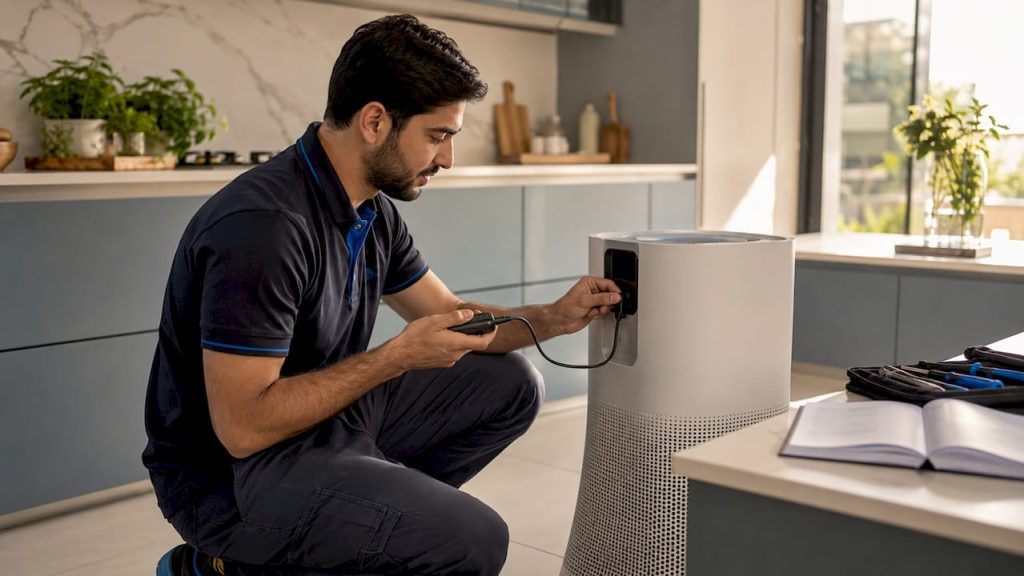
Replace filters on schedule. A clogged HEPA filter does not just underperform; it restricts airflow, increases energy use, and can actually release particles back into the room. Check the manufacturer’s replacement schedule and keep to it. Many Climasaudi products include filter replacement reminders.
-
Pair HEPA with activated carbon for complete coverage. For homes in coastal cities like Jeddah where humidity accelerates the build-up of biological particles and odours, a combined HEPA and carbon filter unit addresses both particulate and gas-phase pollutants in one pass.
-
Keep windows closed during outdoor pollution peaks. HEPA filtration is most effective in a controlled environment. Opening windows during a dust event introduces far more PM2.5 than any purifier can clear in real time.
Pro Tip: For accurate air quality tracking, use a monitor that reports the pm25_env metric rather than standard PM2.5 values. It gives a more realistic picture of what you are breathing indoors across different seasons.
My view on HEPA filtration and realistic expectations
In my experience, the biggest mistake people make with HEPA air purifiers is treating them as a set-and-forget solution. They buy a certified device, place it in the corner of a large room, and run it on the lowest setting to keep noise down. Then they wonder why their allergy symptoms persist.
HEPA filter air quality improvements are real and measurable. But they depend on consistent use, correct sizing, and regular maintenance. I have seen households in Saudi Arabia invest in premium purifiers and then go months without replacing filters, or fail to use them during the very events that matter most, such as spring dust storms or extended periods of outdoor haze.
What I have also found is that people underestimate the value of layering. A purifier combining HEPA H13 filtration with activated carbon is not a luxury upgrade. For a home in Dammam dealing with humidity, industrial odours, and PM2.5, it is the practical minimum. The benefits of HEPA filters extend well beyond dust capture, but only when the whole system is working as intended.
My advice is straightforward. Buy correctly sized, certified equipment. Run it properly. Replace filters on time. And accept that HEPA is one component of good indoor air quality, not the complete answer on its own.
— Pauline
Find the right HEPA purifier at Climasaudi
If you are ready to act on what you have learned about HEPA filter effectiveness for PM2.5, Climasaudi has a curated range of certified HEPA H13 air purifiers suited to Saudi homes of every size. From compact options for bedrooms to high-CADR units for open-plan living areas, each product is selected for performance in local climate conditions. You can also find replacement HEPA and carbon filters that combine particulate and gas-phase filtration in a single unit. For those looking for a proven all-in-one model, the Blueair ComfortPure T20i delivers powerful PM2.5 reduction with next-day delivery across Riyadh, Jeddah, and Dammam. Browse the full range at Climasaudi and use the Air Match tool to find the right purifier for your specific room and air quality needs.
FAQ
What is the role of a HEPA filter for PM2.5?
A HEPA filter captures PM2.5 particles through three physical mechanisms: impaction, interception, and diffusion. Certified true HEPA filters remove at least 99.97% of particles at 0.3 microns, which means they are highly effective across the full PM2.5 size range.
How much does a HEPA filter reduce indoor PM2.5?
Research shows portable HEPA purifiers can reduce indoor PM2.5 by around 15% (approximately 3 µg/m³) during high-pollution events such as wildfire smoke. Real-world results depend on room size, CADR rating, ventilation, and fan speed.
Is “HEPA-style” the same as true HEPA?
No. “HEPA-style” or “HEPA-like” products are not certified to remove 99.97% of particles at 0.3 microns and may not filter PM2.5 effectively. Always look for products labelled “true HEPA” or certified to H13 standard.
Can a HEPA filter remove odours and gases?
No. HEPA filters are designed strictly for particulate matter and do not remove gases, VOCs, or odours. You need an activated carbon filter alongside HEPA for complete indoor air quality coverage.
What CADR should I look for in a HEPA air purifier?
The recommended guideline is a CADR of at least two-thirds of your room’s square footage. For a 25 square metre living room, that means choosing a purifier with a CADR of at least 165 m³/h to maintain effective air changes per hour.