
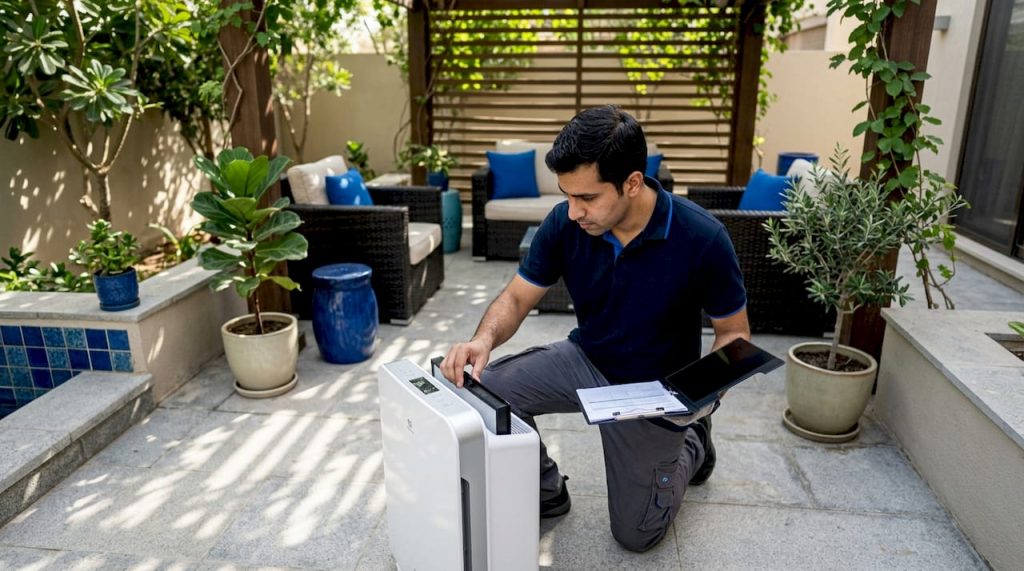
An air purifier maintenance contract is a recurring service agreement that covers scheduled inspections, filter replacements, and repairs to sustain high indoor air quality and equipment reliability. In Saudi Arabia, where desert dust, PM2.5 particles, and seasonal sandstorms place constant pressure on filtration systems, this type of air purifier service agreement is not a luxury. It is a practical necessity for any homeowner or property manager who wants consistent air quality without unexpected repair bills.
What is an air purifier maintenance contract?
An air purifier maintenance contract, also known in the industry as a preventive maintenance agreement or PMA, is a formal arrangement between a property owner and a qualified service provider. The contract commits the provider to visit at set intervals, carry out defined tasks, and deliver written reports on equipment condition. The scope typically covers everything from filter changes and fan calibration to seal integrity checks and electrical safety tests.
The key distinction from a one-off service call is regularity. A single visit fixes a known problem. A maintenance contract prevents problems from forming in the first place. For villas and apartments in Riyadh, Jeddah, or Dammam, where air purifiers run continuously against heavy dust loads, that difference is significant.

What services are included in a maintenance contract?
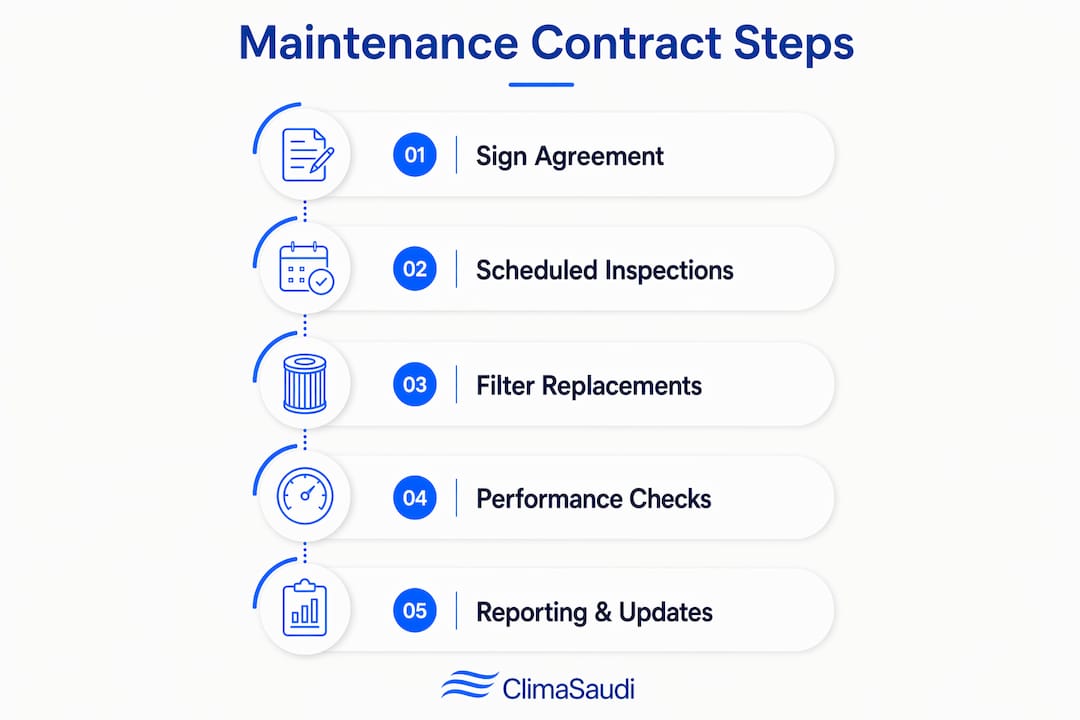
Professional maintenance visits are typically scheduled every 3–4 months, with a comprehensive overhaul carried out at the 12-month mark. Each visit follows a structured checklist rather than a quick wipe-down.
A standard air purifier service agreement covers the following:
- Scheduled inspections and deep cleaning. The technician disassembles accessible components, removes accumulated dust from internal chambers, and cleans fan blades and housing.
- Staged filter replacements. Pre-filters are changed quarterly, while HEPA H13 and activated carbon filters are replaced annually. This staged approach balances filter lifespan with waste reduction.
- Performance checks. These include sensor calibration, fan speed verification, airflow measurement, and CADR (Clean Air Delivery Rate) confirmation.
- Seal integrity inspection. Failing seal integrity allows unfiltered air to bypass the HEPA layer entirely, which makes the unit appear to be working while delivering no real protection.
- Written service report. After every visit, the technician provides a written report confirming fan calibration results, seal condition, and electrical safety test outcomes. This record is essential for tracking equipment health over time.
Pro Tip: Ask your provider to include CADR readings in every written report. A declining CADR figure is the earliest reliable sign that a filter is losing effectiveness, even before the indicator light triggers.
How do maintenance contracts benefit homeowners and property managers?
Consistent upkeep produces measurable gains across health, cost, and equipment longevity. The benefits are not theoretical. They show up in lower energy bills, fewer emergency call-outs, and air quality that stays stable rather than fluctuating between service visits.
- Sustained indoor air quality. Regular filter changes and cleaning keep PM2.5 and allergen capture rates at the levels the manufacturer specifies. Without scheduled maintenance, filtration efficiency drops gradually and silently.
- Preventive risk management. Professional technicians detect mechanical faults and sensor inaccuracies that automated dashboard alerts miss entirely. Catching a failing motor bearing early costs a fraction of a full motor replacement.
- Reduced energy consumption. A clogged pre-filter forces the fan motor to work harder. Quarterly pre-filter changes keep airflow resistance low and energy draw consistent.
- Minimised downtime. Local parts availability is a critical factor. Providers who stock spare parts locally resolve faults in hours rather than weeks. For property managers overseeing multiple units, that speed matters enormously.
- Compliance confidence. Residential and commercial properties in Saudi Arabia face increasing scrutiny on indoor air quality. A documented maintenance history demonstrates due diligence.
Maintenance contracts position servicing as an investment rather than a cost. A unit that runs at full efficiency for five years delivers far more value than one that degrades quietly and fails at year three, requiring full replacement.
Improving your home’s indoor air quality goes beyond buying a good unit. Sustained performance depends on what happens after installation.
What are common contract terms and pricing structures?
Contract structures vary, but most providers offer three duration options: annual, biannual, or a customised frequency based on site assessment. Annual contracts are the most common starting point for residential properties.
Pricing models fall into two broad categories. A fixed-fee contract bundles all scheduled visits, labour, and standard parts into a single annual charge. A tiered or variable model charges a base fee per visit and adds parts costs separately. Fixed-fee contracts are generally better value for homeowners who want predictable budgeting. Service costs range from around $60 for a basic preventive visit to over $850 for comprehensive commercial packages covering multiple units.
Several factors influence the final price:
- Unit model and filter type. HEPA H13 units with multi-stage filtration cost more to service than basic single-filter models.
- Usage intensity. A unit running 24 hours a day in a dusty environment in Riyadh needs more frequent attention than one used intermittently in a coastal apartment.
- Number of units. Property managers covering multiple units often negotiate volume pricing, which reduces the per-unit cost significantly.
- Optional add-ons. Emergency call-outs, extended parts warranties, and priority response windows are common extras that affect the total contract value.
Pro Tip: Before signing, request a full list of what the contract excludes. Accidental damage, consumables beyond the stated filter types, and electrical faults caused by power surges are frequently excluded. Knowing this upfront prevents disputes later.
Transparency in contract scope is non-negotiable. A reputable provider states exactly which parts are covered, which require additional payment, and what the call-out response time is.
How to choose the right air purifier maintenance plan
Selecting the right plan starts with understanding your specific situation. A villa in Riyadh with four occupants and a unit running continuously has very different needs from a two-bedroom apartment in Jeddah used part-time. Site-specific factors including occupancy, layout, and local pollutant levels directly inform the correct service frequency and contract scope.
Work through these considerations before comparing providers:
- Check your unit’s filter type and specifications. A HEPA H13 unit requires different servicing to a basic HEPA filter. Confirm the contract covers the exact filter grade your unit uses. Climasaudi’s HEPA filter maintenance guide explains the differences clearly.
- Assess your property’s air quality demands. Properties near construction sites, busy roads, or coastal areas in Dammam face higher particulate loads. Higher pollution levels call for more frequent pre-filter changes and shorter inspection intervals. City-specific guidance on local air quality factors helps you calibrate this accurately.
- Verify the provider’s parts supply chain. Ask directly whether the provider holds local stock for your unit’s filters and key components. A provider who orders parts from overseas introduces weeks of potential downtime.
- Check technician qualifications. The technician should be trained on your specific unit model, not just air purifiers in general. Ask for evidence of manufacturer-authorised training where available.
- Read the contract for hidden fees. Look specifically for charges related to travel time, after-hours call-outs, and parts not listed in the standard schedule. These are the most common sources of unexpected costs.
- Compare written report formats. A provider who delivers a detailed written report after every visit is demonstrably more accountable than one who provides only a verbal summary.
For property managers handling multiple units across a building or compound, bulk maintenance agreements often include consolidated reporting and priority scheduling that individual contracts do not offer.
Key takeaways
A well-structured air purifier maintenance contract protects both indoor air quality and equipment lifespan by combining scheduled filter changes, professional inspections, and documented service records.
| Point | Details |
|---|---|
| Service frequency | Professional visits every 3–4 months, with a full overhaul at 12 months. |
| Staged filter changes | Pre-filters quarterly, HEPA H13 and carbon filters annually, to balance lifespan and waste. |
| Seal integrity matters | Bypassed seals render HEPA filtration ineffective; contracts should include seal checks every visit. |
| Fixed-fee contracts | Bundle labour and parts into one predictable annual charge, reducing budget surprises. |
| Local parts availability | Providers with local stock resolve faults faster, cutting downtime for homeowners and property managers. |
Why I think most Saudi homeowners underestimate this
I have spoken with dozens of homeowners across Riyadh and Jeddah who bought excellent air purifiers and then ran them for two years without a single professional service. The units looked fine. The indicator lights stayed green. But when a technician finally opened them up, the internal chambers were coated in fine desert dust, the pre-filter seals had degraded, and the HEPA layer was working at a fraction of its rated capacity.
The automated alerts on most units are calibrated for average conditions. Saudi conditions are not average. Sandstorm season, high occupancy during summer months when windows stay shut, and the sheer volume of PM2.5 in urban air all accelerate filter loading beyond what the standard replacement schedule anticipates.
My honest advice: treat the manufacturer’s recommended service interval as a starting point, not a ceiling. If you live in a high-dust area or run your unit continuously, move to a three-month inspection cycle rather than four. And always choose a provider who can show you a written report from a previous client. Accountability is the single biggest differentiator between a reliable maintenance partner and one who simply shows up, changes a filter, and leaves.
— Pauline
Climasaudi’s maintenance support for Saudi homeowners
Climasaudi supports homeowners and property managers across Saudi Arabia with air purifier solutions built for local conditions, from desert dust in Riyadh to coastal humidity in Jeddah and Dammam.
Whether you are setting up a new unit or reviewing your current maintenance plan, Climasaudi’s air purifier catalogue covers HEPA H13 models matched to room size and air quality demands, with transparent SAR pricing and next-day delivery across KSA. Every product listing includes filter specifications and recommended service intervals, so you can plan your maintenance schedule from day one. Local customer support is available to help you match the right unit and service plan to your property.
FAQ
What does an air purifier maintenance contract typically include?
A standard contract covers scheduled inspections every 3–4 months, staged filter replacements, performance checks, seal integrity tests, and a written service report after each visit.
How often should air purifiers be serviced in Saudi Arabia?
Professional servicing every 3–4 months is the standard recommendation, though properties in high-dust areas or with continuous usage may require more frequent pre-filter changes.
What is the difference between a fixed-fee and a variable maintenance contract?
A fixed-fee contract bundles all scheduled visits, labour, and standard parts into one annual charge. A variable contract charges per visit and adds parts costs separately, which can make budgeting less predictable.
Why does seal integrity matter in an air purifier service agreement?
Degraded seals allow unfiltered air to bypass the HEPA layer, making the unit appear functional while delivering no real filtration benefit. Seal checks should be included in every scheduled visit.
How do I know if a maintenance provider is reliable?
Ask for written reports from previous service visits, confirm the provider holds local parts stock, and verify that technicians are trained on your specific unit model.