Desert dust storms roll into Riyadh with little warning. Coastal humidity in Jeddah seeps through closed windows overnight. And inside your bedroom, where you spend roughly a third of your life, these conditions combine with everyday pollutants to create air that actively works against your health. Bedroom air quality improvements are not a luxury consideration for Saudi homeowners. They are a direct response to the environment you live in, and this guide gives you the practical steps to make them count.
Table of Contents
- Key takeaways
- 1. Start with source control: reduce bedroom pollutants at their origin
- 2. Ventilate your bedroom properly
- 3. Use a certified HEPA air purifier correctly
- 4. Optimise your bedding and furnishings
- 5. Monitor your bedroom air quality with a sensor
- 6. Comparing air purifiers for Saudi bedrooms
- My honest take on bedroom air quality in Saudi homes
- Breathe better tonight with Climasaudi
- FAQ
Key takeaways
| Point | Details |
|---|---|
| Source control comes first | Reduce pollutants at their origin before spending money on purifiers or filtration. |
| Humidity must be managed | Keep bedroom humidity between 30% and 50% to suppress mould and dust mites. |
| HEPA H13 filtration works | Running a certified HEPA purifier reduces PM2.5 by 55% compared to untreated rooms. |
| Furnishings matter more than expected | Synthetic bedding traps moisture and allergens; natural fibre alternatives reduce both. |
| Quiet devices protect sleep | Choose purifiers rated below 25 dB with a sleep mode so clean air doesn’t cost you rest. |
1. Start with source control: reduce bedroom pollutants at their origin
The EPA’s three-level hierarchy for improving indoor air quality puts source control first, ventilation second, and filtration third. Most people skip straight to buying a device. That is an expensive mistake.
Your bedroom generates pollutants constantly. Dust mites live in mattresses and pillows. Pets leave dander on fabrics. New furniture off-gasses volatile organic compounds (VOCs) for months. Synthetic air fresheners add chemical particles to the air you breathe while sleeping.
The most cost-effective actions you can take:
- Wash all bedding at above 60°C weekly to kill dust mites. Lower temperatures leave the mites alive.
- Fit allergen-proof covers on mattresses and pillows to create a physical barrier.
- Remove air fresheners, scented candles, and heavily fragranced cleaning sprays from the bedroom.
- Let new furniture air out in a well-ventilated space for several days before placing it in the bedroom.
- Keep bedroom clutter low. Surfaces collect dust faster than you clean them.
Pro Tip: If you have a professional bedroom cleaning service deep-clean your mattress and soft furnishings once or twice a year, you remove the allergen reservoir that no purifier can reach.
Source control is unglamorous but it reduces the load that every other measure needs to handle. Get this right first.
2. Ventilate your bedroom properly
Fresh air dilutes indoor pollutants. Without ventilation, indoor humidity rises and biological contaminants multiply. The challenge in Saudi Arabia is timing it correctly.
In Riyadh, opening windows during a dust storm moves the problem indoors. In Jeddah, night-time air is often more humid than the air inside your home. You need to ventilate strategically, not reflexively.
Practical ventilation approaches for Saudi bedrooms:
- Open windows during cooler morning hours when outdoor air quality is acceptable. Check local air quality index readings before doing so.
- Use exhaust fans to pull stale air out of the room, particularly in bathrooms adjoining the bedroom.
- Consider a heat recovery ventilation (HRV) or energy recovery ventilation (ERV) unit, which exchanges indoor and outdoor air without losing the temperature difference. These are increasingly available in Saudi Arabia and significantly reduce both energy waste and humidity issues.
- Keep internal doors open when the air conditioning is running to promote circulation between rooms.
Pro Tip: Humidity control for your bedroom is as important as fresh air. Target indoor relative humidity between 30% and 50%. Below that, nasal passages dry out. Above it, dust mites and mould thrive. A basic digital hygrometer costs very little and removes all guesswork.
For humid coastal areas like Jeddah or Dammam, a dehumidifier running at night makes a measurable difference to how you breathe and sleep. For drier inland climates, an ultrasonic humidifier can restore the moisture balance that air conditioning strips out.
3. Use a certified HEPA air purifier correctly
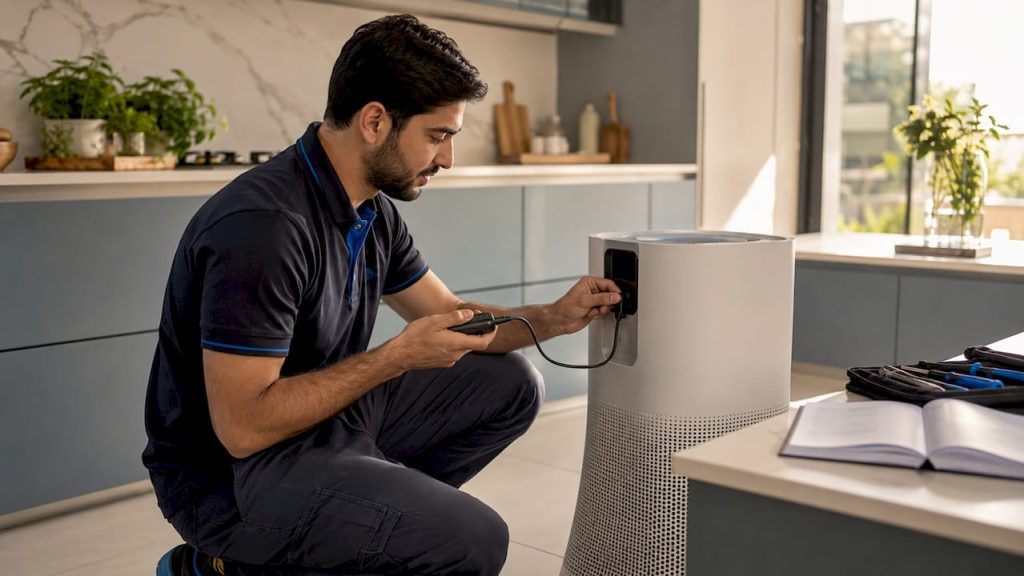
An air purifier is not a plug-and-forget device. Placed incorrectly and running an undersized unit means you are spending electricity to clean a fraction of your room’s air.
True HEPA filtration is the safest and most effective mechanical method for residential spaces. Avoid ozone-generating ionisers. They produce harmful byproducts that irritate airways, the opposite of what you need in a healthy sleeping environment.
Getting the sizing right
CADR (Clean Air Delivery Rate) measures how much filtered air a purifier delivers per minute. To achieve four to eight air changes per hour, which is the target range for allergy and PM2.5 reduction, match the CADR to your room size. A common error is buying a unit rated for 20 square metres and placing it in a 35-square-metre bedroom.
Filter type and construction
Activated carbon filters remove VOCs and odours. A HEPA filter alone will not address the smell from paint, furniture, or cleaning products. Look for units that combine HEPA H13 with an activated carbon layer. Sealed cabinet construction also matters: poor internal sealing allows unfiltered air to bypass the filter stack entirely, reducing the real-world performance well below the rated CADR.
Placement and maintenance
- Position the unit away from walls, with at least 30 centimetres of clear space on all sides.
- Replace filters on schedule. A clogged filter restricts airflow and forces the motor to work harder.
- Run the unit on higher settings while you are out of the room, then switch to sleep mode before bed.
Running a True HEPA purifier continuously in a bedroom reduces PM2.5 by an average of 55%, maintaining particle levels between 3 and 5 μg/m³ versus the WHO guideline of 15 μg/m³. That is the kind of measurable outcome worth investing in.
4. Optimise your bedding and furnishings
Your furnishings directly affect air quality. Synthetic mattress materials and poor moisture-wicking textiles trap humidity and create conditions where allergens build up faster. Replacing them is one of the most underrated bedroom air quality improvements available to you.
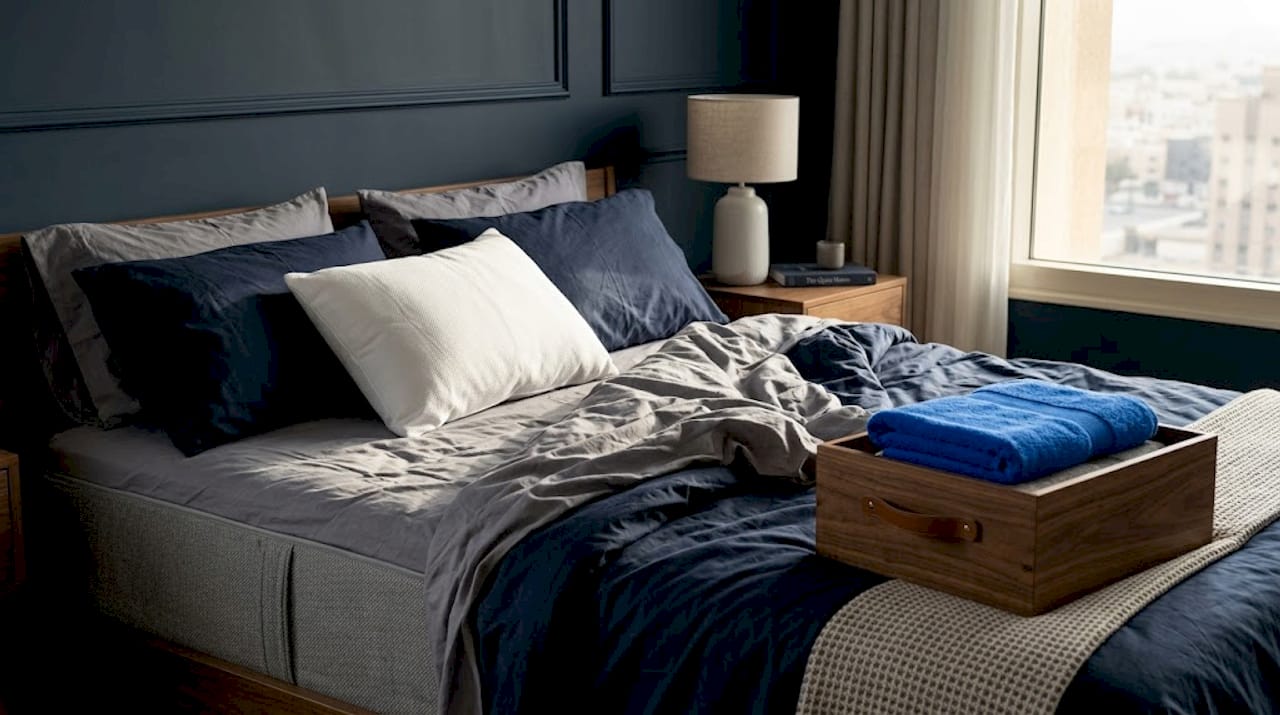
Natural fibre bedding, such as wool or cotton, wicks moisture away from the body more effectively than polyester. This keeps the sleeping surface drier and reduces the humidity microclimate that dust mites depend on.
Key furnishing changes that support cleaner air:
- Replace polyester-fill duvets and pillows with wool or natural fibre alternatives.
- Choose washable bedding that can be cleaned at high temperatures regularly.
- Minimise carpeting in the bedroom. Hard flooring is far easier to clean and retains significantly less dust and dander.
- If curtains are present, choose washable fabric over heavy lined drapes that accumulate dust without being laundered.
- Vacuum upholstered furniture and the mattress using a vacuum with a HEPA-rated filter.
Pro Tip: When vacuuming the bedroom, work from top to bottom: ceiling fans, shelves, then floors. Vacuuming the floor first and then disturbing dust from higher surfaces defeats the purpose.
These changes complement source control and filtration. Together they reduce the allergen load consistently rather than simply recirculating it.
5. Monitor your bedroom air quality with a sensor
You cannot manage what you cannot measure. Air quality monitoring devices have come down considerably in price and are now accessible to most homeowners in Saudi Arabia.
A good bedroom monitor tracks PM2.5 (fine particles), CO2 levels, total VOCs, temperature, and relative humidity. CO2 in particular is a useful proxy for ventilation quality. When CO2 rises above 1,000 ppm while you are sleeping, it indicates that fresh air exchange is insufficient. Many people sleep poorly in rooms with elevated CO2 and attribute it to other causes entirely.
Place the monitor away from the purifier’s output to get an accurate ambient reading. Check readings at different times: early morning before ventilation, after cleaning, and after running a purifier for a full cycle. Patterns become visible within a few days. You will know which of your bedroom air quality improvements are delivering results and which are not.
6. Comparing air purifiers for Saudi bedrooms
The table below compares two commonly referenced models well-suited to Saudi bedroom environments, based on independently verified specifications.
| Feature | Levoit Core 300-P | Blueair ComfortPure T20i |
|---|---|---|
| CADR (m³/h) | ~170 | ~210 |
| Filtration type | True HEPA + activated carbon | HEPA + activated carbon |
| Noise level (sleep mode) | ~24 dB | ~25 dB |
| Sleep mode | Yes | Yes |
| VOC control | Basic | Good |
| Approximate SAR price | ~600 SAR | ~1,503 SAR |
| Room coverage | Up to 18 m² | Up to 25 m² |
Quiet operation below 25 dB with a dedicated sleep mode is the single most important feature for a bedroom unit. A purifier that cleans the air but wakes you up at 3 am is not a workable solution for a healthy sleeping environment.
The Levoit Core 300-P suits smaller Saudi bedrooms, particularly in apartments. The Blueair ComfortPure T20i is better suited to larger rooms and offers stronger VOC performance, useful in newly furnished villas where off-gassing is a concern.
My honest take on bedroom air quality in Saudi homes
I’ve spent a lot of time looking at how people approach improving indoor air quality at home, and the single most consistent pattern I see is this: people treat air purifiers as a complete solution rather than one layer of a system.
In my experience, the hierarchy matters enormously. Source control first. Ventilation where possible. Filtration to handle what remains. When someone skips the first two steps and buys a purifier, they are filtering air that is still being actively polluted by unwashed bedding, synthetic furnishings, and poor moisture control.
I am also cautious about over-complicating things. In Saudi Arabia, the single biggest wins for most bedrooms are washing bedding consistently at high temperature, keeping humidity in check with a dehumidifier or humidifier depending on your city, and running a correctly sized HEPA purifier on sleep mode throughout the night. That combination outperforms expensive multi-device setups that skip the basics.
One thing I genuinely believe is undervalued: air purifiers must supplement, not replace, source control and ventilation. I have seen rooms with three purifiers running and still suffering from poor air quality because nobody addressed the dust-collecting carpets or the synthetic bedding.
Start simple. Be consistent. The results will follow.
— Pauline
Breathe better tonight with Climasaudi
If you are ready to act on what you have read, Climasaudi makes it straightforward to find the right products for your bedroom and your city.
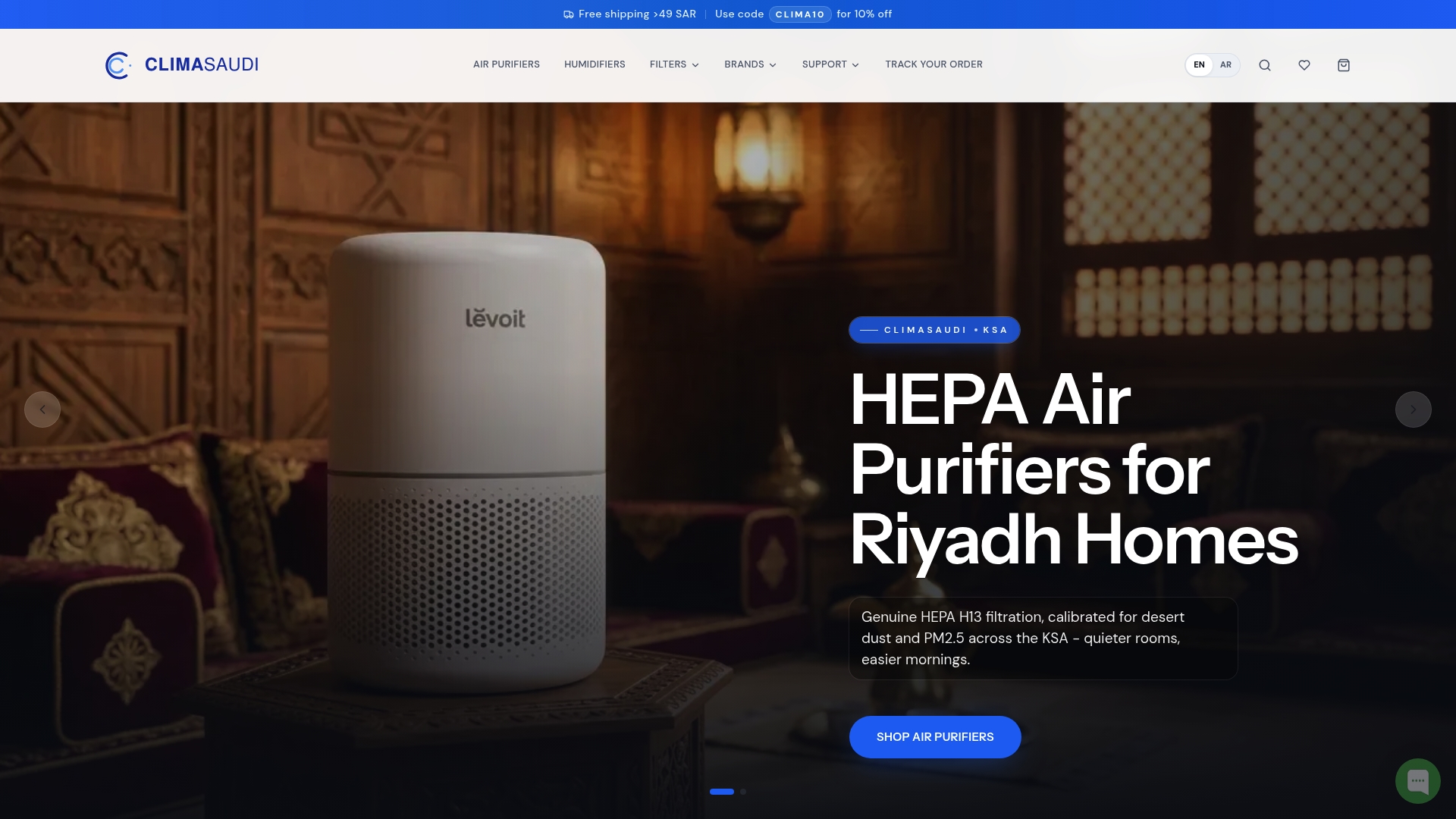
Climasaudi stocks a full range of air purifiers, humidifiers, and HEPA filters specifically selected for Saudi homes in Riyadh, Jeddah, and Dammam. Every product listing includes room size guidance, filter type information, and SAR pricing with no hidden costs. If you are looking for a quiet bedroom unit, the Blueair ComfortPure T20i is available with next-day delivery. Smaller bedrooms are well served by the Blueair Blue 3610, a compact option that balances performance with price. For humidity management, browse the humidifier range to find ultrasonic models suited to both dry inland climates and coastal humidity conditions. Local customer support is available to help you match the right product to your specific bedroom and budget.
FAQ
What is the fastest bedroom air quality improvement?
Washing your bedding at above 60°C and fitting allergen-proof mattress covers provides immediate reduction in dust mite allergens. These steps cost very little and take effect from the first wash.
How do I choose the right air purifier for my bedroom size?
Match the purifier’s CADR rating to your room’s square footage to achieve at least four air changes per hour. A CADR of around 170 m³/h covers bedrooms up to 18 square metres.
Is humidity control really necessary in Saudi bedrooms?
Yes. Indoor humidity above 50% promotes mould growth and dust mite proliferation. Coastal cities like Jeddah and Dammam regularly exceed this threshold indoors without active humidity management.
Are ioniser air purifiers safe for bedrooms?
No. Ozone-generating ionisers produce byproducts that irritate the respiratory system. Stick to mechanical HEPA filtration, which is safer and more effective for residential use.
How often should I replace HEPA filters in a Saudi bedroom?
In Saudi Arabia, high dust levels mean filters may clog faster than the manufacturer’s standard schedule suggests. Check the filter every three months and replace it when airflow noticeably decreases or the indicator signals.
Recommended
- Apartment air purifier benefits for cleaner air in Saudi homes — Blog | ClimaSaudi
- How air purifiers cut cleaning time in Saudi homes — Blog | ClimaSaudi
- Air purifier vs air filter: what works for Saudi homes? — Blog | ClimaSaudi
- City-specific air purifier features for Saudi homes — Blog | ClimaSaudi