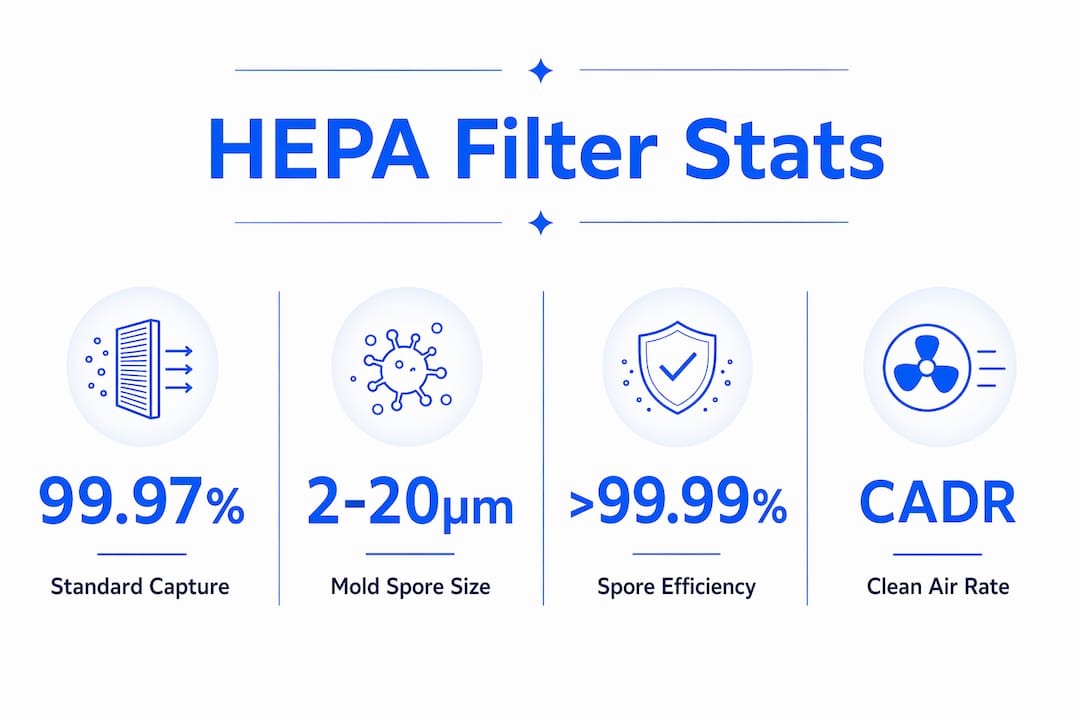
A True HEPA filter captures at least 99.97% of airborne particles at 0.3 microns, and because mold spores typically measure between 2 and 20 microns, they are trapped at even higher efficiency, often exceeding 99.99%. Understanding how a HEPA filter captures mold spores is the first step toward genuinely cleaner air in your home. The process relies on three distinct physical mechanisms, not a simple mesh screen, and that distinction matters enormously when you are choosing a unit for your bedroom, living room, or any space prone to humidity. Brands certified to True HEPA standards, including Blueair, and classification systems such as H13 and H14 under European EN 1822 norms, set the benchmark for what actually works.
How HEPA filters capture mold spores: the physical mechanisms
Most people assume a HEPA filter works like a kitchen sieve, blocking anything too large to pass through the holes. That assumption is wrong, and it leads to poor purchasing decisions. HEPA filters are constructed from a dense, randomly arranged web of glass or synthetic fibres that create a tortuous pathway for air. Particles are not simply blocked at the surface. They are captured deep within the filter matrix through three simultaneous processes.
Impaction is the dominant mechanism for larger particles, including most mold spores. When air curves around a fibre, a particle with sufficient mass cannot follow the airstream and instead collides directly with the fibre, sticking to it. Because mold spores sit at the larger end of the particle spectrum, impaction is highly effective against them.
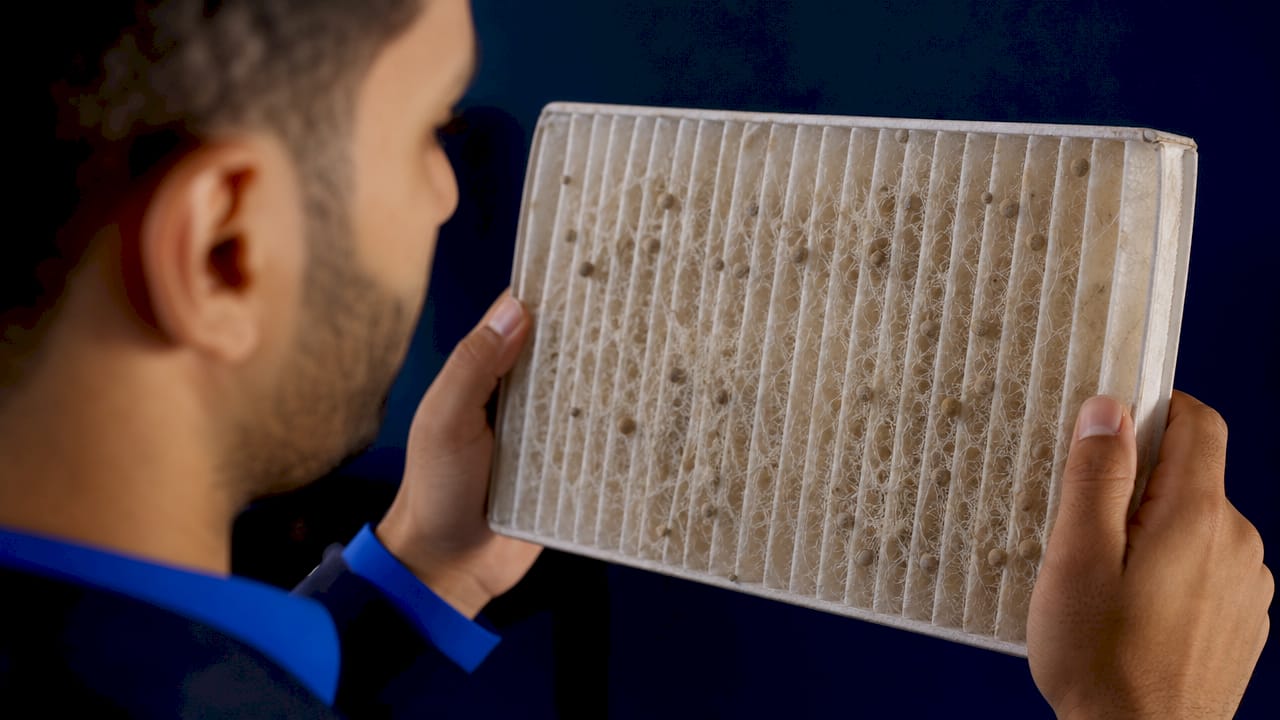
Interception captures mid-sized particles that travel close enough to a fibre to make contact without fully deviating from the airstream. The particle grazes the fibre and adheres. This mechanism works in parallel with impaction and adds a second layer of capture for spores travelling through the filter.
Diffusion applies mainly to very small particles below 0.1 microns. These particles move erratically due to collisions with gas molecules, a behaviour known as Brownian motion, which increases their chance of contacting a fibre. Mold spores are too large for diffusion to be the primary capture route, but the mechanism still contributes when spore fragments are present.
- Impaction: dominant for spores 2 microns and above
- Interception: secondary capture for particles near fibre surfaces
- Diffusion: relevant for sub-micron fragments and ultrafine particles
- All three mechanisms operate simultaneously within a single filter pass
Pro Tip: Never judge a HEPA filter by the size of its visible pores. The fibre web captures particles through physical contact, not exclusion. A filter that looks open to the naked eye can still trap particles far smaller than any visible gap.
How effective are HEPA filters at removing mold spores?
The 0.3-micron rating represents the Most Penetrating Particle Size (MPPS), which is the hardest size for any filter to capture. Particles both smaller and larger than 0.3 microns are actually trapped more efficiently than this baseline figure suggests. Mold spores, sitting between 2 and 20 microns, fall well above the MPPS, which is why real-world capture rates for spores routinely exceed 99.99%.
The table below compares common airborne particles by size and approximate HEPA capture efficiency to give you a clear picture of where mold spores sit relative to other threats.
| Particle type | Typical size (microns) | Approximate HEPA capture rate |
|---|---|---|
| Mold spores | 2–20 | Above 99.99% |
| Pollen | 10–100 | Above 99.99% |
| Dust mite debris | 0.5–50 | 99.97% or above |
| Bacteria | 0.3–10 | 99.97% or above |
| Virus particles | 0.02–0.3 | 99.97% at MPPS |
| Tobacco smoke | 0.01–1 | 99.97% or above |
These figures apply to certified True HEPA media under controlled test conditions. In a real home, two additional factors determine whether those numbers translate into actual spore reduction.
The first is the Clean Air Delivery Rate, or CADR. Even a filter rated at 99.97% delivers limited results if the unit moves too little air through the room. CADR measures the volume of clean air a purifier produces per minute, and matching that figure to your room size is non-negotiable for meaningful mold spore reduction.
The second is the distinction between True HEPA and so-called “HEPA-type” or “HEPA-style” filters. These unregulated labels carry no certification requirement and can perform significantly below the 99.97% threshold. For air filters for mold removal, only filters labelled True HEPA or carrying an H13 or H14 classification under EN 1822 should be considered.
What limits HEPA filter performance against mold spores?
HEPA filter effectiveness against mold spores is not solely determined by the filter media itself. Air leakage around filter frames and low-quality housings can reduce a unit’s effective capture rate from 99.97% to as low as 95%. That gap is large enough to allow millions of spores to recirculate through your home each hour.
There are four practical limitations every homeowner should understand before relying on an air purifier for mold spore control.
- Surface mold is unaffected. Air purifiers capture spores suspended in the air. They do not kill mold colonies growing on walls, ceilings, or behind skirting boards. Mold growing on surfaces requires physical remediation and moisture control, not filtration alone.
- Filter bypass reduces capture. Units with poor housing seals allow air to travel around the filter rather than through it. This is the single most common reason a certified filter underperforms in a real home.
- Filters degrade over time. A clogged or overloaded filter restricts airflow, reducing CADR and increasing the chance that spores pass through. Replacement schedules, typically every six to twelve months depending on usage, are not optional.
- HEPA does not remove mold-related gases. HEPA filters remove zero gases or volatile organic compounds (VOCs). Mold produces microbial VOCs (mVOCs) that cause musty odours and can affect health. Only activated carbon filtration addresses these compounds.
Pro Tip: When comparing air purifiers, check whether the unit uses a sealed True HEPA design. Look for the word “sealed” in the product specification. A sealed housing means all air must pass through the filter, not around it.
Moisture control sits alongside filtration as an equal priority. A dehumidifier that keeps indoor relative humidity below 60% removes the conditions mold needs to grow and release fresh spores. Filtration and humidity management work together. Neither replaces the other.
How to choose and use a HEPA air purifier to reduce mold spores
Selecting the right unit is straightforward when you focus on four criteria. Here is a practical sequence for homeowners and renters.
- Confirm True HEPA or H13 certification. Check the product specification for “True HEPA” or the H13 filter classification under EN 1822. H13 filters capture 99.95% of particles at the MPPS, and H14 captures 99.995%. Both exceed the standard True HEPA threshold and are appropriate for homes with mold concerns.
- Match CADR to room size. A general rule is to select a unit with a CADR rating that delivers at least five air changes per hour in the target room. For a 20-square-metre bedroom with a 2.7-metre ceiling, that means a CADR of roughly 180 cubic metres per hour or above.
- Choose a unit with activated carbon. A True HEPA combined with activated carbon addresses both mold spores and the mVOCs responsible for musty smells. This combination is the minimum specification for any home dealing with mold-related air quality issues.
- Position the unit correctly. Place the purifier in the room where mold is most likely to release spores, such as a bathroom-adjacent bedroom or a basement living area. Keep it away from walls and furniture to allow unrestricted airflow on all sides.
- Follow the filter maintenance schedule strictly. A degraded filter is worse than no filter in one specific way: it gives a false sense of protection. Replace filters according to the manufacturer’s guidance, and check pre-filters monthly in dusty environments like those found in Riyadh or coastal areas near Jeddah.
- Pair filtration with moisture control. Run a dehumidifier alongside your air purifier in any room where humidity regularly exceeds 60%. This two-pronged approach removes airborne spores while denying mold the conditions it needs to produce more.
For larger rooms, air purifiers for large spaces require higher CADR ratings and are worth reviewing separately before purchase.
Key takeaways
A True HEPA filter captures mold spores at above 99.99% efficiency because spores are larger than the Most Penetrating Particle Size, but real-world performance depends equally on sealed housing, adequate CADR, and pairing filtration with moisture control.
| Point | Details |
|---|---|
| Capture efficiency for spores | Mold spores (2–20 microns) are captured above 99.99% due to their size relative to MPPS. |
| Three capture mechanisms | Impaction, interception, and diffusion work simultaneously; HEPA is not a simple sieve. |
| Sealed housing matters | Air bypass can reduce effective capture from 99.97% to as low as 95% in poorly sealed units. |
| Activated carbon is needed | HEPA alone does not remove mold-related VOCs; combine with activated carbon for full protection. |
| Moisture control is non-negotiable | Filtration removes airborne spores but does not stop mold growth; dehumidification is equally critical. |
Why I think most people underestimate the housing, not the filter
People spend hours comparing filter ratings and almost no time checking whether the unit is actually sealed. In my experience, this is where most air purifier purchases go wrong. A True HEPA filter inside a poorly constructed housing is like a high-quality door fitted with a gap at the bottom. The rating on the box becomes irrelevant.
The second mistake I see regularly is treating an air purifier as a cure for a mold problem rather than a management tool. If there is visible mold growth in your home, the source is moisture, not air quality. Filtration reduces the spore load you breathe, which matters for health, but it does not address the colony itself. I have seen homes in coastal cities like Jeddah where residents ran air purifiers continuously yet still experienced worsening mold because the underlying humidity was never controlled.
My honest recommendation is to buy the best-sealed H13 unit your budget allows, pair it with a dehumidifier, and treat any visible mold growth as a separate remediation task. The allergy and respiratory benefits of genuinely clean air are real and measurable. But they only materialise when the whole system works together.
— Pauline
Protect your home with the right air quality tools
If mold spores are a concern in your home, the right combination of filtration and moisture management makes a measurable difference to the air you breathe every day.
Climasaudi stocks a range of True HEPA-certified air purifiers, including the Blueair Blue Max 3450i with high CADR for larger rooms, and the Blueair ComfortPure T20i with integrated activated carbon for mVOC removal. For homes where humidity is the primary driver of mold growth, Climasaudi’s range of dehumidifiers for Saudi homes provides targeted moisture control suited to the local climate. All products are available with next-day delivery across Riyadh, Jeddah, and Dammam, with transparent SAR pricing and local customer support.
FAQ
What size are mold spores and can HEPA filters catch them?
Mold spores typically measure between 2 and 20 microns. True HEPA filters capture particles at this size above 99.99% efficiency, making them highly effective at removing mold spores from indoor air.
Does a HEPA filter kill mold or just capture spores?
A HEPA filter captures airborne mold spores but does not kill mold colonies growing on surfaces. Addressing mold growth requires physical remediation and humidity control alongside air filtration.
What is the difference between True HEPA and HEPA-type filters for mold?
True HEPA filters meet a certified standard of 99.97% capture at 0.3 microns. HEPA-type filters carry no regulated standard and may perform significantly below this threshold, making them unreliable for mold spore removal.
How often should I replace my HEPA filter if I have a mold problem?
Most manufacturers recommend replacing True HEPA filters every six to twelve months. In homes with active mold concerns or high dust environments, checking the filter every three months and replacing it sooner if airflow is visibly reduced is advisable.
Do I need activated carbon alongside HEPA to deal with mold?
Yes. HEPA filters remove mold spores as particulate matter but do not capture the volatile organic compounds mold produces. A combined HEPA and activated carbon filter addresses both spores and the musty odours associated with mold growth.