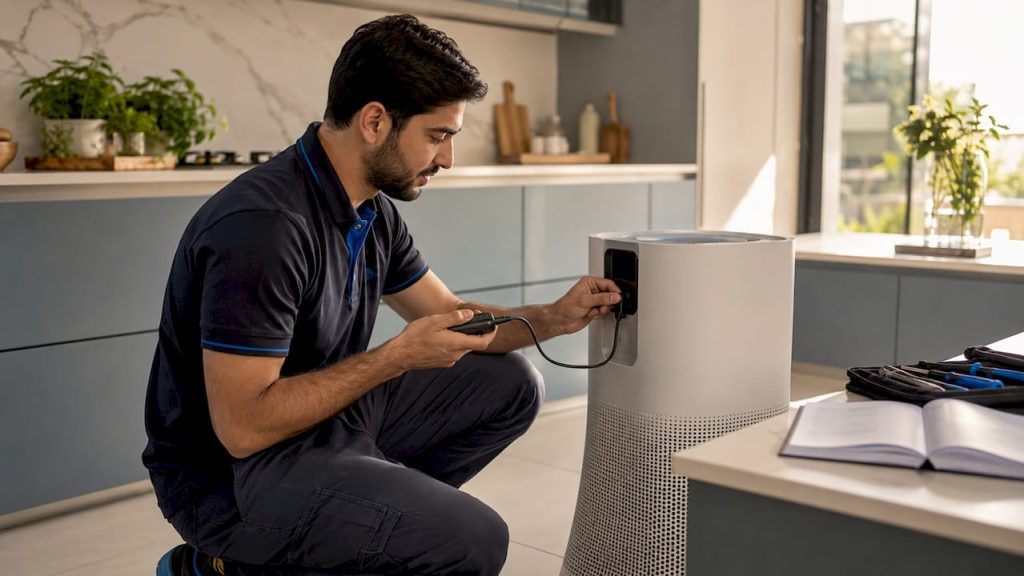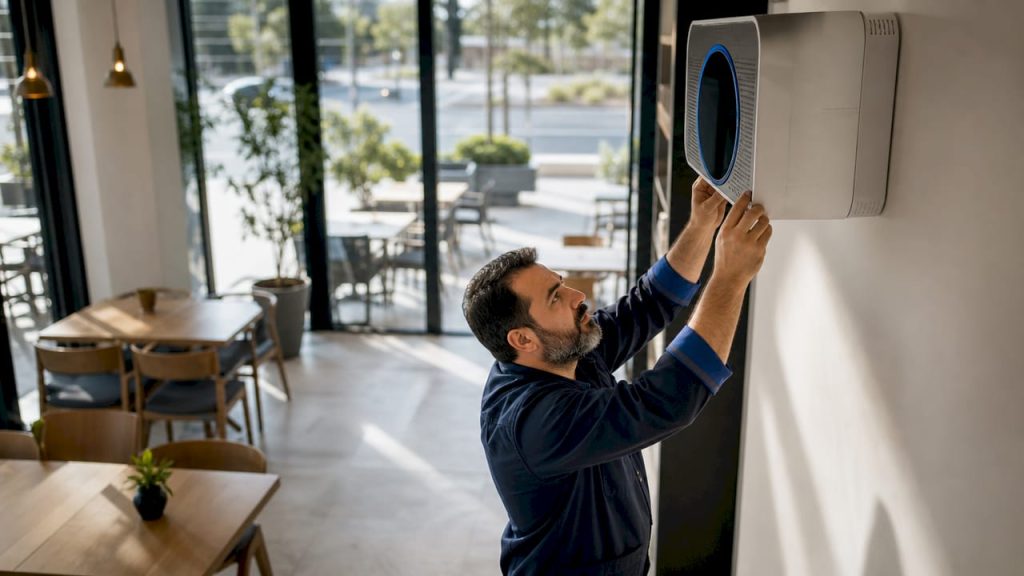
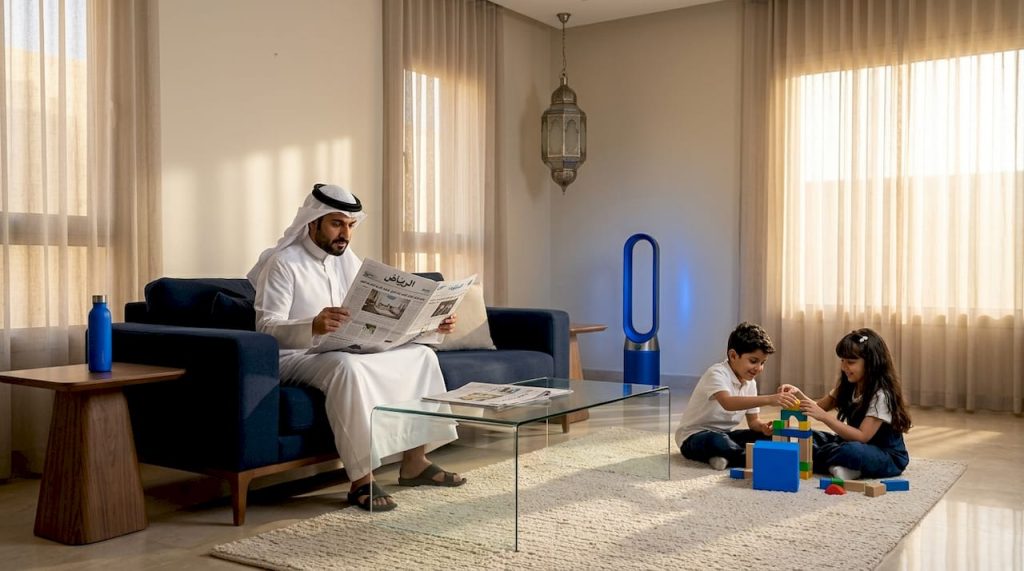
You seal your windows, you clean on the weekend, and by Tuesday the shelves are grey again. That is the daily reality for many homeowners across Riyadh, Jeddah, and Dammam, where desert dust does not wait for an invitation. The good news is that this cycle is not inevitable. Air purifiers reduce cleaning frequency by capturing airborne dust particles in HEPA filters before they ever settle on your surfaces, which means less time with a cleaning cloth and more time simply living in your home.
Table of Contents
- Why desert dust demands constant cleaning
- How air purifiers slow down dust accumulation
- What makes a purifier effective in extreme Saudi conditions
- Expert tips for maximising dust reduction and cleaning savings
- The reality few mention: Why most homeowners miss out on the full benefits
- Find the right air purifier for a cleaner Saudi home
- Frequently asked questions
Key Takeaways
| Point | Details |
|---|---|
| Major cleaning relief | Air purifiers can cut Saudi home dusting frequency by up to 50 percent with the right setup. |
| Importance of pre-filters | Pre-filters catch sand and large particles, making HEPA filters last longer and perform better. |
| Continuous operation is key | Running purifiers at 4-5 air changes per hour is essential to keep dust levels low in high-dust areas. |
| Maintenance is non-negotiable | HEPA filters need replacing more often in Saudi Arabia’s climate, especially after sandstorms. |
| Combine methods for best results | Air purifiers work best alongside wet cleaning and HEPA vacuums for a truly dust-controlled home. |
Why desert dust demands constant cleaning
Saudi Arabia sits at the heart of one of the world’s most dust-intensive environments. Sandstorms, known locally as haboob, push enormous volumes of fine particulate matter into the air and, inevitably, into your home. Even well-sealed apartments in central Riyadh are not immune. Microscopic particles slip through door frames, ventilation grilles, and gaps around window edges. Once inside, they circulate through the air for hours before finally settling on every horizontal surface in sight.
The particles involved here are not just large, visible sand grains. The real problem is PM2.5 and PM10. PM10 refers to particles up to 10 micrometres in diameter, roughly the width of a human hair. PM2.5 refers to particles smaller than 2.5 micrometres. These fine particles stay airborne far longer than coarser dust, travel deeper into your lungs, and coat surfaces with a fine, sticky layer that is harder to remove than ordinary grit. During peak sandstorm months, outdoor PM10 concentrations in Saudi cities can spike to levels many times above World Health Organisation guidelines.
“Saudi and Gulf desert conditions mean HEPA filters require replacement every 3 to 4 months, compared to 6 to 12 months in less dusty regions, with pre-filter cleaning needed every 2 to 4 weeks to maintain performance.”
This environment creates a compounding problem for your home. Dust settles on furniture, electronics, and soft furnishings. It then gets disturbed by movement, re-enters the air, and settles again. Your AC system circulates it further. Left unchecked, the situation also aggravates allergies, irritates airways, and contributes to more frequent AC servicing. For those wanting to understand air purifier features for Saudi homes in detail, the starting point is always understanding just how much more demanding the local environment is compared to temperate climates.
Key issues caused by heavy indoor dust in Saudi homes:
- Surface build-up: Furniture, shelves, and electronics accumulate visible dust within days, sometimes hours after cleaning.
- Allergy triggers: PM2.5 and pollen fragments irritate airways, particularly in children and those with asthma.
- AC strain: Dust-clogged AC filters reduce cooling efficiency and increase energy consumption.
- Humidity interaction: In coastal cities like Jeddah, humidity causes dust to clump and stick more stubbornly to surfaces, making cleaning harder.
- Shortened filter life: All filtration systems, from AC units to standalone purifiers, work significantly harder in Saudi conditions.
How air purifiers slow down dust accumulation
Understanding the bulk of the problem reveals why a targeted solution is necessary. Air purifiers work by drawing room air through a series of filters. A pre-filter catches larger particles first. A HEPA filter (High-Efficiency Particulate Air) then captures the finer particles, including PM2.5 and PM10. Many units also include an activated carbon layer to address odours and gases. The key result is simple: particles that would otherwise float through your room and settle on surfaces are instead trapped inside the filter.
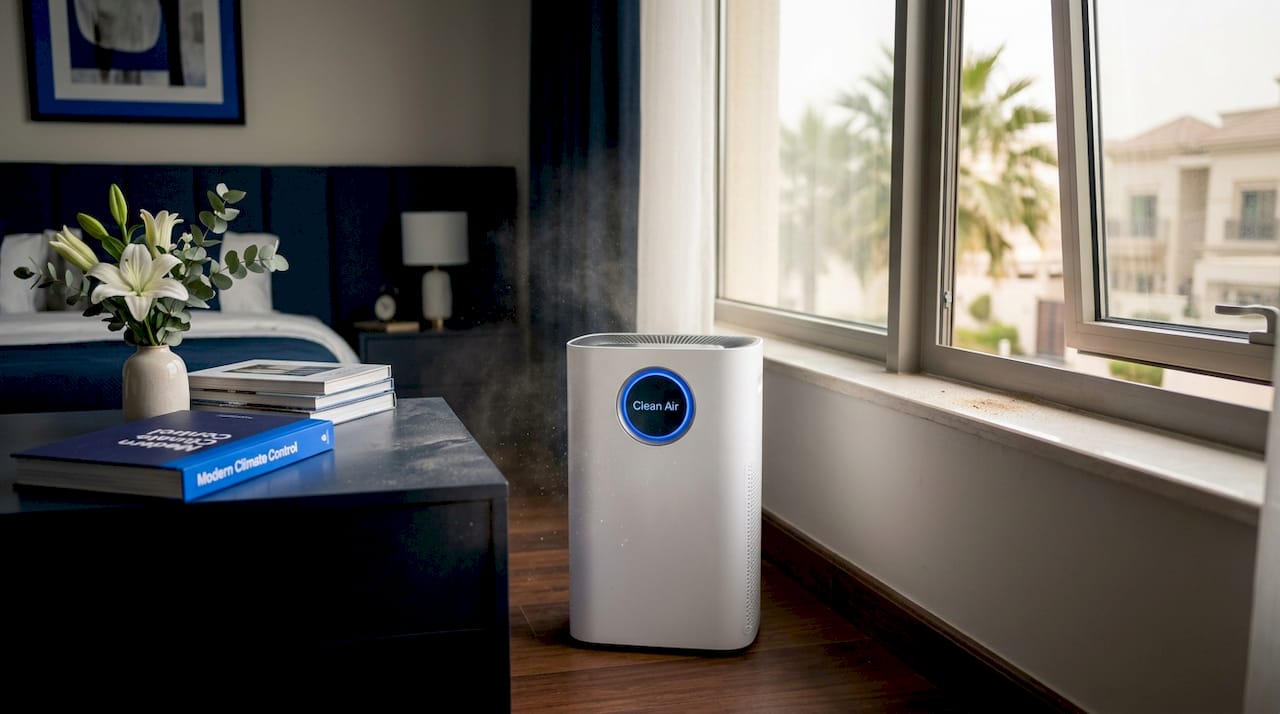
The difference this makes to cleaning frequency is measurable. Air purifiers reduce cleaning frequency by preventing particles from reaching your shelves and floors in the first place. Laboratory evidence backs this up strongly. Some models achieve a 98.9% particle reduction within 15 minutes of operation, dramatically reducing the number of particles available to settle. In practice, quality purifiers can reduce dusting needs by up to 50% by removing 99.98% of particles as small as 0.3 microns from the circulating air.
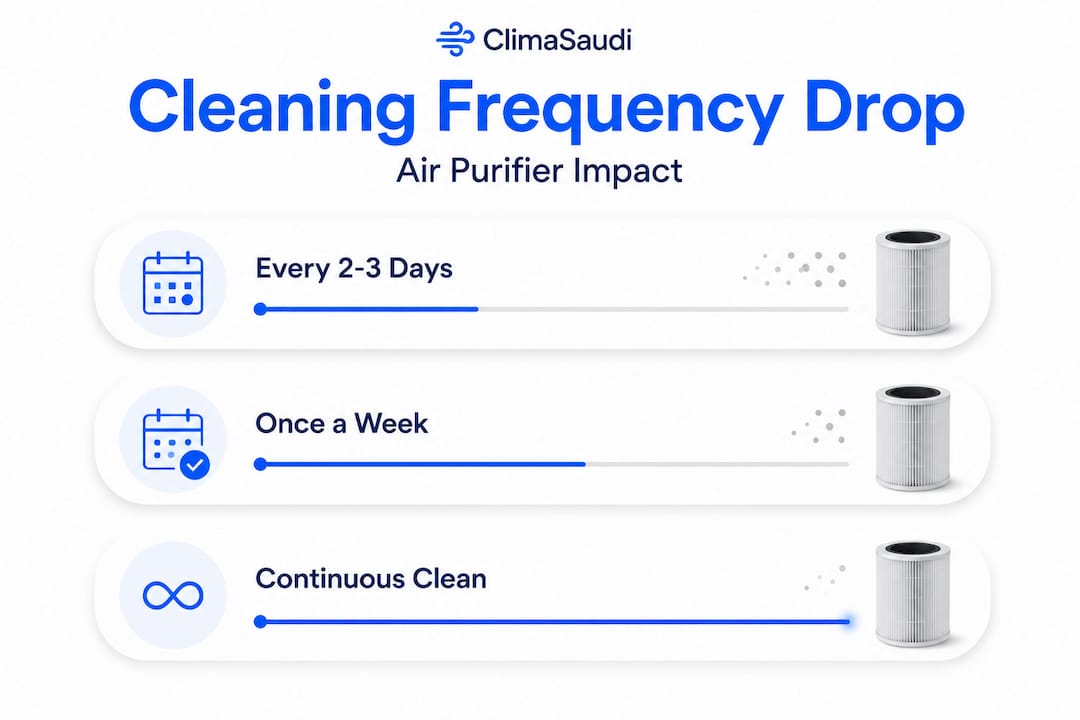
For a Saudi home where dusting might currently happen every two to three days, that could mean dusting once a week instead. That is a meaningful saving in time and effort, particularly for larger villas or homes with many open surfaces.
Pro Tip: Run your air purifier continuously, not just during sandstorm alerts. Dust infiltration in Saudi Arabia is a constant process, not just an event. Stopping and starting the purifier allows particles to accumulate during the off periods, reducing the overall benefit.
| Cleaning task | Without air purifier | With quality air purifier |
|---|---|---|
| Surface dusting | Every 2 to 3 days | Once a week |
| Floor sweeping | Daily | Every 2 to 3 days |
| AC filter cleaning | Every 2 to 3 weeks | Every 4 to 6 weeks |
| HEPA filter replacement | Not applicable | Every 3 to 4 months in Saudi conditions |
| Allergy symptom days | Frequent | Noticeably reduced |
Knowing how HEPA filters trap dust helps you appreciate why filter quality matters so much. A genuine HEPA H13 filter captures particles down to 0.3 microns with at least 99.97% efficiency. Cheaper filters labelled “HEPA-style” or “HEPA-like” offer significantly weaker performance and will not deliver the same reduction in surface dust accumulation.
What makes a purifier effective in extreme Saudi conditions
Once you know the mechanism, choosing the right device and keeping it working well is the next key step. Not all air purifiers perform equally in Saudi Arabia’s environment. Several technical factors genuinely determine how much cleaning relief you will experience.
Air changes per hour (ACH) is one of the most important metrics to understand. ACH refers to how many times per hour the purifier cycles the entire volume of air in a room through its filters. For ordinary indoor environments, 2 ACH is often sufficient. In Saudi Arabia, where ambient PM2.5 and PM10 levels are significantly elevated, PM2.5 reductions of 40 to 82% are achievable with purifiers operating at 4 to 6 ACH, which directly slows dust settling. Choosing a unit rated for a larger room than you actually have is a practical way to achieve higher ACH without running the device at maximum fan speed.
Pre-filters are not optional extras. In Saudi conditions, multi-stage filtration with pre-filters catches the larger sand particles before they reach the main HEPA filter, extending the HEPA’s effective life and maintaining overall efficiency. Without a pre-filter, your HEPA filter can become clogged with coarse particles far faster than the manufacturer’s standard replacement schedule assumes.
| Feature | Benefit in Saudi conditions | Maintenance interval |
|---|---|---|
| Pre-filter | Extends HEPA life, catches coarse sand | Clean every 2 to 4 weeks |
| HEPA H13 filter | Captures PM2.5 and PM10 | Replace every 3 to 4 months |
| Activated carbon layer | Reduces odours from dust and humidity | Replace every 4 to 6 months |
| High ACH rating | More passes of air per hour, fewer particles settling | Monitor via air quality indicator |
| Real-time PM2.5 sensor | Adjusts fan speed automatically during sandstorms | Calibrate periodically |
Additional features that matter for Saudi homes:
- Sealed filter housing: Prevents unfiltered air from bypassing the filter media entirely.
- Auto mode with PM sensor: Responds immediately when outdoor events push indoor PM levels higher.
- Quiet operation at medium speed: Allows continuous use day and night without disturbance.
- Local availability of genuine replacement filters: This is often overlooked until a filter needs changing urgently.
For a deeper look at what to prioritise when shopping, the guide on desert-ready air purifier features covers the specific requirements across Riyadh, Jeddah, and Dammam in practical detail.
Pro Tip: Check the Clean Air Delivery Rate (CADR) value for dust specifically when comparing models. A high CADR for dust means the purifier removes dust-sized particles faster. Match the CADR to your room’s square meterage, not just the manufacturer’s maximum room size claim.
Expert tips for maximising dust reduction and cleaning savings
With the right purifier and setup, the final step is applying smart routines that protect your investment and stretch out the time between cleaning sessions.
-
Position the purifier centrally or near the main entry point for dust. Placing the unit near a door or window that admits outside air helps intercept particles early, before they disperse through the room. Avoid placing it in a corner where airflow is restricted.
-
Run it continuously, not reactively. Continuous operation at 4 to 5 ACH is necessary for meaningful dust control. Switching the purifier on only after you notice dust on the furniture means particles have already settled. Consistent, always-on use is what creates the measurable reduction in cleaning frequency.
-
Clean your pre-filter on schedule, every two to four weeks. A clogged pre-filter restricts airflow, reduces ACH, and forces the main HEPA to work harder. In extreme cases, a very dirty filter can actually re-release trapped particles back into the room air, undoing much of your cleaning savings.
-
Combine your purifier with wet-cleaning methods. Purifiers reduce but do not eliminate dusting. For the best results, use damp microfibre cloths for surface wiping and a HEPA-equipped vacuum for floors. Dry dusting with a feather duster disperses particles back into the air, where the purifier then has to recapture them.
-
Size your purifier correctly for each room. Using a device rated for 20 square metres in a 45-square-metre living room means it operates at half the required ACH. You will see some benefit, but nowhere near the 50% reduction in dusting that properly sized units deliver.
-
Keep a filter replacement log. Saudi Arabia’s environment means filters exhaust faster than the packaging states. A simple note of the installation date on your phone calendar is enough. Maintaining HEPA filters on schedule is the single most important step for consistent dust reduction.
Pro Tip: During major sandstorm events, close all windows and run your purifier on its highest setting. Once the storm passes and outdoor air quality improves, return to your normal medium-speed continuous operation to preserve filter life.
The reality few mention: Why most homeowners miss out on the full benefits
Most guides will give you a list of tips and leave you confident that buying an air purifier solves the dust problem. The reality we see, and hear from customers across Saudi Arabia, is more nuanced.
The biggest issue is not the device itself. It is the gap between what the product can do in ideal laboratory conditions and what it delivers in a typical Saudi home. A purifier running in a sealed, single-room laboratory test achieves those impressive 98.9% particle reduction figures. A purifier running in an open-plan villa in Riyadh, with foot traffic, open kitchen areas, and windows that are occasionally opened, delivers something more modest but still genuinely valuable.
What undermines results most often is neglecting pre-filter cleaning. Many homeowners clean or replace the main HEPA filter on schedule but forget the pre-filter entirely. Within weeks, the pre-filter becomes so loaded with coarse sand that airflow drops sharply. The unit runs, but at a fraction of its rated ACH. Dust accumulates almost as fast as it would without the purifier running at all. This is not a device failure. It is a maintenance oversight that manufacturers do not always emphasise clearly enough.
The second overlooked reality is unit sizing. Marketing materials often present maximum room size claims based on open, obstacle-free spaces. Real rooms have furniture, wall dividers, and multiple air pathways. A conservative approach to sizing, choosing a unit rated for a larger room than you have, consistently delivers better cleaning relief than choosing the exact rated size.
Finally, there is the question of tailored purifier selection for your specific city and setting. What works well in Dammam’s humid coastal air is not always the best choice for the dry, intense dust of central Riyadh. Acknowledging those differences and choosing accordingly is what separates homeowners who genuinely reduce their cleaning burden from those who see only marginal improvement.
The honest position is this: a well-maintained, correctly sized air purifier running continuously will noticeably reduce your cleaning frequency in a Saudi home. But it works best as part of a considered routine, not as a standalone fix.
Find the right air purifier for a cleaner Saudi home
Knowing what works is only part of the picture. Finding the right unit for your specific home, your city, and your room sizes is where the real difference is made.
At ClimaSaudi, we stock air purifiers specifically selected for Saudi Arabia’s climate conditions, from high-ACH models for dust-heavy Riyadh interiors to humidity-resilient options for Jeddah homes. Every unit comes with transparent SAR pricing, next-day delivery, and local customer support. If you are ready to start reducing your cleaning routine, browse our full range of air purifiers or explore a trusted option like the Blueair Blue 3610, a popular choice for Saudi homes that balances strong filtration performance with quiet, continuous operation.
Frequently asked questions
How much can an air purifier reduce dusting in a Saudi home?
Quality air purifiers can cut dusting needs by up to 50% by trapping airborne particles before they settle on surfaces, with results depending on correct sizing and consistent operation.
How often should I replace air purifier filters in desert environments?
In Saudi Arabia’s desert conditions, HEPA filters need replacing every 3 to 4 months, roughly half the interval recommended for less dusty climates, with pre-filter cleaning every 2 to 4 weeks to maintain performance.
Will an air purifier eliminate the need to dust?
Air purifiers significantly reduce but do not eliminate the need to dust. Combining purifier use with damp-cloth wiping and HEPA vacuum cleaning delivers the most complete reduction in cleaning effort.
How quickly do air purifiers reduce dust particles indoors?
Some models achieve a 98.9% particle reduction within just 15 minutes of operation, which significantly slows the rate at which dust settles on furniture and floors.
Does humidity affect how much dust settles indoors?
Humidity causes fine dust particles to clump and stick more firmly to surfaces, making them harder to remove. Purifiers with multi-stage filtration, including pre-filters, help manage dust settling effectively even in the humid coastal conditions common in Jeddah.