An air purifier traps airborne dust particles with high efficiency, but it cannot remove dust already settled on your floors, shelves, or furniture. This distinction sits at the heart of any honest purifier vs dust particles comparison. In Saudi Arabia, where desert dust and PM2.5 particles enter homes regularly in cities like Riyadh, Jeddah, and Dammam, understanding what a purifier actually does is the first step toward cleaner indoor air. True HEPA filters capture 99.97% of airborne particles down to 0.3 microns. That figure covers dust, pollen, and pet dander floating in the air, but not the layer of grit sitting on your windowsill. Climasaudi stocks HEPA H13 certified purifiers designed specifically for these local conditions, and this guide explains how to use them effectively.
How do air purifiers remove dust particles from indoor air?
Air purifiers work by drawing room air through a series of filters, trapping particles before returning clean air to the space. The core technology is the True HEPA filter, which captures 99.97% of particles at 0.3 microns. That size range covers the most harmful airborne dust components, including fine desert sand, PM2.5 particles, pollen, and pet dander.
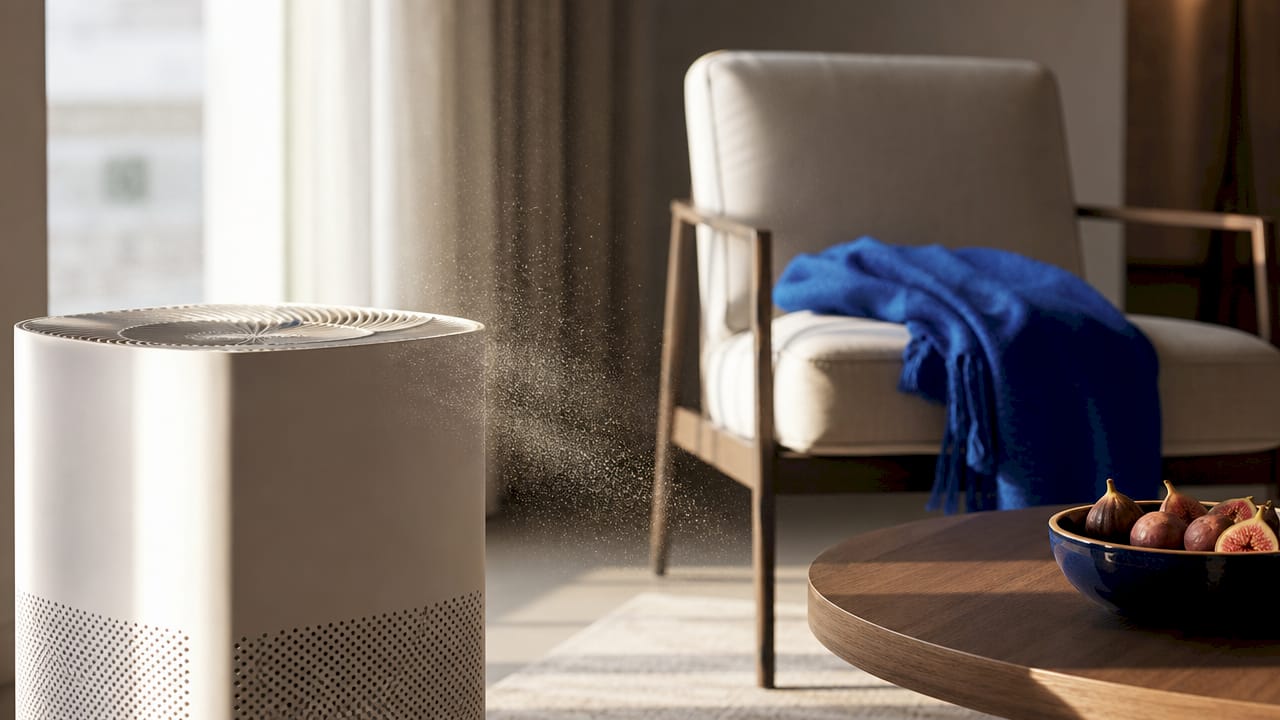
Understanding particle sizes helps you appreciate why HEPA matters. Visible dust you can see floating in sunlight sits around 10 microns. The particles that cause the most respiratory harm are far smaller, often below 2.5 microns, and they stay suspended in air for hours. A True HEPA filter catches both.
Most quality purifiers combine filter types for broader protection:
- True HEPA filter: Targets solid particles including dust, pollen, mould spores, and fine sand.
- Activated carbon filter: Absorbs gases, odours, and volatile organic compounds. It does not capture dust particles.
- Pre-filter: Catches larger debris like hair and coarse dust, extending the life of the HEPA layer.
The Clean Air Delivery Rate, known as CADR, tells you how quickly a purifier cleans a given room volume. A higher CADR means faster particle removal. However, real-world occupancy can overwhelm a purifier’s rated capacity if placement and ventilation do not support it. CADR is a useful guide, not a guarantee.
Pro Tip: Match your purifier’s CADR to your room size. A unit rated for 20 square metres will struggle in a 40 square metre living room, regardless of its filter quality.
Air purifiers vs HVAC filters: key differences for dust removal
The purifier vs dust particles comparison becomes more complex when you include HVAC filters. Both systems filter air, but they serve different purposes and perform differently in residential Saudi homes.
| Feature | Standalone air purifier | HVAC system filter |
|---|---|---|
| Filter standard | True HEPA (H13), captures 0.3 micron particles | MERV rated, typically MERV 8–11 for homes |
| Primary purpose | Improve room air quality | Protect HVAC equipment from dust buildup |
| Particle size captured | Down to 0.3 microns | Larger particles; finer allergens often pass through |
| Air coverage | Single room or zone | Whole house via duct system |
| Filter cost | Varies by model | MERV 8–11 filters cost approximately SAR 30–90 per filter |
| Replacement frequency | Every 6–12 months typically | Every 1–3 months depending on dust load |
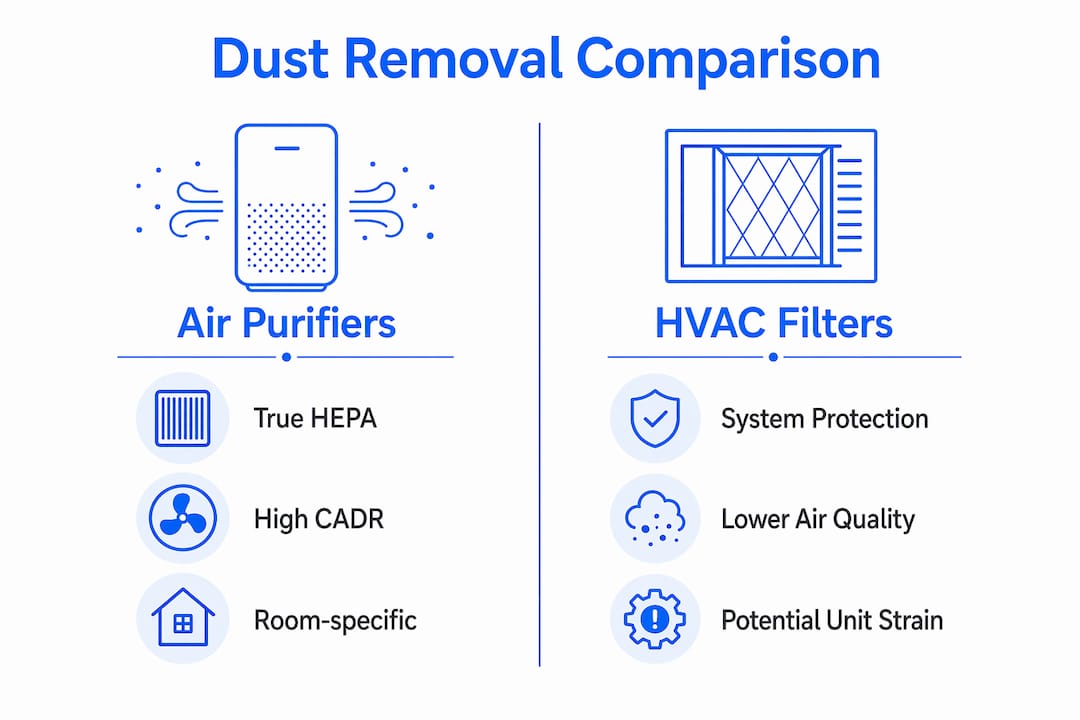
Furnace and HVAC filters protect your system from dust buildup but offer limited air quality benefits compared to a dedicated purifier. They remove larger particles, but fine allergens and PM2.5 particles pass through most standard HVAC filters. This is why a MERV 8 filter keeps your system running but does not meaningfully reduce the fine dust you breathe.
MERV ratings above 13 create a different problem. Upgrading to high MERV filters may damage older HVAC units because the denser filter material increases airflow resistance. Before changing your HVAC filter grade, check your system’s specifications. For most Saudi residential villas and apartments, MERV 8–11 is the practical sweet spot.
HEPA remains the only industry-standard rating for effective fine particulate removal. Unlike retailer-specific metrics, HEPA certification is consistent across brands and guarantees performance at 0.3 microns. Using both systems together, a MERV-rated HVAC filter and a HEPA purifier in key rooms, gives you the most complete coverage. For a detailed breakdown of pricing and performance suited to local homes, the purifier vs filter guide on Climasaudi’s blog is worth reading.
How to get the most from your air purifier against dust
Placement is the single most important factor in air purifier effectiveness. Positioning a unit near dust sources yields higher real-world benefits than simply choosing a high-powered model. In Saudi homes, that means placing purifiers near windows, doorways, or air conditioning vents where outdoor dust enters.
Follow these steps to maximise dust reduction:
- Vacuum and damp-dust before switching on a new purifier. High-powered units can initially stir settled dust into the air. Cleaning surfaces first prevents the purifier from temporarily worsening air quality.
- Place the purifier in the room where you spend the most time. Bedrooms are the priority for most households, as you spend 7–9 hours there breathing while asleep.
- Keep the unit at least 30 centimetres from walls and furniture. Restricted airflow around the unit reduces its effective output.
- Run the purifier continuously, not just when dust is visible. Continuous operation and strategic placement matter more than maximum CADR ratings alone. Dust particles are always present, even when you cannot see them.
- Replace filters on schedule. A clogged HEPA filter does not just lose efficiency; it can push trapped particles back into the room air.
Pro Tip: During Saudi dust storms, close windows and run your purifier on its highest setting. Once the storm passes, vacuum all surfaces before reducing the fan speed. This two-step approach prevents recirculated dust from overwhelming the filter.
Understanding how purifiers cut cleaning time in Saudi homes helps you build a routine that works with the purifier rather than against it.
What air purifiers cannot do: dust control beyond filtration
Air purifiers are not a complete dust solution on their own. Multi-layer dust management combining source control, ventilation, and filtration is the most effective indoor dust strategy. Relying on a purifier alone leaves a significant portion of your dust problem unaddressed.
The key limitations to understand:
- Surface dust is invisible to a purifier. Dust embedded in carpets, upholstery, curtains, and mattresses stays there until you physically remove it. A purifier only acts on particles suspended in the air.
- Purifiers can temporarily worsen air quality. Initial purifier use can stir up dust, particularly if settled dust is disturbed by the fan. Pre-cleaning before use prevents this.
- Source control reduces the total dust load. In Saudi homes, sealing gaps around windows and doors, using door mats, and removing shoes indoors all reduce the volume of desert dust entering the space.
- HEPA vacuuming is non-negotiable. A standard vacuum redistributes fine dust back into the air. A vacuum with a HEPA filter traps it. Using a HEPA vacuum weekly, especially on carpets and sofas, removes the settled dust that your purifier cannot reach.
- Ventilation strategy matters. Opening windows during dust storms brings in more particles than your purifier can handle. Timed ventilation, during cooler and calmer periods, reduces the overall particle load.
Dust extraction targets the source, while air filtration cleans dispersed airborne contaminants. Both approaches address different parts of the same problem. Combining them gives you cleaner air and cleaner surfaces. For a broader view of managing indoor air quality in Saudi homes, Climasaudi’s educational resources cover the full picture.
Key takeaways
A True HEPA filter is the only proven technology for removing fine airborne dust particles, but sustained dust control requires combining air purification with regular surface cleaning and source control.
| Point | Details |
|---|---|
| HEPA captures fine dust | True HEPA filters trap 99.97% of airborne particles down to 0.3 microns. |
| Purifiers miss settled dust | Surface dust on carpets and furniture requires vacuuming and damp-dusting to remove. |
| Placement beats power | Positioning your purifier near dust entry points delivers better results than a higher CADR rating alone. |
| HVAC filters serve a different role | MERV-rated filters protect your system; they do not replace a dedicated HEPA purifier for air quality. |
| Combined approach works best | Source control, HEPA vacuuming, and continuous purifier use together give the most sustained dust reduction. |
What I have learned about purifiers and dust in Saudi homes
People consistently overestimate what an air purifier can do on its own. The most common mistake I see is placing a purifier in a dusty room, switching it on, and expecting the dust problem to disappear within days. It does not work that way. The purifier handles what is floating in the air. Everything on your shelves, your sofa, and your floor is your job.
The second mistake is placement. Putting a purifier in the corner of a large room, away from where dust enters, is like placing a fan at the wrong end of a corridor. The unit runs, the indicator light glows, but the air near the window or the air conditioning vent stays thick with particles. Move the unit closer to the source and you will notice the difference within hours.
Saudi homes face a specific challenge that most generic purifier advice ignores: the sheer volume of fine desert particulate that enters during dust storms. A single haboob can deposit more PM2.5 indoors than weeks of normal activity. The right response is not a bigger purifier. It is a sealed home during the storm, a thorough vacuum immediately after, and a purifier running continuously in the rooms you use most.
My honest recommendation is to treat the purifier as one part of a three-part system: source control at the entry points, HEPA vacuuming on surfaces, and continuous air filtration in occupied rooms. That combination works. A purifier alone, however good, does not.
— Pauline
Cleaner air for Saudi homes with Climasaudi
Saudi homes face dust conditions that standard purifiers are not always built to handle. Climasaudi stocks a range of HEPA air purifiers certified to H13 standard, selected specifically for the dust loads common in Riyadh, Jeddah, and Dammam. Each unit is available with genuine replacement filters and next-day delivery across KSA.
Whether you are managing a bedroom, a villa, or an open-plan living space, Climasaudi’s product range covers room sizes and filtration needs across the board. Pair your purifier with a replacement filter on a regular schedule to keep performance consistent. Transparent SAR pricing and local customer support make it straightforward to find the right unit and keep it running at its best.
FAQ
Do air purifiers actually remove dust from a room?
Air purifiers remove dust particles suspended in the air, not dust settled on surfaces. True HEPA filters capture 99.97% of airborne particles down to 0.3 microns, including fine desert dust and PM2.5.
What is the best filter type for dust removal?
True HEPA is the most effective filter type for dust particle removal. It is the only filter standard with a certified efficiency rating at 0.3 microns, unlike MERV-rated HVAC filters, which target larger particles.
How often should I replace my HEPA filter in Saudi Arabia?
Most manufacturers recommend replacing HEPA filters every 6–12 months. In Saudi Arabia, high dust loads during summer and dust storm seasons may require more frequent replacement to maintain air purifier effectiveness.
Can I rely on my HVAC filter instead of buying a purifier?
HVAC filters protect your system from dust buildup but do not deliver the same air quality benefits as a dedicated purifier. MERV 8–11 filters remove larger particles; fine allergens and PM2.5 pass through most standard HVAC filters.
Where should I place my air purifier for the best results against dust?
Place your purifier near the main dust entry points in a room, such as windows, doors, or air conditioning vents. Positioning near dust sources consistently outperforms placing a unit in the centre of a room based on fan power alone.