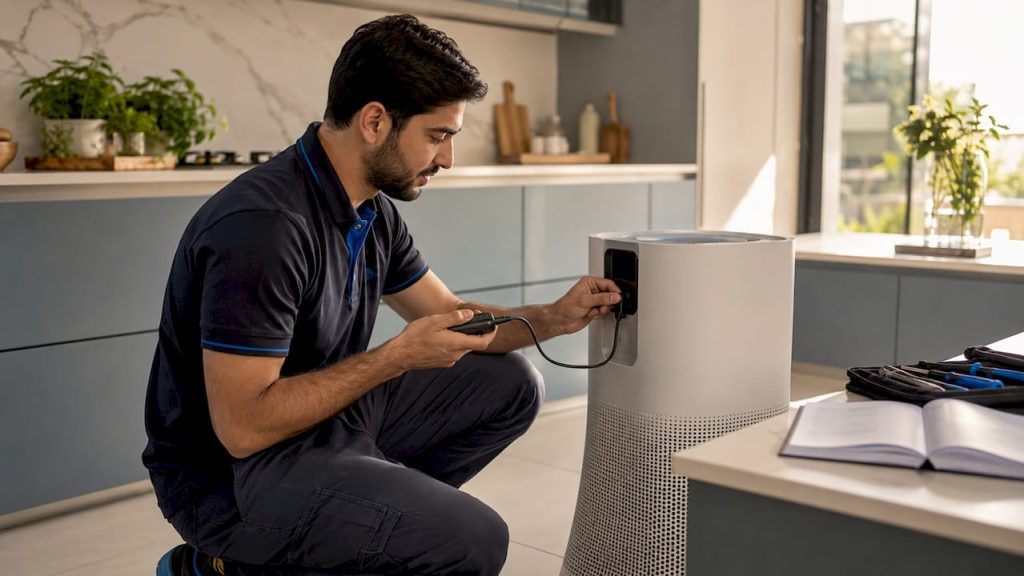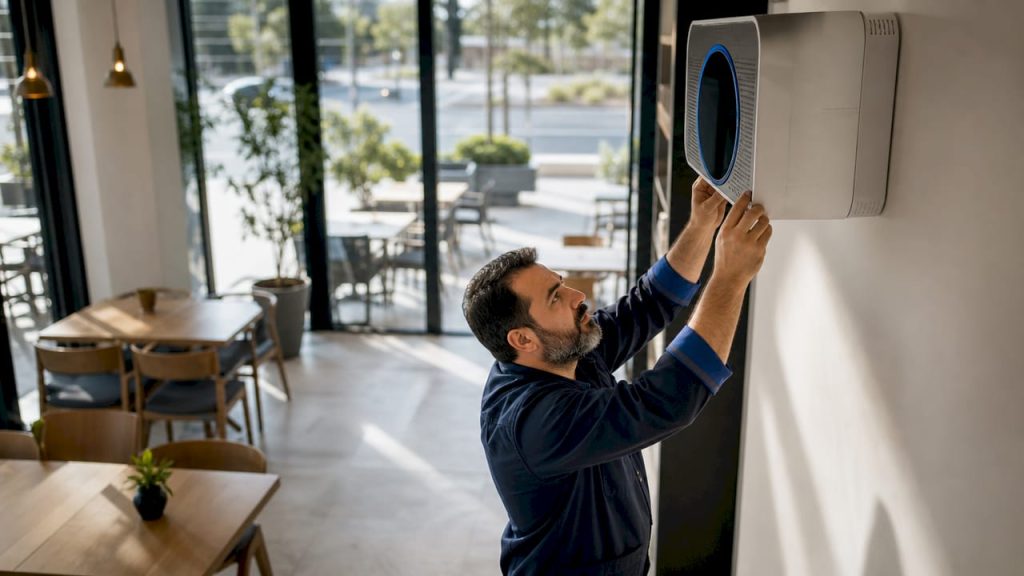
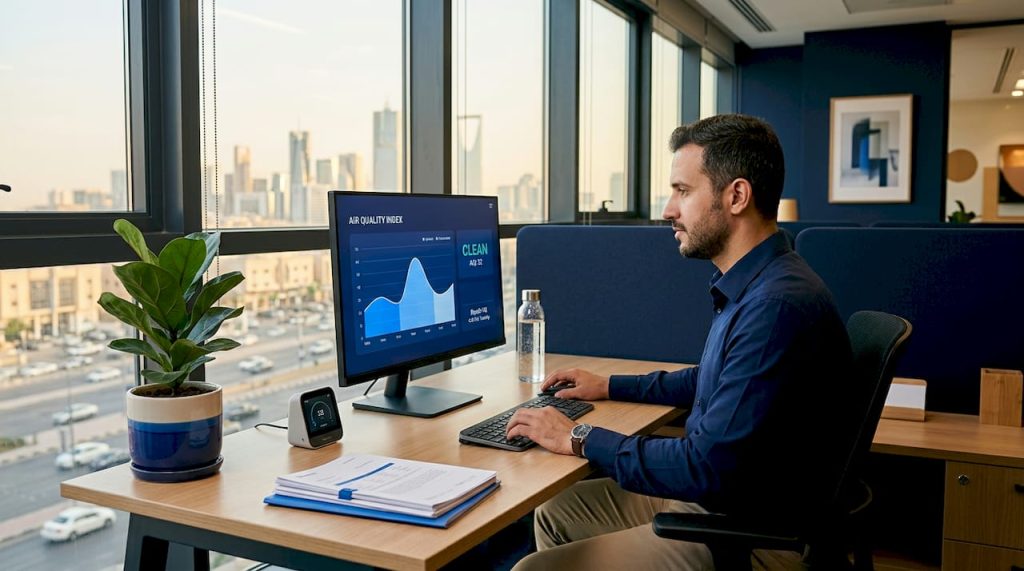
Poor indoor air quality is one of the most under-addressed problems in modern offices. Headaches, dry eyes, fatigue, and recurring allergies are often blamed on stress or long hours, but the air itself is frequently the culprit. This purify air office space guide covers the full picture: what drives indoor air pollution, how to choose and size the right equipment, how to position it correctly, and what else you can do alongside filtration to create a genuinely healthy office environment. Whether you manage a single room or an entire floor, the strategies here are practical, specific, and grounded in how office air quality actually works.
Table of Contents
- Key takeaways
- Understanding what affects office air quality
- Choosing the right air purifier for your office
- Positioning and integrating purifiers with your HVAC system
- Complementary strategies for cleaner office air
- My honest take on office air purification
- ClimaSaudi’s office air quality solutions
- FAQ
Key takeaways
| Point | Details |
|---|---|
| IAQ is multi-factor | Improving indoor air quality requires managing pollutant sources, ventilation, and moisture together, not just adding a purifier. |
| Match purifier to room size | Use air changes per hour (ACH) and CADR ratings to size equipment correctly for your specific office room. |
| HEPA and carbon work together | True HEPA filters remove particles; activated carbon handles gases and VOCs. You often need both in an office. |
| Placement matters as much as spec | A correctly sized purifier placed badly will underperform. Central positioning with clear intake space is non-negotiable. |
| Plants alone are not enough | Houseplants offer negligible air cleaning at realistic quantities. Ventilation and filtration do the real work. |
Understanding what affects office air quality
The term “indoor air quality” or IAQ is the standard industry term for what most people casually call “office air.” IAQ is shaped by multiple interacting factors: pollutant sources, ventilation system design, moisture levels, and occupant-specific sensitivities. None of these factors works in isolation. A good HVAC system cannot compensate for a room full of off-gassing furniture. A high-quality purifier cannot fix a mould problem caused by unchecked humidity.
The main sources of office air pollution
Before buying any equipment, you need to know what you are actually dealing with. Common office pollutant sources include:
- Off-gassing materials. New furniture, carpet, partition panels, and adhesives release volatile organic compounds (VOCs) for weeks or months after installation.
- Office equipment. Printers, photocopiers, and even computers emit ultrafine particles and ozone during operation.
- Occupant bio-effluents. Carbon dioxide, moisture, and airborne particles from breathing and movement accumulate quickly in poorly ventilated spaces.
- Cleaning products. Many standard office cleaning chemicals release VOCs and irritants into the air. Following office kitchen cleaning guidance can significantly reduce chemical emissions in shared spaces.
- Outdoor air infiltration. In cities like Riyadh and Dammam, desert dust, PM2.5, and sandstorm particles enter through windows, doors, and leaky HVAC systems.
HVAC and humidity: your first line of management
Your HVAC system is not just a heating and cooling unit. It is your primary ventilation and, often, your first filtration layer. A poorly maintained system recirculates dust, mould spores, and allergens rather than removing them. Employers should prioritise ventilation, moisture control, and HVAC upkeep as foundational steps before any additional purification technology is considered.
Humidity deserves particular attention. Both excessively dry and excessively damp air cause problems. Damp conditions promote mould and dust mite growth, which directly negates the benefit of any filtration you add. Keeping relative humidity between 40% and 60% is the target range for most offices. A basic digital hygrometer costs very little and should be standard equipment in every office.
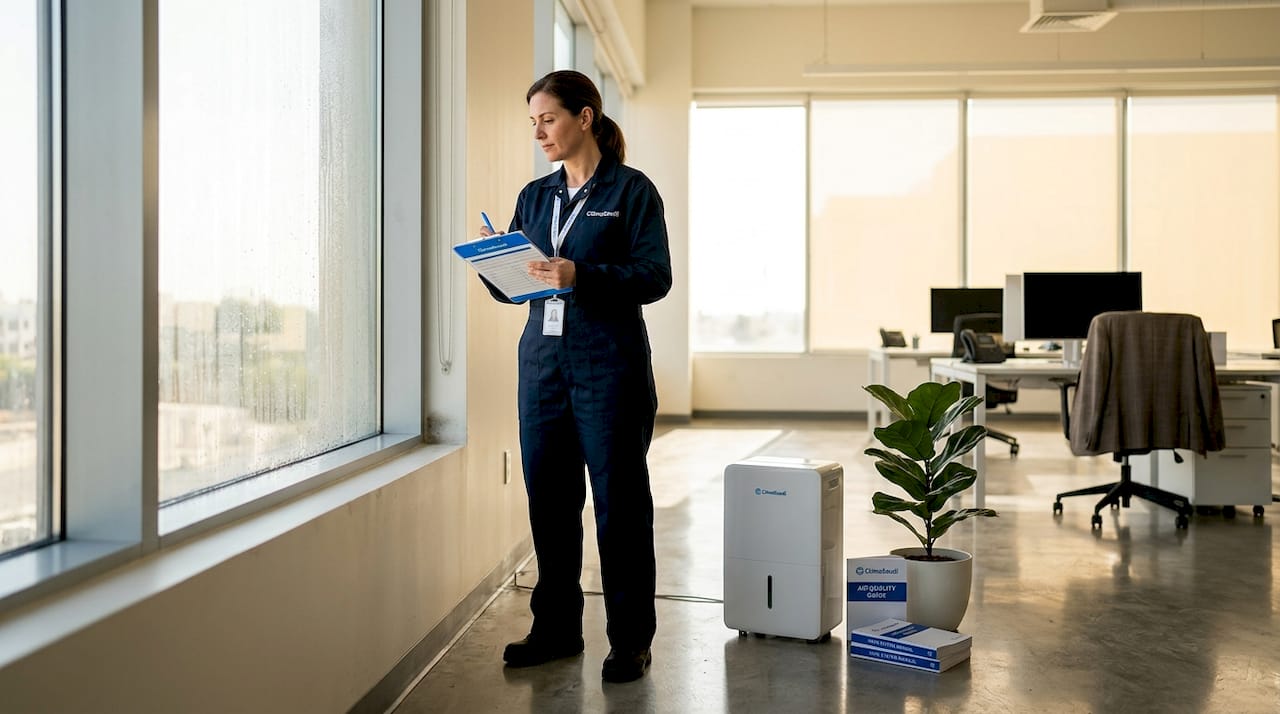
Pro Tip: Before fitting any air purifier, walk the office and check for damp patches, condensation on windows, or a musty smell near air vents. These indicate moisture issues that need fixing first. A purifier cannot remove mould spores as fast as the source produces them.
Choosing the right air purifier for your office
This is where most offices go wrong. A purifier that is too small for the room will run continuously without achieving meaningful clean air delivery. Getting the sizing right is not complicated, but it does require a few specific numbers.
Calculating the capacity you actually need
The industry standard method uses air changes per hour (ACH). For general office use, 4 ACH is adequate. For allergy-sensitive environments, 4 to 5 ACH is the recommended minimum. Here is how the calculation works:
Multiply the room’s volume (length × width × ceiling height in feet) by your target ACH, then divide by 60 to get the required airflow in cubic feet per minute (CFM). That CFM figure should match or be lower than the purifier’s Clean Air Delivery Rate (CADR) for the relevant pollutant type.
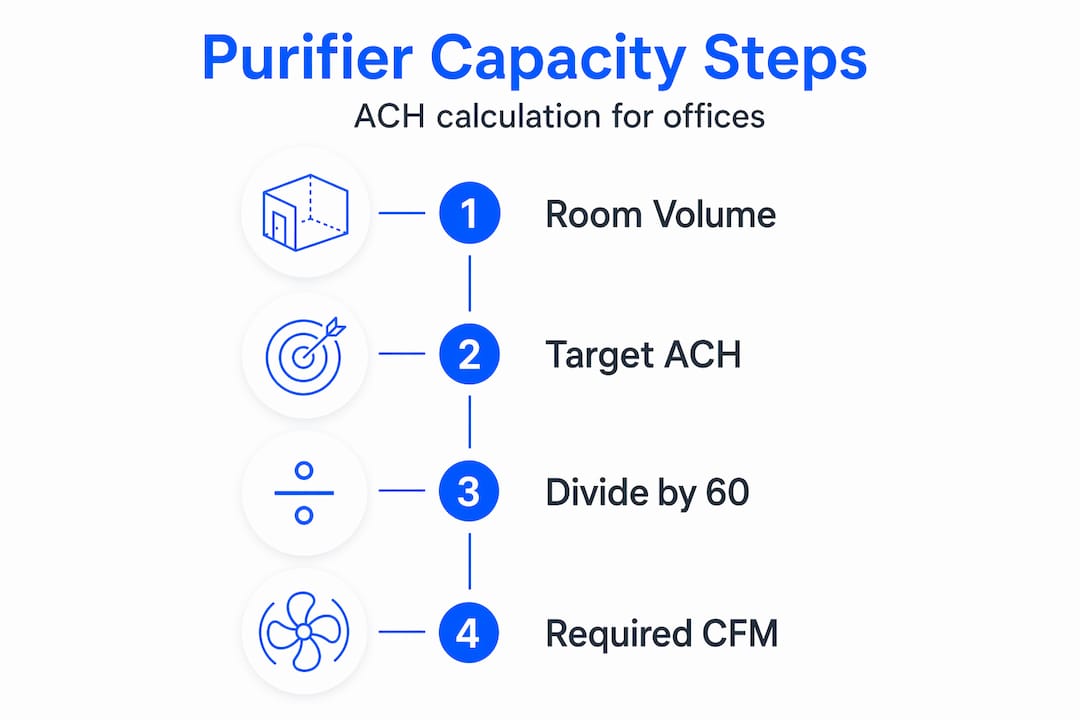
Example: a 5-person office measuring 5 metres × 4 metres with 2.7-metre ceilings has a volume of roughly 2,160 cubic feet. At 4 ACH, you need approximately 144 CFM minimum airflow. Any purifier with a CADR below that figure will not keep up.
Filtration types: what removes what
| Pollutant type | Required filter | What it addresses |
|---|---|---|
| Dust, pollen, PM2.5, mould spores | True HEPA (H13) | Captures particles down to 0.3 microns at 99.97% efficiency |
| VOCs, odours, chemical fumes | Activated carbon | Adsorbs gaseous pollutants that HEPA cannot capture |
| Bacteria, viruses (airborne) | HEPA + UV-C (optional) | Combined filtration with germicidal light for added protection |
| Carbon dioxide | Ventilation only | No filter removes CO2; only fresh air exchange works |
True HEPA filters capture particles; activated carbon handles gases and odours. An office with a printer, carpeted floors, and a kitchen nearby needs both filtration types. Buying a HEPA-only unit and expecting it to handle chemical odours from cleaning products will leave you disappointed.
Pro Tip: Do not rely on the manufacturer’s quoted “room coverage area” alone. That figure is usually calculated at 2 ACH, which is too low for occupied offices. Always cross-check using the CADR and your own room volume calculation.
Additional points to consider when selecting a unit:
- Energy consumption. Purifiers run for many hours daily. Look for Energy Star ratings or equivalent; the running cost over a year can easily exceed the purchase price.
- Filter replacement cost and availability. Genuine HEPA H13 replacement filters are the ongoing expense most buyers overlook. Check how to maintain HEPA filters properly before committing to a model.
- Noise levels. In open-plan offices, a purifier running above 45 dB on its working speed becomes a distraction.
Positioning and integrating purifiers with your HVAC system
Buying the right purifier is step one. Deploying it correctly is step two, and it is just as important. Two of the most common purifier failures are under-sizing and poor placement, and the second is entirely preventable.
Here is a practical placement process:
- Place the unit centrally in the room. Air should be able to circulate from all directions into the unit’s intake. Corners reduce this dramatically.
- Keep at least 15 to 20 cm of clearance around all intake vents. Blocking air intakes reduces cleaning efficiency significantly, regardless of the purifier’s rated power.
- Avoid placing purifiers near competing airflow sources. Open windows, desk fans, and HVAC supply vents push directional airflow that disrupts the purifier’s natural draw pattern.
- Keep units away from corners and behind furniture. These are dead zones where stagnant air collects. A purifier placed there cleans the air in that corner, not the room.
- Position at breathing height where possible. Floor-level placement in a room with high ceilings is less effective than placing the unit on a desk or shelf at the height where people actually breathe.
Upgrading your HVAC filtration
If you want to improve air quality across the whole office rather than in individual zones, upgrading HVAC filtration is the most impactful single change you can make. Upgrading to MERV 13 filters is recommended where the system allows, but this requires a static pressure check first. Forcing higher MERV filters without verifying system capacity risks reduced airflow and equipment damage. If your HVAC cannot handle the additional resistance, the practical solution is to keep MERV 8 in the main system and add portable HEPA purifiers in occupied zones.
Pro Tip: Ask your HVAC maintenance contractor for a static pressure reading before specifying any filter upgrade. This one step prevents the most common and costly HVAC filtration mistake.
Complementary strategies for cleaner office air
Air purifiers and HVAC upgrades do most of the heavy lifting, but several additional practices make a measurable difference, particularly for allergen reduction.
Source control and procurement
- Specify low-VOC paints, adhesives, and furniture for any refurbishment. If this is not possible, air out new materials externally for several days before installation to reduce initial off-gassing inside the building.
- Implement a fragrance policy. Heavily scented products worn by employees or used in cleaning are a direct source of airborne irritants.
- Establish a no-smoking perimeter around building entrances that actually keeps smoke away from air intakes.
Moisture and cleaning protocols
Prompt response to spills and leaks is not just about damage control. Moisture control and rapid drying are foundational to preventing mould growth that filtration alone cannot address. Every hour a wet surface sits is time for mould and bacteria to establish.
For cleaning, the focus should be on damp dusting rather than dry dusting, which simply redistributes particles into the air. Vacuuming with HEPA-filter vacuums rather than standard models prevents re-releasing captured particles. For guidance on reducing contamination in shared kitchen areas, see how structured cleaning protocols complement air filtration in enclosed spaces.
The truth about office plants
| Intervention | Realistic air quality impact | Practical limitation |
|---|---|---|
| Office plants (typical quantity) | Very low | Studies indicate 10 to 1,000 plants per square metre needed to match ventilation effect |
| HEPA air purifier (correctly sized) | High | Removes 99.97% of particles at 0.3 microns |
| HVAC ventilation upgrade | Very high | Addresses whole building; requires system access |
| Low-VOC product procurement | Medium | Removes source rather than treating symptom |
Plants are pleasant to have in an office. They are not, however, an air purification strategy. The science is clear: the quantities needed to produce a meaningful cleaning effect are far beyond what any normal office would contain.
My honest take on office air purification
By Pauline
In my experience, the biggest mistake offices make is treating air purification as a purchase rather than a practice. A manager orders two purifiers, places them wherever there is a free surface, and considers the problem solved. Six months later, the filters are clogged, the units are tucked behind a storage cabinet, and everyone is still complaining about headaches.
What I have seen work is a coordinated approach. You map the sources first. You fix the moisture. You check the HVAC. Then you size and place the purifiers correctly, and you schedule filter changes before they are overdue, not after. This sequence matters more than the brand you buy.
I would also push back on the idea that this is primarily an equipment problem. Some of the worst air quality offices I have seen had expensive purifiers. The machines were undersized, placed in corners, and running on the lowest fan speed because someone complained about the noise. Meanwhile, the cleaning team was using chemical sprays right next to the intake vents.
The technical side of this is genuinely accessible to any manager who takes an hour to understand ACH calculations and filter types. The harder part is getting buy-in from building management for HVAC changes and building a maintenance routine that people actually follow. That is where most good intentions stall.
— Pauline
ClimaSaudi’s office air quality solutions
If you are ready to move from planning to action, Climasaudi offers a curated range of air purifiers tested for the specific conditions across Saudi Arabia, from the heavy dust loads in Riyadh to the coastal humidity of Jeddah. Every unit in the range features certified HEPA H13 filtration, and many include activated carbon layers for VOC and odour control.
For small to medium office rooms, the Blueair Blue 3610 offers reliable particle removal at an accessible price. For larger or more demanding spaces, the Blueair ComfortPure T20i delivers three-stage filtration with smart controls. Climasaudi stocks locally, prices transparently in SAR, and offers next-day delivery across major cities. Browse the full office air quality range and use the Air Match tool to find the right fit for your room size and specific air concerns.
FAQ
What is the best ACH rate for an office air purifier?
For general office use, 4 ACH is the standard target. For allergy-sensitive environments or spaces with high occupancy, aim for 4 to 5 ACH minimum.
Do I need both a HEPA filter and an activated carbon filter?
Yes, if your office has VOC sources such as printers, cleaning chemicals, or new furniture. HEPA filters capture particles but cannot remove gases or odours; activated carbon handles those separately.
How often should office air purifier filters be replaced?
Most HEPA filters in office use need replacing every 6 to 12 months, depending on local air quality and how many hours the unit runs daily. Check the filter indicator rather than relying on a fixed schedule.
Can I rely on my HVAC system instead of a standalone purifier?
A well-maintained HVAC with MERV 13 filtration handles a large portion of airborne particles. However, most standard systems run MERV 8 filters and do not address localised VOC or odour sources. Standalone purifiers fill that gap effectively.
Do plants genuinely improve office air quality?
Research shows you would need between 10 and 1,000 plants per square metre to match the effect of standard building ventilation. Plants offer negligible air cleaning at typical office quantities.