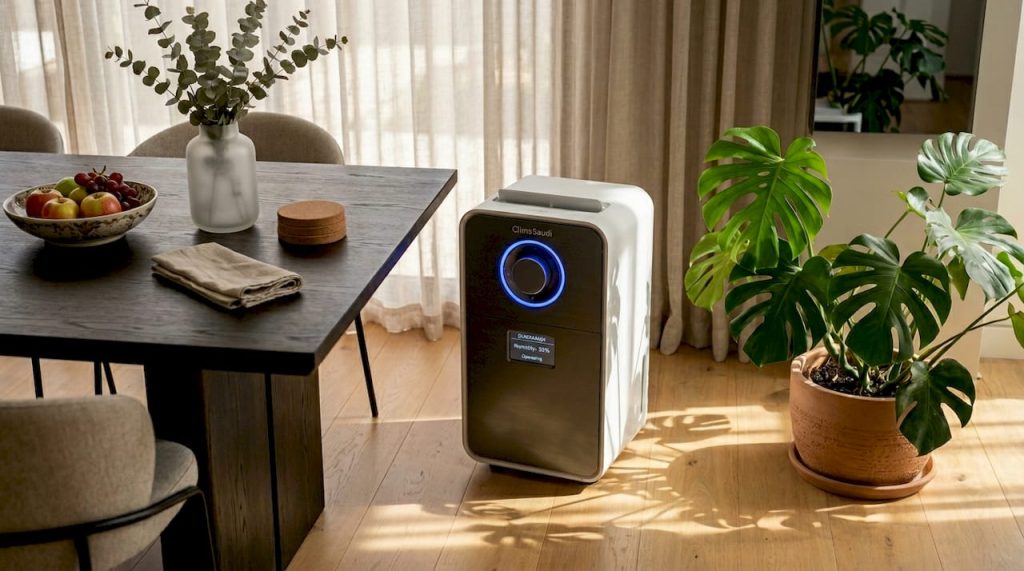
A dehumidifier is a device that removes excess moisture, specifically water vapour, from indoor air to control humidity levels and improve home comfort. This is distinct from what an air purifier does. Air purifiers target airborne particles such as dust, pollen, and PM2.5. A dehumidifier targets the water content of the air itself. Models from brands like Olimpia Splendid and Pro Breeze handle this through either refrigeration or desiccant technology, and high-capacity units can extract up to 73 litres of moisture in a single 24-hour period. That figure matters because it shows just how much hidden water can accumulate in a typical home, particularly in coastal cities like Jeddah or Dammam where humidity is a persistent challenge.
What does a dehumidifier remove from the air?
A dehumidifier removes water vapour, the invisible moisture suspended in indoor air. The industry term for this process is dehumidification, and it is measured by how many litres of water a unit extracts per day. When indoor relative humidity rises above 60%, conditions become favourable for mould, dust mites, and structural dampness. A dehumidifier brings that figure down to a healthier range, typically between 40% and 55%.
The device does not capture dust, pollen, or bacteria. Those particles remain in the air unless a separate filtration system is present. What the dehumidifier does is alter the environment so that moisture-dependent problems cannot take hold. Think of it as removing the conditions that allow problems to grow, rather than removing the problems themselves.
How does a dehumidifier remove moisture from the air?
The two main technologies behind dehumidification are refrigeration (also called compressor-based) and desiccant absorption. Both achieve the same result through different physical processes.
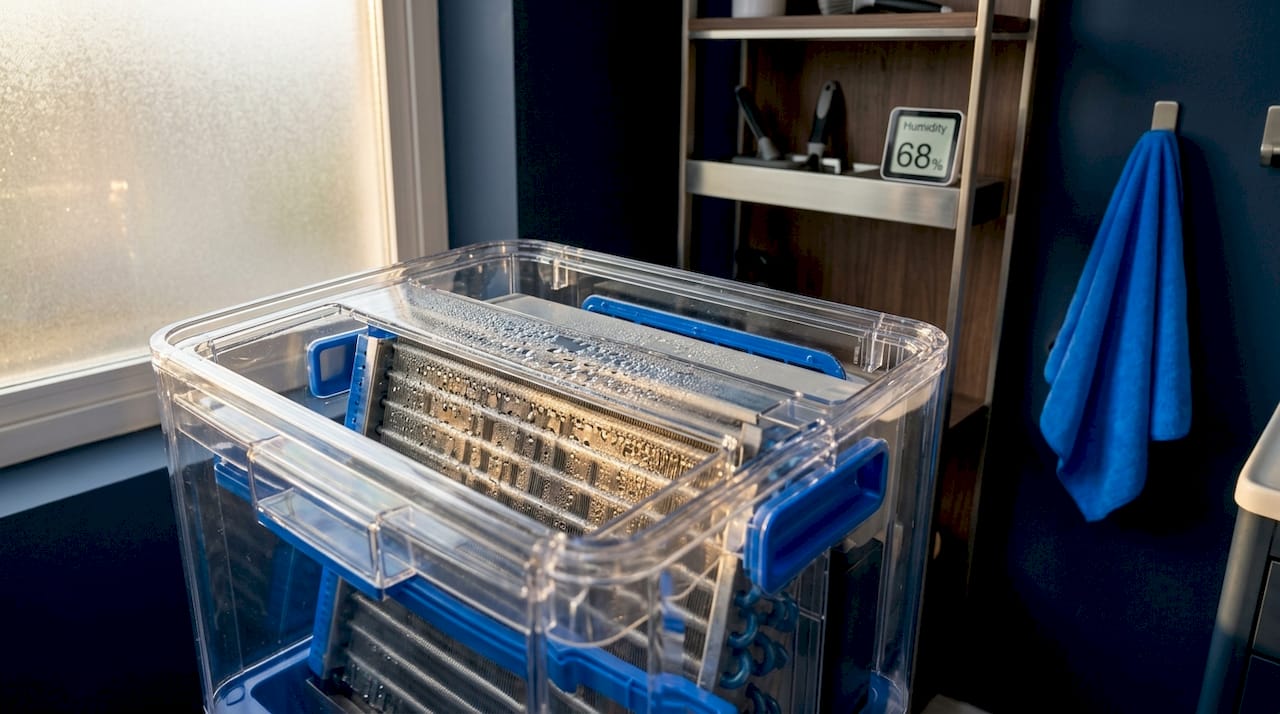
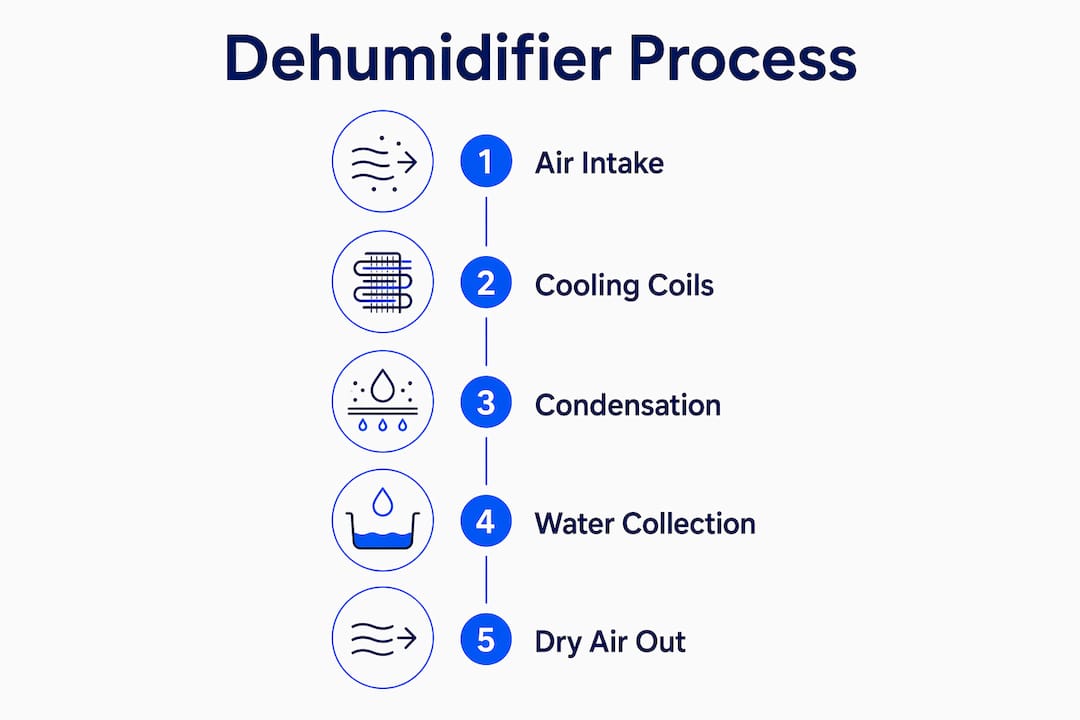
Refrigerant dehumidifiers work by drawing humid air across a set of cold coils. The air cools below its dew point, and moisture condenses on the coils as liquid water droplets. That water drains into a collection tank. The now-dry air passes over a warm condenser coil, is reheated to near its original temperature, and is released back into the room. The cycle repeats continuously.
Desiccant dehumidifiers use a different approach. A rotating wheel coated with a moisture-absorbing material, such as silica gel, draws water vapour directly out of the passing air. A second heated airflow then dries the wheel so it can absorb moisture again, allowing continuous desiccant operation without interruption. This makes desiccant units particularly effective in cooler rooms where refrigerant coils would struggle to condense moisture efficiently.
Choosing between the two comes down to your room temperature:
- Refrigerant models perform best above 15°C to 20°C, making them well-suited to living rooms, bedrooms, and kitchens in warmer climates.
- Desiccant models are superior in cooler spaces such as garages, utility rooms, or storage areas where temperatures drop below 15°C.
- Capacity matters too. A small 10-litre-per-day unit suits a single room; a 20-litre or larger unit is better for open-plan spaces or heavily damp properties.
Pro Tip: If you live in a warm, humid city like Jeddah or Dammam, a refrigerant dehumidifier will almost always outperform a desiccant model in your main living areas. Save the desiccant unit for cooler storage spaces.
Does a dehumidifier improve air quality?
This is where many buyers get confused. Dehumidifiers do not filter particles from the air. They do not capture pollen, pet dander, smoke, or bacteria. What they do is lower humidity to a level where allergen-producing organisms cannot thrive. The distinction is indirect but genuinely significant for your health.
Here is what lower humidity actually prevents:
- Mould and mildew growth. Both require moisture to reproduce. Keeping relative humidity below 55% makes surfaces inhospitable to spore development.
- Dust mite populations. Dust mites depend on humidity to survive. Drier air reduces their numbers, which directly lowers the allergen load in bedding, carpets, and upholstery.
- Musty odours. Musty smells come from mould and mildew, not from dry air. Remove the moisture and the odour source disappears. Regular cleaning and ventilation support this further.
- Condensation damage. Persistent condensation on windows and walls creates damp patches that feed mould colonies. A dehumidifier stops that cycle before it starts.
“Reducing indoor humidity eases allergy symptoms and supports asthma sufferers by making breathing easier in homes with controlled moisture levels.” This is not a minor benefit. For households in Saudi Arabia where windows are often kept closed against heat and dust, indoor humidity can accumulate quickly without any natural ventilation to correct it.
Dehumidifier use reduces allergen presence, easing allergy and asthma symptoms, particularly in sealed indoor environments. The improvement to air quality is real, even though no particle filtration is taking place.
Dehumidifier vs air purifier: which one do you need?
A dehumidifier and an air purifier solve different problems. Buying the wrong one means the problem you actually have goes unaddressed.
| Feature | Dehumidifier | Air purifier |
|---|---|---|
| Removes water vapour | Yes | No |
| Filters dust and pollen | No | Yes (HEPA) |
| Reduces mould risk | Yes (indirectly) | No |
| Captures PM2.5 particles | No | Yes |
| Controls musty odours | Yes | Partially (carbon filter) |
| Reduces dust mite allergens | Yes (indirectly) | Yes (directly, via filtration) |
If your main concern is desert dust, PM2.5, or pollen coming through ventilation, an air purifier with HEPA H13 filtration is the right choice. If your concern is condensation, damp walls, or a persistently humid room, a dehumidifier addresses the root cause directly.
Hybrid appliances now combine dehumidification, HEPA filtration, and cooling into a single unit. Brands like Dyson and Blueair offer devices that handle moisture control and particle filtration simultaneously, which is particularly useful in Saudi homes where both coastal humidity and airborne dust are genuine concerns. The Blueair 2-in-1 Purify + Humidify DH3i is one such device that combines moisture management with air purification in a single unit.
Pro Tip: If you are unsure which problem is worse in your home, check for visible condensation on windows or walls. If you see it regularly, start with a dehumidifier. If the air feels dry but dusty, start with an air purifier.
Practical benefits of using a dehumidifier at home
The everyday advantages of dehumidification go beyond simply reducing humidity numbers on a display. Here are the most practical benefits, in order of impact for most households:
- Protects walls, furniture, and flooring. Moisture removal prevents warped furniture, peeling wallpaper, and damp patches that standard cooling cannot address. This is a structural benefit that pays off over years of ownership.
- Speeds up indoor laundry drying. Modern dehumidifiers with a dedicated laundry mode can reduce drying times to around 6 hours at a running cost of approximately 4p per hour. For households that dry clothes indoors, this is a meaningful energy and time saving.
- Reduces allergy and asthma triggers. Lower humidity means fewer dust mites and less mould. Both are among the most common indoor allergen sources, and controlling them through moisture management is one of the most effective steps you can take.
- Improves general comfort. High humidity makes warm air feel hotter and heavier. Reducing it makes the same temperature feel noticeably more comfortable, which can reduce reliance on air conditioning and lower energy bills.
- Protects stored items. Books, clothing, electronics, and wooden instruments are all vulnerable to moisture damage. A dehumidifier in a storage room or wardrobe area extends the life of these items considerably.
For efficient operation, run your dehumidifier with windows and doors closed so it is not working against incoming humid air. Empty the collection tank regularly, or connect a continuous drain hose if the unit supports it. Indoor air quality professionals also recommend pairing dehumidification with adequate ventilation to avoid air becoming excessively dry, which brings its own discomforts.
Key takeaways
A dehumidifier removes water vapour from indoor air, and by doing so it indirectly reduces mould, dust mites, musty odours, and structural dampness in ways that no air purifier can replicate.
| Point | Details |
|---|---|
| Core function | A dehumidifier removes water vapour, not airborne particles like dust or pollen. |
| Two main technologies | Refrigerant models suit warm rooms above 15°C; desiccant models work better in cooler spaces. |
| Indirect air quality benefit | Lower humidity prevents mould and dust mite growth, reducing allergen levels without filtration. |
| Hybrid devices | Combined units from brands like Dyson and Blueair handle both moisture and particle filtration. |
| Practical home benefits | Laundry drying, structural protection, and allergy relief are the most measurable everyday gains. |
My honest view on dehumidifiers and home air quality
I have tested both refrigerant and desiccant units across different room types, and the single biggest mistake I see homeowners make is expecting a dehumidifier to clean the air. It does not. What it does is change the conditions of the air, and that distinction matters enormously when you are choosing what to buy.
The second mistake is underestimating capacity. A 10-litre unit in a large open-plan apartment will run continuously without ever bringing humidity down to a comfortable level. Matching the unit’s extraction rate to the room size is not optional. It determines whether the device actually solves your problem.
What genuinely surprised me is how much of a difference dehumidification makes in sealed Saudi homes. When air conditioning runs constantly and windows stay closed against heat and dust, moisture from cooking, showering, and breathing has nowhere to go. A dehumidifier in that environment is not a luxury. It is the only practical way to manage what builds up.
I am also watching hybrid technology closely. Devices that combine HEPA filtration with moisture control are becoming genuinely capable, and for a home in Riyadh or Jeddah dealing with both dust and humidity, a single well-chosen hybrid unit is a more practical solution than two separate appliances competing for the same socket.
The one caution I would add: do not over-dehumidify. Dropping relative humidity below 35% causes dry skin, irritated airways, and static electricity. Aim for 40% to 55% and use a hygrometer to monitor it. The goal is balanced air, not bone-dry air.
— Pauline
Find the right dehumidifier or hybrid unit for your home
If damp walls, musty rooms, or persistent condensation are affecting your home, the right device makes a clear difference. Climasaudi stocks a range of dehumidifiers in Saudi Arabia with SAR pricing, local inventory, and next-day delivery across Riyadh, Jeddah, and Dammam.
For homes dealing with both humidity and airborne dust, Climasaudi also carries hybrid units from Dyson, including the Dyson Purifier Humidify+Cool PH2 De-NOx, which combines HEPA H13 filtration with moisture management in one device. Browse the full range of air quality solutions to find the right match for your room size and specific conditions.
FAQ
What does a dehumidifier remove from the air?
A dehumidifier removes water vapour from indoor air, reducing relative humidity. It does not filter dust, pollen, or other airborne particles.
Does a dehumidifier remove mould from the air?
A dehumidifier does not capture mould spores directly. It lowers humidity to a level where mould cannot grow, preventing new colonies from forming rather than removing existing spores.
What is the difference between a dehumidifier and an air purifier?
An air purifier filters airborne particles such as dust, pollen, and PM2.5 using HEPA filtration. A dehumidifier removes moisture from the air. Hybrid units from brands like Dyson and Blueair now combine both functions.
How much moisture can a dehumidifier remove per day?
High-capacity residential dehumidifiers can extract up to 73 litres of moisture from indoor air within 24 hours, though most household units operate in the 10 to 20 litre range.
Does a dehumidifier help with allergies?
Yes, indirectly. By reducing humidity, a dehumidifier limits the growth of dust mites and mould, both of which are major allergen sources. This can ease symptoms for allergy and asthma sufferers.
Recommended
- How a dehumidifier works in your home — Blog | ClimaSaudi
- Buy Blueair InvisibleMist Humidifier H35i in Saudi Arabia | Best Price SAR 446 | ClimaSaudi
- Buy Blueair 2-in-1 Purify + Humidify DH3i in Saudi Arabia | Best Price SAR 1,190 | ClimaSaudi
- Buy Dyson Purifier Humidify+Cool PH2 De-NOx in Saudi Arabia | Best Price SAR 2,214 | ClimaSaudi