High-rise apartments require air purifiers because indoor pollutants, including fine particulate matter (PM2.5), volatile organic compounds (VOCs), and allergens, concentrate in sealed upper-floor units at levels that exceed outdoor air. Elevation does not protect you from poor air quality. The stack effect, shared ventilation systems, and modern energy-efficient construction all work against you. Studies confirm that HEPA-certified purifiers reduce PM2.5 by 25–56% in urban residential environments. For residents in Riyadh, Jeddah, and Dammam, where desert dust adds a significant local burden, the case for purification is even stronger.
Why high-rise apartments need purifiers: the core problem
The air inside your flat is not a sealed bubble. Pollutants enter through gaps around doors, shared ventilation ducts, elevator shafts, and even the building’s stack effect. The stack effect describes how warm air rises through a building, pulling contaminants from garages, waste chutes, and lower floors upward into living spaces on higher floors. A study of residential towers in Mumbai found that toxic gases exceed safety limits even on the 26th floor, with hydrogen sulphide measured at nearly 15 times the permitted level and carbon monoxide at 50% above the safe threshold. That finding dismantles the common assumption that living higher up means breathing cleaner air.
Modern apartments compound the problem. Energy-efficient, well-sealed construction reduces heat loss but also traps pollutants indoors. VOCs from furnishings and materials can accumulate at 2–5 times outdoor concentrations inside sealed flats. This means off-gassing from new furniture, cleaning products, and paint sits in your air far longer than it would in a naturally ventilated space.
The specific pollutants you face in a high-rise include:
- PM2.5 and PM10 from urban traffic, construction, and desert dust storms
- VOCs from furniture, flooring, adhesives, and cleaning products
- Allergens including dust mites, mould spores, and pollen carried in through ventilation
- Toxic gases such as carbon monoxide and hydrogen sulphide from building infrastructure
- Cross-unit contaminants from neighbours’ cooking, smoking, or chemical use
Building infrastructure allows pollutants to travel between units via shared ventilation, door gaps, and elevator shafts. Most residents do not realise their air quality is partly determined by what their neighbours do indoors.
What does the science say about HEPA purifiers in apartments?
The evidence for air purifiers in residential settings is well established. HEPA filtration reduces indoor PM2.5 by 25–56% in urban apartments, based on multiple peer-reviewed studies published as of early 2026. That reduction directly lowers your exposure to the particles most associated with respiratory and cardiovascular harm.
The benefits extend beyond breathing comfort. Adults aged 40 and over who used in-home HEPA filtration for one month completed cognitive tests 12% faster than those without filtration, with average test times improving from 61.4 seconds to 54.0 seconds in a randomised crossover trial. Cleaner air does not just protect your lungs. It supports how clearly you think.
“Air purifiers effectively reduce allergen and asthma symptom severity but must be combined with source control and ventilation for best results.” — Verywell Health
For allergy and asthma sufferers, the benefits of air purifiers include measurable reductions in airborne allergens such as dust mite particles, pet dander, and mould spores. In Saudi Arabia, where seasonal dust storms push PM10 and PM2.5 concentrations sharply higher, HEPA filtration provides a reliable indoor refuge. The HEPA filter allergy benefits for residents managing rhinitis or asthma are particularly significant during haboob season.
One important limitation: HEPA filters capture particles but not gases. Carbon monoxide, formaldehyde, and other VOCs pass through HEPA filters untreated. A purifier without an activated carbon stage leaves gaseous pollutants unaddressed. This distinction matters when choosing a model.
Are HVAC filters enough for high-rise indoor air quality?
Standard HVAC filters are not designed to protect your health. They are designed to protect the equipment. Most building HVAC systems use filters rated at MERV 8 or below, which capture large particles but allow fine PM2.5 and gases to pass through freely. The table below shows how HVAC filtration compares to a standalone HEPA purifier.
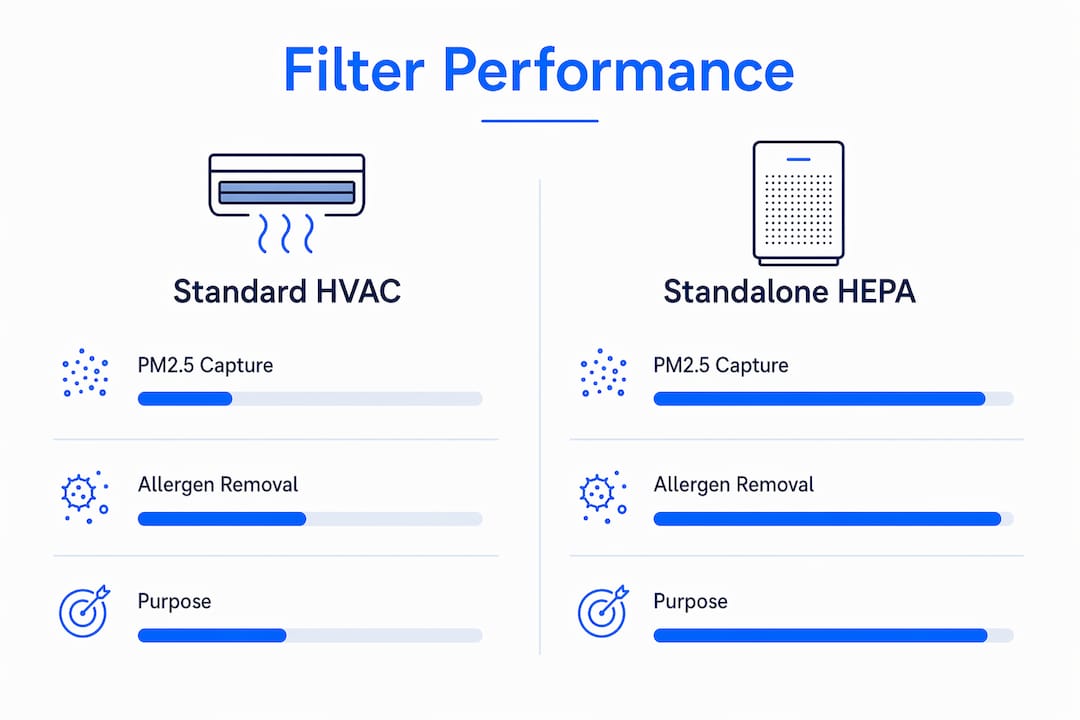
| Feature | Standard HVAC filter | Standalone HEPA purifier |
|---|---|---|
| PM2.5 capture | Poor | Excellent (99.97% at 0.3 microns) |
| VOC and gas removal | None | Yes, with activated carbon stage |
| Allergen removal | Partial | High |
| Cross-unit contamination risk | High (shared ducts) | None (unit-specific) |
| Placement control | Fixed | Flexible, room-specific |
| Filter replacement control | Building-managed | Owner-controlled |
Shared HVAC systems carry an additional risk. When one unit’s air circulates through shared ducts, contaminants from cooking, cleaning products, or tobacco smoke in a neighbouring flat can enter your space. A standalone purifier placed in your bedroom or living room gives you control that a building system cannot. For a detailed comparison, the HVAC vs standalone purifier guide from Climasaudi covers this in depth for Saudi residential settings.
How to choose and maintain a purifier for your flat
Selecting the right purifier for a high-rise flat requires matching three things: filter type, unit size, and placement.
-
Choose True HEPA with activated carbon. A True HEPA filter captures 99.97% of particles at 0.3 microns. Pair it with a substantial activated carbon layer to address VOCs, formaldehyde, and odours. Thin carbon pre-filters found in budget models are not sufficient for sealed apartments with new furnishings.
-
Match the CADR to your room size. CADR (Clean Air Delivery Rate) measures how quickly a purifier cleans a given volume of air. Use the purifier coverage area guide to match the unit’s CADR to your room’s square meterage. An undersized unit running continuously still underperforms.
-
Place the unit for maximum airflow. Position the purifier away from walls and corners. Place it in the room where you spend the most time, typically the bedroom. Running it at night, when you are stationary and breathing for 7–8 hours, delivers the greatest health benefit.
-
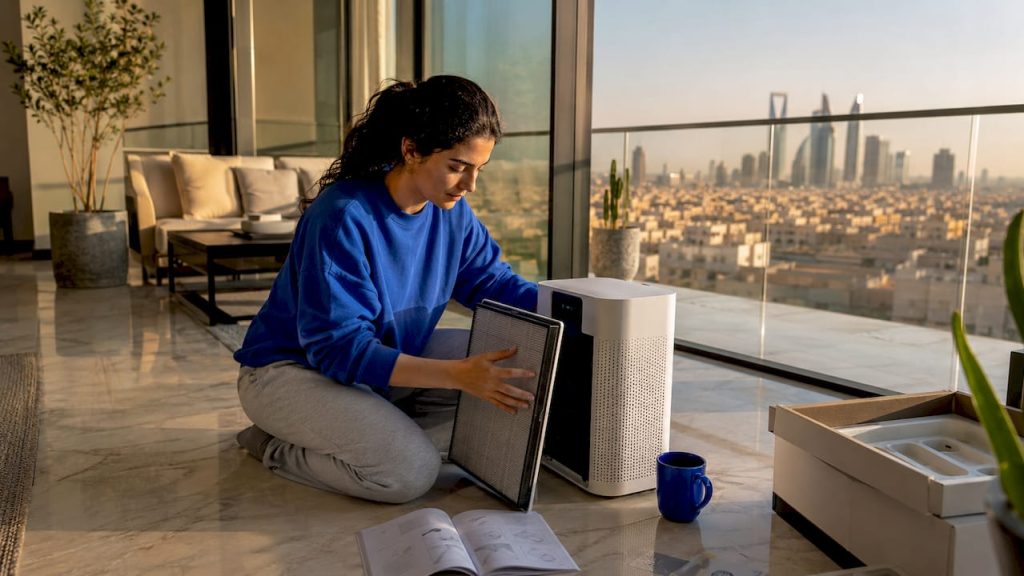
Replace filters on schedule. Incorrect purifier use including saturated filters, wrong sizing, and blocked airflow drastically reduces effectiveness. Check manufacturer guidance, but most HEPA filters in dusty Saudi environments need replacement every 6–8 months rather than the standard 12.
-
Run it consistently, not occasionally. Purifiers work by continuously cycling room air. Switching the unit on only when you notice dust or odours means you are already breathing the problem.
Pro Tip: If you have recently moved into a newly furnished flat, run your purifier on its highest setting for the first two weeks. New furniture, flooring, and paint off-gas VOCs most heavily in the first month.
What else can you do to improve air quality in a high-rise?
A purifier is your primary tool, but it works best alongside a few practical habits. Professional assessment of contamination type improves purifier selection and helps you understand whether your main concern is particulates, gases, or biological allergens.
Complementary steps that make a measurable difference include:
- Regular damp dusting and vacuuming. Settled dust re-enters the air with foot traffic and air movement. A vacuum with a HEPA filter prevents re-suspension of particles. Removing allergens from ducts through periodic professional duct cleaning reduces the load on your purifier.
- Controlling indoor humidity. Humidity between 40–60% discourages dust mite reproduction and mould growth. In coastal cities like Jeddah, a dehumidifier may be needed. In dry Riyadh winters, a humidifier prevents the dry conditions that irritate airways and carry more airborne particles.
- Avoiding indoor pollution sources. Scented candles, incense, and aerosol sprays release VOCs and fine particles directly into your breathing zone. Unvented gas cooking is a significant source of nitrogen dioxide in apartments.
- Keeping windows closed during dust events. Opening windows during a haboob or high-pollution period floods your flat with PM10 and PM2.5 that your purifier will take hours to clear.
Pro Tip: Use a low-cost PM2.5 monitor such as the Xiaomi Mi Air Detector or a similar device to check your indoor air quality before and after running your purifier. Real data helps you understand your specific flat’s pollution pattern.
Key takeaways
High-rise apartments concentrate indoor pollutants through sealed construction, shared building systems, and the stack effect, making a True HEPA purifier with activated carbon the most effective single intervention for residents.
| Point | Details |
|---|---|
| Height does not mean cleaner air | Toxic gases and PM2.5 have been recorded at dangerous levels on the 26th floor of residential towers. |
| HEPA filtration delivers proven results | Peer-reviewed studies confirm 25–56% reductions in indoor PM2.5 with correct purifier use. |
| HVAC filters are not a substitute | Standard building filters protect equipment, not health, and can spread contaminants between units. |
| Filter type determines effectiveness | True HEPA captures particles; activated carbon is required to remove VOCs and gases. |
| Correct sizing and maintenance matter | An undersized or filter-saturated unit provides little protection regardless of its specification. |
Living in a high-rise changed how I think about indoor air
I spent years writing about indoor air quality before I moved into a flat on the 18th floor of a building in a busy city centre. I assumed the elevation would work in my favour. Within a week, I had a persistent dry throat and noticed a fine layer of dust on surfaces I had cleaned two days earlier.
What surprised me most was not the dust itself. It was realising how much of my air was shared with the rest of the building. The smell of a neighbour’s cooking, the faint chemical odour after the cleaning crew used the corridor, the subtle stuffiness that appeared whenever the HVAC cycled. None of that was visible, but all of it was present.
The conventional advice is to “open a window for fresh air.” In a city with heavy traffic, construction, or seasonal dust storms, that advice is genuinely counterproductive. Opening a window during a haboob or a high-traffic morning rush introduces more pollution than it removes.
What I have found actually works is treating the purifier as infrastructure, not an accessory. It runs continuously, at a low setting, in the room where I sleep. I replace the filter before it is visually dirty, not after. I pair it with a PM2.5 monitor so I can see the numbers rather than guess. And I have accepted that source control matters as much as filtration. Fewer candles, no aerosols, and a HEPA vacuum have reduced the load on the purifier significantly.
The residents I see struggle most are those who buy a purifier, place it in a corner, and expect it to solve everything without changing any habits. Purifiers are not passive solutions. They reward attention and correct use with genuinely cleaner air.
— Pauline
Find the right purifier for your high-rise flat with Climasaudi
Climasaudi stocks a full range of HEPA H13 certified air purifiers suited to the specific conditions of Saudi high-rise living, from compact bedroom units to models covering large open-plan spaces. Whether your priority is desert dust, VOC control, or allergy relief, the Climasaudi air purifier range includes models with True HEPA and activated carbon filtration, sized for Saudi apartments in Riyadh, Jeddah, and Dammam. The Blueair Blue 3610 is a strong choice for bedrooms, while the Blueair ComfortPure T20i handles larger living areas with a three-stage filtration system. Next-day delivery, genuine replacement filters, and local customer support are available across KSA.
FAQ
Why do high-rise apartments have worse air quality than houses?
High-rise apartments are typically sealed and energy-efficient, which traps VOCs and particulates indoors at 2–5 times outdoor concentrations. Shared ventilation systems also allow pollutants to travel between units.
Do air purifiers actually remove desert dust?
Yes. True HEPA filters capture particles as small as 0.3 microns, which includes the fine PM2.5 and PM10 particles found in desert dust storms. Running the purifier on a higher setting during and after a dust event clears the air significantly faster than ventilation alone.
How often should I replace the HEPA filter in Saudi Arabia?
In dusty environments like Riyadh or Dammam, replace HEPA filters every 6–8 months rather than the standard 12-month recommendation. High particulate loads saturate filters faster and reduce their effectiveness.
Can a purifier help with allergies in a high-rise flat?
HEPA filtration reduces allergens including dust mite particles, mould spores, and pollen, and is clinically associated with reduced allergy and asthma symptom severity. Combine it with regular damp dusting and humidity control for the best results.
Is one purifier enough for an entire flat?
One purifier covers the room it is placed in, not the entire flat. For a two-bedroom apartment, place one unit in the bedroom and a second in the main living area, sized correctly using the CADR rating for each room’s square meterage.